The Tremor at the Observatory
Một truyện tiếng Anh miễn phí trình độ C1 cho người học, đọc trực tuyến bằng 5 ngôn ngữ, có thể nghe qua ứng dụng Storyteller miễn phí.
Alone on the night shift at a volcano observatory, a scientist must decide whether a pattern of small tremors justifies evacuating the nearest village.
Hết phần nghe thử! Nghe trọn truyện trong ứng dụng Storyteller miễn phí. Tải app
Hiện chưa thể phát audio.
The first tremor of the night was so small that Silvia logged it without lifting her eyes from her sandwich. The second came eleven minutes later, just as small, and the third eleven minutes after that. By the fourth she had put the sandwich down.
Cơn rung đầu tiên trong đêm nhỏ đến mức Silvia ghi nhận nó mà không rời mắt khỏi chiếc bánh sandwich. Cơn thứ hai đến mười một phút sau, cũng nhỏ như vậy, và cơn thứ ba mười một phút sau nữa. Đến cơn thứ tư, cô đã đặt bánh xuống.
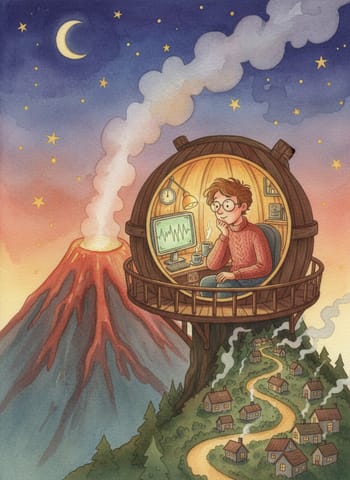
Alone on the night shift, with four screens, a kettle and a window in which the mountain showed as a darker piece of the dark, she watched the main trace. It drew its spikes like a comb laid on its side. Taken separately, none of them meant anything; the mountain made noises all the time. What bothered her was the regularity, and then, as the hours passed, the way the gaps between the spikes had begun to shrink: eleven minutes, then ten, then nine and a half.
Một mình trong ca đêm, với bốn màn hình, một ấm nước và một ô cửa sổ nơi ngọn núi hiện ra như một mảng tối sẫm hơn bóng tối, cô quan sát đường ghi chính. Nó vẽ những mũi nhọn như một chiếc lược đặt nằm ngang. Xét riêng, mũi nào cũng chẳng có nghĩa gì; ngọn núi lúc nào cũng phát ra tiếng động. Điều khiến cô bận tâm là sự đều đặn, rồi khi nhiều giờ trôi qua, là cách các khoảng cách giữa những mũi nhọn bắt đầu thu hẹp: mười một phút, rồi mười, rồi chín phút rưỡi.
The forecasting model the observatory had adopted the previous spring put the chance of an eruption within three days at thirty-one percent, and showed this as a calm amber bar. Silvia had been taught to respect amber bars. She had also spent fourteen years learning the mountain's habits, and what the instruments were telling her looked less like noise than like something clearing its throat. The tilt meter on the western flank had shifted by a hair. The gas sensor above the upper vent had quietly stopped complaining, which it never did unless something below had changed.
Mô hình dự báo mà đài quan trắc áp dụng từ mùa xuân năm trước cho xác suất phun trào trong ba ngày là ba mươi mốt phần trăm, và hiển thị nó bằng một thanh màu hổ phách êm dịu. Silvia đã được dạy phải tôn trọng những thanh màu hổ phách. Nhưng cô cũng đã mười bốn năm học thói quen của ngọn núi, và điều các thiết bị nói với cô trông ít giống tiếng nhiễu hơn là giống một thứ gì đó đang tằng hắng. Máy đo độ nghiêng ở sườn tây đã dịch đi một sợi tóc. Cảm biến khí phía trên miệng núi trên đã lặng lẽ thôi phàn nàn, điều nó không bao giờ làm trừ khi có gì bên dưới đã đổi khác.
Everything about the decision was uncomfortable. Two years earlier the observatory had advised evacuating Cold Spring, the village on the lower slope, for three days. Nothing had happened, the market week had been lost, and the following spring the open day, which once drew hundreds, drew eleven. People had been kind about it, in the way of people who have decided not to listen next time. Had she been wrong then too, Silvia wondered, or merely early? She would never know, and that was exactly the trouble with being right in advance.
Mọi thứ về quyết định này đều khó chịu. Hai năm trước, đài đã khuyến cáo sơ tán Cold Spring, ngôi làng ở sườn dưới, trong ba ngày. Chẳng có gì xảy ra, tuần chợ bị mất, và mùa xuân sau đó ngày hội mở cửa, từng thu hút hàng trăm người, chỉ có mười một. Người ta đã tử tế về chuyện đó, theo kiểu những người đã quyết định lần sau sẽ không nghe. Hồi ấy cô cũng sai sao, Silvia tự hỏi, hay chỉ là sớm? Cô sẽ không bao giờ biết, và đó chính là rắc rối khi đúng từ trước.
Not until she had written the sentence in the log, in plain words with no hedging, did she let herself ring the director. He was at a conference three time zones away and answered on the second ring. He heard her out. "The model says amber," he said. "What do you say?"
Phải đến khi viết câu ấy vào nhật ký, bằng lời giản dị không rào đón, cô mới cho phép mình gọi giám đốc. Ông đang dự một hội nghị cách ba múi giờ và nhấc máy ở hồi chuông thứ hai. Ông nghe cô nói hết. "Mô hình nói hổ phách," ông nói. "Còn cô nói gì?"
"I say that if the pattern holds for another hour, I want the village out by morning." She heard the sentence as she spoke it and did not take it back. "If I'm wrong, I'll write the apology myself."
"Tôi nói nếu hình mẫu này giữ thêm một giờ nữa, tôi muốn làng được sơ tán trước sáng." Cô nghe câu ấy khi nói ra và không rút lại. "Nếu tôi sai, tôi sẽ tự viết thư xin lỗi."
"Then that's the recommendation," said the director. "Make the call."
"Vậy đó là kiến nghị," giám đốc nói. "Gọi đi."
The civil protection officer asked her twice whether she was sure, then said nothing for a long moment, and then said, "Understood." By five o'clock the first buses were idling beside the village hall with their lights on. Silvia watched them on the camera feed: people in coats carrying children, and cats in boxes, up the steps, without anyone seeming to hurry. Had she waited for the model to turn red, she would have lost the one thing an evacuation cannot do without, which is time.
Viên chức bảo vệ dân sự hỏi cô hai lần có chắc không, rồi im lặng một lúc lâu, rồi nói: "Đã rõ." Đến năm giờ, những chiếc xe buýt đầu tiên đã nổ máy chờ cạnh hội trường làng, đèn sáng. Silvia nhìn chúng qua camera: những người mặc áo khoác bế con, và những con mèo trong hộp, bước lên bậc, mà không ai có vẻ vội vàng. Nếu cô đợi mô hình chuyển sang màu đỏ, cô đã mất thứ duy nhất một cuộc sơ tán không thể thiếu, là thời gian.
The day shift arrived at six and stopped taking off their coats when they saw the screens. The gaps were down to seven minutes. Nobody said what it would mean if they went on shrinking, and nobody said what it would mean if they stopped.
Ca ngày đến lúc sáu giờ và ngừng cởi áo khoác khi thấy các màn hình. Khoảng cách đã xuống còn bảy phút. Không ai nói điều gì sẽ xảy ra nếu chúng tiếp tục thu hẹp, và không ai nói điều gì sẽ xảy ra nếu chúng dừng.
At twenty past, the line went flat. Silvia looked at the clock and then, deliberately, away from it. She began to count. Four minutes passed, then five, then six, and behind her not one person spoke.
Sáu giờ hai mươi, đường ghi phẳng lặng. Silvia nhìn đồng hồ rồi cố ý nhìn đi chỗ khác. Cô bắt đầu đếm. Bốn phút trôi qua, rồi năm, rồi sáu, và sau lưng cô không một ai lên tiếng.