The Tremor at the Observatory
Cerita bahasa Inggris gratis level C1 untuk pelajar, bisa dibaca online dalam 5 bahasa, dengan pilihan untuk mendengarkannya di aplikasi Storyteller gratis.
Alone on the night shift at a volcano observatory, a scientist must decide whether a pattern of small tremors justifies evacuating the nearest village.
Itu cuplikannya! Dengarkan cerita lengkapnya di aplikasi Storyteller gratis. Unduh aplikasi
Audio belum tersedia saat ini.
The first tremor of the night was so small that Silvia logged it without lifting her eyes from her sandwich. The second came eleven minutes later, just as small, and the third eleven minutes after that. By the fourth she had put the sandwich down.
Getaran pertama malam itu begitu kecil sehingga Silvia mencatatnya tanpa mengangkat mata dari sandwich-nya. Yang kedua datang sebelas menit kemudian, sama kecilnya, dan yang ketiga sebelas menit setelah itu. Pada yang keempat ia sudah meletakkan sandwich-nya.
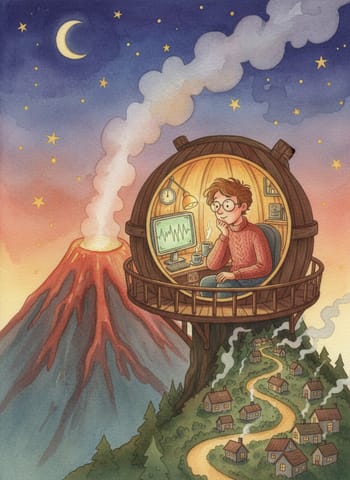
Alone on the night shift, with four screens, a kettle and a window in which the mountain showed as a darker piece of the dark, she watched the main trace. It drew its spikes like a comb laid on its side. Taken separately, none of them meant anything; the mountain made noises all the time. What bothered her was the regularity, and then, as the hours passed, the way the gaps between the spikes had begun to shrink: eleven minutes, then ten, then nine and a half.
Sendirian di shift malam, dengan empat layar, sebuah ketel, dan sebuah jendela tempat gunung tampak sebagai bagian yang lebih gelap dari kegelapan, ia memperhatikan garis utama. Garis itu menggambar lonjakannya seperti sisir yang diletakkan miring. Satu per satu, tak ada yang berarti; gunung itu memang selalu mengeluarkan bunyi-bunyian. Yang mengganggunya adalah keteraturannya, dan kemudian, seiring berjalannya jam, jarak antar lonjakan yang mulai menyusut: sebelas menit, lalu sepuluh, lalu sembilan setengah.
The forecasting model the observatory had adopted the previous spring put the chance of an eruption within three days at thirty-one percent, and showed this as a calm amber bar. Silvia had been taught to respect amber bars. She had also spent fourteen years learning the mountain's habits, and what the instruments were telling her looked less like noise than like something clearing its throat. The tilt meter on the western flank had shifted by a hair. The gas sensor above the upper vent had quietly stopped complaining, which it never did unless something below had changed.
Model peramalan yang dipakai observatorium sejak musim semi lalu menempatkan peluang letusan dalam tiga hari ke depan pada tiga puluh satu persen, dan menampilkannya sebagai batang kuning yang tenang. Silvia diajari untuk menghormati batang kuning. Ia juga sudah empat belas tahun mempelajari kebiasaan gunung itu, dan apa yang ditunjukkan alat-alat itu lebih mirip sesuatu yang sedang berdeham daripada sekadar derau. Alat ukur kemiringan di lereng barat bergeser sehelai rambut. Sensor gas di atas lubang kawah bagian atas diam-diam berhenti "mengeluh", sesuatu yang tak pernah terjadi kecuali ada perubahan di bawah sana.
Everything about the decision was uncomfortable. Two years earlier the observatory had advised evacuating Cold Spring, the village on the lower slope, for three days. Nothing had happened, the market week had been lost, and the following spring the open day, which once drew hundreds, drew eleven. People had been kind about it, in the way of people who have decided not to listen next time. Had she been wrong then too, Silvia wondered, or merely early? She would never know, and that was exactly the trouble with being right in advance.
Segala hal tentang keputusan itu tidak nyaman. Dua tahun sebelumnya, observatorium menganjurkan pengungsian Cold Spring, desa di lereng bawah, selama tiga hari. Tak terjadi apa-apa, pekan pasar hilang, dan musim semi berikutnya acara hari terbuka, yang dulu menarik ratusan orang, hanya menarik sebelas. Orang-orang bersikap baik soal itu, dengan cara orang yang sudah memutuskan untuk tidak mendengarkan lain kali. Apakah dulu ia juga keliru, Silvia bertanya-tanya, atau hanya terlalu cepat? Ia tak akan pernah tahu, dan itulah persoalan dari menjadi benar lebih awal.
Not until she had written the sentence in the log, in plain words with no hedging, did she let herself ring the director. He was at a conference three time zones away and answered on the second ring. He heard her out. "The model says amber," he said. "What do you say?"
Baru setelah menuliskan kalimat itu di buku catatan, dengan kata-kata lugas tanpa keraguan, ia mengizinkan dirinya menelepon sang direktur. Direktur sedang menghadiri konferensi tiga zona waktu jauhnya dan menjawab pada dering kedua. Dia mendengarkannya sampai selesai. "Model bilang kuning," katanya. "Menurutmu bagaimana?"
"I say that if the pattern holds for another hour, I want the village out by morning." She heard the sentence as she spoke it and did not take it back. "If I'm wrong, I'll write the apology myself."
"Menurut saya, kalau polanya bertahan satu jam lagi, saya ingin desa itu dikosongkan sebelum pagi." Ia mendengar kalimat itu saat mengucapkannya dan tidak menariknya kembali. "Kalau saya salah, saya sendiri yang akan menulis permintaan maafnya."
"Then that's the recommendation," said the director. "Make the call."
"Kalau begitu itu rekomendasinya," kata sang direktur. "Lakukan panggilannya."
The civil protection officer asked her twice whether she was sure, then said nothing for a long moment, and then said, "Understood." By five o'clock the first buses were idling beside the village hall with their lights on. Silvia watched them on the camera feed: people in coats carrying children, and cats in boxes, up the steps, without anyone seeming to hurry. Had she waited for the model to turn red, she would have lost the one thing an evacuation cannot do without, which is time.
Petugas perlindungan sipil menanyakan dua kali apakah ia yakin, lalu terdiam lama, lalu berkata, "Dimengerti." Pukul lima, bus-bus pertama sudah menderu pelan di samping balai desa dengan lampu menyala. Silvia menontonnya lewat siaran kamera: orang-orang berjaket menggendong anak, dan kucing-kucing dalam kardus, menaiki tangga, tanpa ada yang tampak tergesa-gesa. Seandainya ia menunggu model itu berubah merah, ia akan kehilangan satu-satunya hal yang tak bisa dilepaskan dari sebuah evakuasi, yaitu waktu.
The day shift arrived at six and stopped taking off their coats when they saw the screens. The gaps were down to seven minutes. Nobody said what it would mean if they went on shrinking, and nobody said what it would mean if they stopped.
Shift siang tiba pukul enam dan berhenti melepas mantel begitu melihat layar-layarnya. Jaraknya sudah turun menjadi tujuh menit. Tak seorang pun mengatakan apa artinya kalau jarak itu terus menyusut, dan tak seorang pun mengatakan apa artinya kalau berhenti.
At twenty past, the line went flat. Silvia looked at the clock and then, deliberately, away from it. She began to count. Four minutes passed, then five, then six, and behind her not one person spoke.
Pada pukul enam lewat dua puluh, garis itu mendatar. Silvia menatap jam dan kemudian, dengan sengaja, memalingkan wajah darinya. Ia mulai menghitung. Empat menit berlalu, lalu lima, lalu enam, dan di belakangnya tak seorang pun bicara.