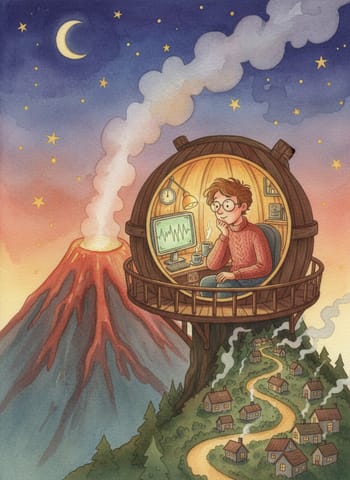
The Tremor at the Observatory
Una historia gratuita en inglés de nivel C1 para estudiantes, para leer en línea en 5 idiomas, con opción de escucharla en la app gratuita Storyteller.
Alone on the night shift at a volcano observatory, a scientist must decide whether a pattern of small tremors justifies evacuating the nearest village.
¡Ese fue el avance! Escucha la historia completa en la app gratuita Storyteller. Descargar la app
El audio no está disponible en este momento.
The first tremor of the night was so small that Silvia logged it without lifting her eyes from her sandwich. The second came eleven minutes later, just as small, and the third eleven minutes after that. By the fourth she had put the sandwich down.
El primer temblor de la noche fue tan pequeño que Silvia lo registró sin levantar la vista de su sándwich. El segundo llegó once minutos después, igual de pequeño, y el tercero once minutos más tarde. Para el cuarto, ya había dejado el sándwich.
Alone on the night shift, with four screens, a kettle and a window in which the mountain showed as a darker piece of the dark, she watched the main trace. It drew its spikes like a comb laid on its side. Taken separately, none of them meant anything; the mountain made noises all the time. What bothered her was the regularity, and then, as the hours passed, the way the gaps between the spikes had begun to shrink: eleven minutes, then ten, then nine and a half.
Sola en el turno de noche, con cuatro pantallas, una tetera y una ventana en la que la montaña se veía como un trozo más oscuro de la oscuridad, observaba el trazado principal. Dibujaba sus picos como un peine tendido de lado. Tomados por separado, ninguno significaba nada; la montaña hacía ruidos todo el tiempo. Lo que la inquietaba era la regularidad y, con el paso de las horas, el modo en que los intervalos entre los picos habían empezado a acortarse: once minutos, luego diez, luego nueve y medio.
The forecasting model the observatory had adopted the previous spring put the chance of an eruption within three days at thirty-one percent, and showed this as a calm amber bar. Silvia had been taught to respect amber bars. She had also spent fourteen years learning the mountain's habits, and what the instruments were telling her looked less like noise than like something clearing its throat. The tilt meter on the western flank had shifted by a hair. The gas sensor above the upper vent had quietly stopped complaining, which it never did unless something below had changed.
El modelo de pronóstico que el observatorio había adoptado la primavera anterior situaba en un treinta y uno por ciento la probabilidad de una erupción en tres días, y lo mostraba como una tranquila barra ámbar. A Silvia le habían enseñado a respetar las barras ámbar. También había pasado catorce años aprendiendo las costumbres de la montaña, y lo que decían los instrumentos se parecía menos a ruido que a algo que se aclara la garganta. El inclinómetro del flanco occidental se había desplazado un pelo. El sensor de gas sobre la boca superior había dejado de quejarse en silencio, algo que nunca hacía a menos que algo hubiera cambiado debajo.
Everything about the decision was uncomfortable. Two years earlier the observatory had advised evacuating Cold Spring, the village on the lower slope, for three days. Nothing had happened, the market week had been lost, and the following spring the open day, which once drew hundreds, drew eleven. People had been kind about it, in the way of people who have decided not to listen next time. Had she been wrong then too, Silvia wondered, or merely early? She would never know, and that was exactly the trouble with being right in advance.
Todo en la decisión era incómodo. Dos años antes, el observatorio había aconsejado evacuar Cold Spring, el pueblo de la ladera baja, durante tres días. No había pasado nada, se había perdido la semana del mercado, y la primavera siguiente la jornada de puertas abiertas, que antes atraía a cientos de personas, atrajo a once. La gente había sido amable al respecto, a la manera de quienes han decidido no escuchar la próxima vez. ¿Se había equivocado también entonces Silvia, o simplemente se había adelantado? Nunca lo sabría, y ese era justamente el problema de tener razón por anticipado.
Not until she had written the sentence in the log, in plain words with no hedging, did she let herself ring the director. He was at a conference three time zones away and answered on the second ring. He heard her out. "The model says amber," he said. "What do you say?"
Solo después de haber escrito la frase en el registro, con palabras llanas y sin atenuantes, se permitió llamar al director. Estaba en un congreso a tres husos horarios de distancia y contestó al segundo tono. La escuchó hasta el final. «El modelo dice ámbar», dijo. «¿Usted qué dice?»
"I say that if the pattern holds for another hour, I want the village out by morning." She heard the sentence as she spoke it and did not take it back. "If I'm wrong, I'll write the apology myself."
«Digo que, si el patrón se mantiene una hora más, quiero el pueblo evacuado por la mañana». Oyó la frase al pronunciarla y no la retiró. «Si me equivoco, yo misma escribiré la disculpa».
"Then that's the recommendation," said the director. "Make the call."
«Entonces esa es la recomendación», dijo el director. «Haga la llamada».
The civil protection officer asked her twice whether she was sure, then said nothing for a long moment, and then said, "Understood." By five o'clock the first buses were idling beside the village hall with their lights on. Silvia watched them on the camera feed: people in coats carrying children, and cats in boxes, up the steps, without anyone seeming to hurry. Had she waited for the model to turn red, she would have lost the one thing an evacuation cannot do without, which is time.
El oficial de protección civil le preguntó dos veces si estaba segura, luego guardó silencio un largo momento y por fin dijo: «Entendido». A las cinco, los primeros autobuses esperaban con el motor encendido junto al salón comunal. Silvia los miraba en la transmisión de las cámaras: gente con abrigos cargando niños, y gatos en cajas, subiendo los escalones, sin que nadie pareciera apurarse. Si hubiera esperado a que el modelo se pusiera rojo, habría perdido lo único que una evacuación no puede permitirse perder, que es el tiempo.
The day shift arrived at six and stopped taking off their coats when they saw the screens. The gaps were down to seven minutes. Nobody said what it would mean if they went on shrinking, and nobody said what it would mean if they stopped.
El turno de día llegó a las seis y dejó de quitarse los abrigos al ver las pantallas. Los intervalos habían bajado a siete minutos. Nadie dijo lo que significaría que siguieran acortándose, y nadie dijo lo que significaría que se detuvieran.
At twenty past, the line went flat. Silvia looked at the clock and then, deliberately, away from it. She began to count. Four minutes passed, then five, then six, and behind her not one person spoke.
A las seis y veinte, la línea se quedó plana. Silvia miró el reloj y luego, deliberadamente, apartó la vista. Empezó a contar. Pasaron cuatro minutos, luego cinco, luego seis, y a su espalda no habló una sola persona.