The Tremor at the Observatory
A free C1-level English story for language learners, readable online in 5 languages, with an option to listen via the free Storyteller app.
Alone on the night shift at a volcano observatory, a scientist must decide whether a pattern of small tremors justifies evacuating the nearest village.
That was the preview! Hear the full story in the free Storyteller app. Get the app
Audio isn't available right now.
The first tremor of the night was so small that Silvia logged it without lifting her eyes from her sandwich. The second came eleven minutes later, just as small, and the third eleven minutes after that. By the fourth she had put the sandwich down.
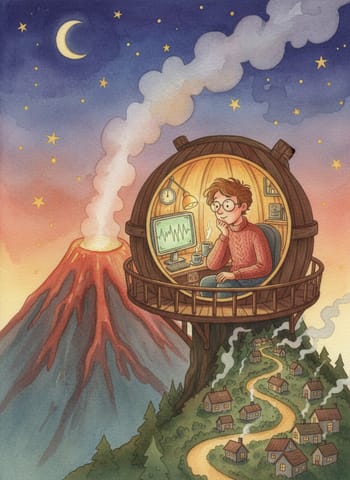
Alone on the night shift, with four screens, a kettle and a window in which the mountain showed as a darker piece of the dark, she watched the main trace. It drew its spikes like a comb laid on its side. Taken separately, none of them meant anything; the mountain made noises all the time. What bothered her was the regularity, and then, as the hours passed, the way the gaps between the spikes had begun to shrink: eleven minutes, then ten, then nine and a half.
The forecasting model the observatory had adopted the previous spring put the chance of an eruption within three days at thirty-one percent, and showed this as a calm amber bar. Silvia had been taught to respect amber bars. She had also spent fourteen years learning the mountain's habits, and what the instruments were telling her looked less like noise than like something clearing its throat. The tilt meter on the western flank had shifted by a hair. The gas sensor above the upper vent had quietly stopped complaining, which it never did unless something below had changed.
Everything about the decision was uncomfortable. Two years earlier the observatory had advised evacuating Cold Spring, the village on the lower slope, for three days. Nothing had happened, the market week had been lost, and the following spring the open day, which once drew hundreds, drew eleven. People had been kind about it, in the way of people who have decided not to listen next time. Had she been wrong then too, Silvia wondered, or merely early? She would never know, and that was exactly the trouble with being right in advance.
Not until she had written the sentence in the log, in plain words with no hedging, did she let herself ring the director. He was at a conference three time zones away and answered on the second ring. He heard her out. "The model says amber," he said. "What do you say?"
"I say that if the pattern holds for another hour, I want the village out by morning." She heard the sentence as she spoke it and did not take it back. "If I'm wrong, I'll write the apology myself."
"Then that's the recommendation," said the director. "Make the call."
The civil protection officer asked her twice whether she was sure, then said nothing for a long moment, and then said, "Understood." By five o'clock the first buses were idling beside the village hall with their lights on. Silvia watched them on the camera feed: people in coats carrying children, and cats in boxes, up the steps, without anyone seeming to hurry. Had she waited for the model to turn red, she would have lost the one thing an evacuation cannot do without, which is time.
The day shift arrived at six and stopped taking off their coats when they saw the screens. The gaps were down to seven minutes. Nobody said what it would mean if they went on shrinking, and nobody said what it would mean if they stopped.
At twenty past, the line went flat. Silvia looked at the clock and then, deliberately, away from it. She began to count. Four minutes passed, then five, then six, and behind her not one person spoke.