The Tremor at the Observatory
Uma história gratuita em inglês de nível C1 para estudantes, para ler online em 5 idiomas, com opção de ouvir no app gratuito Storyteller.
Alone on the night shift at a volcano observatory, a scientist must decide whether a pattern of small tremors justifies evacuating the nearest village.
Essa foi a prévia! Ouça a história completa no app gratuito Storyteller. Baixar o app
O áudio não está disponível no momento.
The first tremor of the night was so small that Silvia logged it without lifting her eyes from her sandwich. The second came eleven minutes later, just as small, and the third eleven minutes after that. By the fourth she had put the sandwich down.
O primeiro tremor da noite foi tão pequeno que Silvia o registrou sem tirar os olhos do sanduíche. O segundo veio onze minutos depois, igualmente pequeno, e o terceiro onze minutos depois desse. No quarto, ela já havia largado o sanduíche.
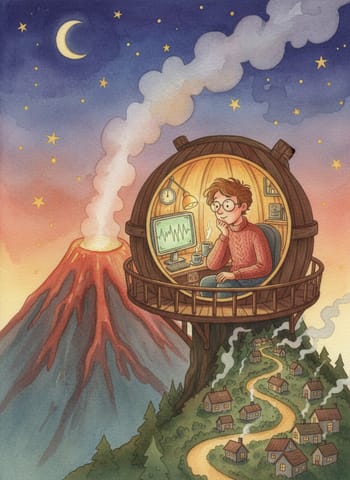
Alone on the night shift, with four screens, a kettle and a window in which the mountain showed as a darker piece of the dark, she watched the main trace. It drew its spikes like a comb laid on its side. Taken separately, none of them meant anything; the mountain made noises all the time. What bothered her was the regularity, and then, as the hours passed, the way the gaps between the spikes had begun to shrink: eleven minutes, then ten, then nine and a half.
Sozinha no turno da noite, com quatro telas, uma chaleira e uma janela em que a montanha aparecia como um pedaço mais escuro do escuro, ela observava o traçado principal. Ele desenhava os picos como um pente deitado de lado. Isoladamente, nenhum significava nada; a montanha fazia barulhos o tempo todo. O que a incomodava era a regularidade e, com o passar das horas, o modo como os intervalos entre os picos haviam começado a encolher: onze minutos, depois dez, depois nove e meio.
The forecasting model the observatory had adopted the previous spring put the chance of an eruption within three days at thirty-one percent, and showed this as a calm amber bar. Silvia had been taught to respect amber bars. She had also spent fourteen years learning the mountain's habits, and what the instruments were telling her looked less like noise than like something clearing its throat. The tilt meter on the western flank had shifted by a hair. The gas sensor above the upper vent had quietly stopped complaining, which it never did unless something below had changed.
O modelo de previsão que o observatório adotara na primavera anterior calculava em trinta e um por cento a chance de erupção nos próximos três dias e a mostrava como uma calma barra âmbar. Silvia aprendera a respeitar barras âmbar. Também passara catorze anos aprendendo os hábitos da montanha, e o que os instrumentos lhe diziam parecia menos ruído do que algo pigarreando. O inclinômetro do flanco oeste havia se deslocado por um fio de cabelo. O sensor de gás acima da cratera superior havia parado, discretamente, de reclamar, o que nunca fazia a menos que algo lá embaixo tivesse mudado.
Everything about the decision was uncomfortable. Two years earlier the observatory had advised evacuating Cold Spring, the village on the lower slope, for three days. Nothing had happened, the market week had been lost, and the following spring the open day, which once drew hundreds, drew eleven. People had been kind about it, in the way of people who have decided not to listen next time. Had she been wrong then too, Silvia wondered, or merely early? She would never know, and that was exactly the trouble with being right in advance.
Tudo na decisão era desconfortável. Dois anos antes, o observatório aconselhara evacuar Cold Spring, a vila da encosta baixa, por três dias. Nada acontecera, a semana do mercado fora perdida e, na primavera seguinte, o dia de portas abertas, que antes atraía centenas, atraiu onze. As pessoas foram gentis a respeito, no jeito de quem decidiu não escutar na próxima vez. Teria ela errado também naquela vez, perguntava-se Silvia, ou apenas chegado cedo? Nunca saberia, e esse era exatamente o problema de ter razão com antecedência.
Not until she had written the sentence in the log, in plain words with no hedging, did she let herself ring the director. He was at a conference three time zones away and answered on the second ring. He heard her out. "The model says amber," he said. "What do you say?"
Só depois de escrever a frase no registro, em palavras simples e sem rodeios, ela se permitiu ligar para o diretor. Ele estava num congresso a três fusos de distância e atendeu no segundo toque. Ouviu-a até o fim. "O modelo diz âmbar", disse ele. "O que você diz?"
"I say that if the pattern holds for another hour, I want the village out by morning." She heard the sentence as she spoke it and did not take it back. "If I'm wrong, I'll write the apology myself."
"Digo que, se o padrão se mantiver por mais uma hora, quero a vila fora até de manhã." Ela ouviu a frase enquanto a dizia e não a retirou. "Se eu estiver errada, escrevo eu mesma o pedido de desculpas."
"Then that's the recommendation," said the director. "Make the call."
"Então essa é a recomendação", disse o diretor. "Faça a ligação."
The civil protection officer asked her twice whether she was sure, then said nothing for a long moment, and then said, "Understood." By five o'clock the first buses were idling beside the village hall with their lights on. Silvia watched them on the camera feed: people in coats carrying children, and cats in boxes, up the steps, without anyone seeming to hurry. Had she waited for the model to turn red, she would have lost the one thing an evacuation cannot do without, which is time.
O oficial da defesa civil perguntou duas vezes se ela tinha certeza, depois ficou um longo momento calado e por fim disse: "Entendido." Às cinco horas, os primeiros ônibus esperavam de motor ligado junto ao salão comunitário, com os faróis acesos. Silvia os observava pela câmera: pessoas de casaco carregando crianças, e gatos em caixas, subindo os degraus sem que ninguém parecesse ter pressa. Se tivesse esperado o modelo ficar vermelho, teria perdido a única coisa de que uma evacuação não pode prescindir, que é tempo.
The day shift arrived at six and stopped taking off their coats when they saw the screens. The gaps were down to seven minutes. Nobody said what it would mean if they went on shrinking, and nobody said what it would mean if they stopped.
O turno do dia chegou às seis e parou de tirar os casacos ao ver as telas. Os intervalos estavam em sete minutos. Ninguém disse o que significaria se continuassem encolhendo, e ninguém disse o que significaria se parassem.
At twenty past, the line went flat. Silvia looked at the clock and then, deliberately, away from it. She began to count. Four minutes passed, then five, then six, and behind her not one person spoke.
Às seis e vinte, a linha ficou reta. Silvia olhou o relógio e depois, deliberadamente, para longe dele. Começou a contar. Passaram quatro minutos, depois cinco, depois seis, e atrás dela ninguém disse uma palavra.