The Sabbatical Letters
Uma história gratuita em inglês de nível C1 para estudantes, para ler online em 5 idiomas, com opção de ouvir no app gratuito Storyteller.
A visiting academic and a retired harbourmaster exchange pencilled notes tucked inside the returned books of a coastal library.
Essa foi a prévia! Ouça a história completa no app gratuito Storyteller. Baixar o app
O áudio não está disponível no momento.
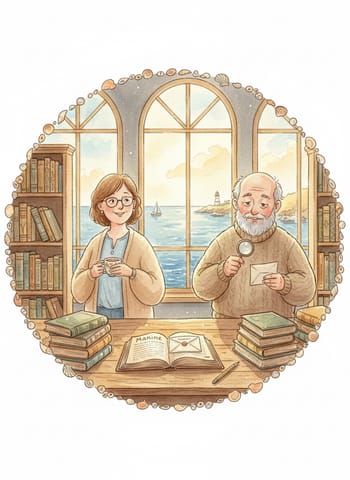
Lydia had come to the coastal town of Harlow Bay for a sabbatical year, and by the third week she had learned that the only dependable heating in the place was the public library's. She worked there in the afternoons, at a long table under a window that rattled in every wind, reading and failing to write. On one of those afternoons she took a novel from the returned-books trolley, the librarian having waved her towards it, and found a slip of paper marking the page where a storm began.
Lydia fora para a cidade litorânea de Harlow Bay passar um ano sabático, e na terceira semana já havia aprendido que o único aquecimento confiável do lugar era o da biblioteca pública. Trabalhava ali à tarde, numa longa mesa sob uma janela que chacoalhava a cada vento, lendo e fracassando em escrever. Numa dessas tardes, pegou um romance no carrinho dos livros devolvidos, para o qual a bibliotecária a encaminhara com um aceno, e encontrou um pedaço de papel marcando a página em que uma tempestade começava.
The slip was written in pencil, in an upright, slightly old-fashioned hand. "The author has the tide wrong here. It would not run that way against a north wind. Not a criticism of the book, only of the sea." Lydia, who had spent the morning staring at a paragraph she disliked, read it twice and felt, absurdly, that she had been addressed. She wrote underneath, "Then how would it run?" and put the book back on the trolley, telling herself that the librarian would shelve it, the slip would be thrown away, and the experiment would end there.
O papel estava escrito a lápis, numa letra ereta e um tanto antiquada. "O autor errou a maré aqui. Ela não correria assim contra um vento norte. Não é uma crítica ao livro, só ao mar." Lydia, que passara a manhã encarando um parágrafo de que não gostava, leu duas vezes e sentiu, absurdamente, que tinha sido interpelada. Escreveu embaixo: "Então como ela correria?" e devolveu o livro ao carrinho, dizendo a si mesma que a bibliotecária o colocaria na estante, o papel seria jogado fora e o experimento terminaria ali.
Four days later a different book, a travel memoir marked at a chapter about fog, held an answer in four careful lines, with a diagram. The librarian, asked, would say only that the retired harbourmaster, Zaid, borrowed a great deal and returned things on Thursdays. She said it with the empty face of a woman who has watched several correspondences begin in her returned books. Lydia did not ask to be introduced. Having discovered that she could talk to him without being looked at, she was reluctant to risk the arrangement.
Quatro dias depois, outro livro, um relato de viagem marcado num capítulo sobre neblina, trazia uma resposta em quatro linhas cuidadosas, com um diagrama. A bibliotecária, quando perguntada, disse apenas que o capitão do porto aposentado, Zaid, pegava muitos livros emprestados e devolvia tudo às quintas-feiras. Disse isso com o rosto vazio de quem já viu várias correspondências começarem entre seus livros devolvidos. Lydia não pediu para ser apresentada. Tendo descoberto que podia conversar com ele sem ser olhada, relutava em arriscar o arranjo.
Through the winter the notes multiplied, though only slightly. They discussed weather, mostly, and then lighthouses, and why one stretch of coast made her homesick when it looked nothing like home. Once he left a small drawing of a knot, captioned "this one holds when nothing else will", and she carried it in her coat pocket for a week. What she noticed was how little either of them asked. He never said why he had stopped going to sea, and she never explained what she was failing to write.
Ao longo do inverno, os bilhetes se multiplicaram, ainda que pouco. Falavam do tempo, sobretudo, e depois de faróis, e de por que um trecho da costa a deixava saudosa de casa mesmo não se parecendo em nada com ela. Certa vez ele deixou um pequeno desenho de um nó, com a legenda "este aguenta quando nada mais aguenta", e ela o carregou no bolso do casaco durante uma semana. O que ela notava era o pouco que cada um perguntava. Ele nunca disse por que deixara de navegar, e ela nunca explicou o que estava fracassando em escrever.
Once, in February, she saw him. She was almost certain: a tall man in a worn blue jacket at the far shelves, running a finger along the spines with the patience of someone who has the whole afternoon. Had she been a braver person, she would have crossed the room. Instead she stayed at her table with her pen hovering, and he left without turning round, and on Thursday the trolley carried a note that said only, "The light is coming back earlier now."
Uma vez, em fevereiro, ela o viu. Tinha quase certeza: um homem alto, de jaqueta azul gasta, junto às estantes do fundo, passando o dedo pelas lombadas com a paciência de quem tem a tarde inteira. Se fosse uma pessoa mais corajosa, teria atravessado a sala. Em vez disso, ficou à mesa com a caneta suspensa, e ele saiu sem se virar, e na quinta-feira o carrinho trouxe um bilhete que dizia apenas: "A luz está voltando mais cedo agora."
By the end of spring her year was nearly over, and so, she suspected, was the thing she did not know how to name. Only on the fourth attempt did she arrive at a version she could bear. It was short: "I leave on Saturday. Thank you for correcting the sea." She borrowed the first novel again for the purpose, folded the note into the page where the storm began, and set the book on the trolley on Thursday morning.
No fim da primavera, o ano dela estava quase acabando, e também, suspeitava, aquilo que não sabia nomear. Só na quarta tentativa chegou a uma versão que conseguiu suportar. Era curta: "Parto no sábado. Obrigada por corrigir o mar." Pegou emprestado o primeiro romance outra vez para a ocasião, dobrou o bilhete na página em que a tempestade começava e deixou o livro no carrinho na manhã de quinta-feira.
She did not stay to see who came for it. At the door the librarian, who had said nothing all year, remarked that she would make sure it was shelved with care. It was not what Lydia had asked, and not, she thought, quite what the woman meant. Outside, the wind had turned to the north. Lydia stood for a moment on the steps, looking at the water beyond the harbour wall, and could not tell which way it was running.
Não ficou para ver quem viria buscá-lo. Na porta, a bibliotecária, que não dissera nada o ano inteiro, comentou que cuidaria para que o livro fosse guardado com carinho. Não era o que Lydia pedira e não era, pensou ela, bem o que a mulher queria dizer. Lá fora, o vento virara para o norte. Lydia ficou um instante nos degraus, olhando a água além do paredão do porto, e não soube dizer em que direção ela corria.