The Sabbatical Letters
A free C1-level English story for language learners, readable online in 5 languages, with an option to listen via the free Storyteller app.
A visiting academic and a retired harbourmaster exchange pencilled notes tucked inside the returned books of a coastal library.
That was the preview! Hear the full story in the free Storyteller app. Get the app
Audio isn't available right now.
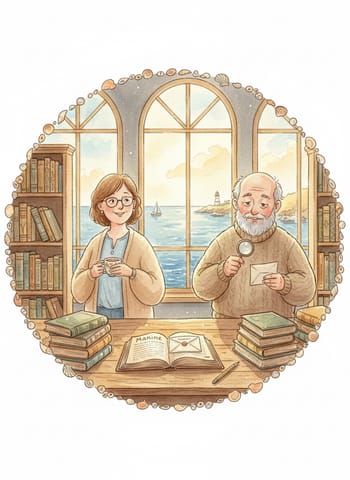
Lydia had come to the coastal town of Harlow Bay for a sabbatical year, and by the third week she had learned that the only dependable heating in the place was the public library's. She worked there in the afternoons, at a long table under a window that rattled in every wind, reading and failing to write. On one of those afternoons she took a novel from the returned-books trolley, the librarian having waved her towards it, and found a slip of paper marking the page where a storm began.
The slip was written in pencil, in an upright, slightly old-fashioned hand. "The author has the tide wrong here. It would not run that way against a north wind. Not a criticism of the book, only of the sea." Lydia, who had spent the morning staring at a paragraph she disliked, read it twice and felt, absurdly, that she had been addressed. She wrote underneath, "Then how would it run?" and put the book back on the trolley, telling herself that the librarian would shelve it, the slip would be thrown away, and the experiment would end there.
Four days later a different book, a travel memoir marked at a chapter about fog, held an answer in four careful lines, with a diagram. The librarian, asked, would say only that the retired harbourmaster, Zaid, borrowed a great deal and returned things on Thursdays. She said it with the empty face of a woman who has watched several correspondences begin in her returned books. Lydia did not ask to be introduced. Having discovered that she could talk to him without being looked at, she was reluctant to risk the arrangement.
Through the winter the notes multiplied, though only slightly. They discussed weather, mostly, and then lighthouses, and why one stretch of coast made her homesick when it looked nothing like home. Once he left a small drawing of a knot, captioned "this one holds when nothing else will", and she carried it in her coat pocket for a week. What she noticed was how little either of them asked. He never said why he had stopped going to sea, and she never explained what she was failing to write.
Once, in February, she saw him. She was almost certain: a tall man in a worn blue jacket at the far shelves, running a finger along the spines with the patience of someone who has the whole afternoon. Had she been a braver person, she would have crossed the room. Instead she stayed at her table with her pen hovering, and he left without turning round, and on Thursday the trolley carried a note that said only, "The light is coming back earlier now."
By the end of spring her year was nearly over, and so, she suspected, was the thing she did not know how to name. Only on the fourth attempt did she arrive at a version she could bear. It was short: "I leave on Saturday. Thank you for correcting the sea." She borrowed the first novel again for the purpose, folded the note into the page where the storm began, and set the book on the trolley on Thursday morning.
She did not stay to see who came for it. At the door the librarian, who had said nothing all year, remarked that she would make sure it was shelved with care. It was not what Lydia had asked, and not, she thought, quite what the woman meant. Outside, the wind had turned to the north. Lydia stood for a moment on the steps, looking at the water beyond the harbour wall, and could not tell which way it was running.