The Sabbatical Letters
Una historia gratuita en inglés de nivel C1 para estudiantes, para leer en línea en 5 idiomas, con opción de escucharla en la app gratuita Storyteller.
A visiting academic and a retired harbourmaster exchange pencilled notes tucked inside the returned books of a coastal library.
¡Ese fue el avance! Escucha la historia completa en la app gratuita Storyteller. Descargar la app
El audio no está disponible en este momento.
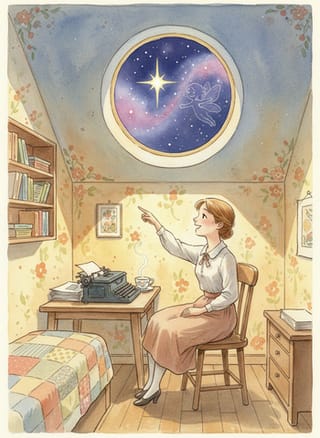
Lydia had come to the coastal town of Harlow Bay for a sabbatical year, and by the third week she had learned that the only dependable heating in the place was the public library's. She worked there in the afternoons, at a long table under a window that rattled in every wind, reading and failing to write. On one of those afternoons she took a novel from the returned-books trolley, the librarian having waved her towards it, and found a slip of paper marking the page where a storm began.
Lydia había llegado al pueblo costero de Harlow Bay para pasar un año sabático, y a la tercera semana había aprendido que la única calefacción fiable del lugar era la de la biblioteca pública. Trabajaba allí por las tardes, en una larga mesa bajo una ventana que traqueteaba con cada viento, leyendo y fracasando en escribir. Una de esas tardes tomó una novela del carrito de libros devueltos, hacia el cual la bibliotecaria la había encaminado con un gesto, y encontró una tira de papel marcando la página donde empezaba una tormenta.
The slip was written in pencil, in an upright, slightly old-fashioned hand. "The author has the tide wrong here. It would not run that way against a north wind. Not a criticism of the book, only of the sea." Lydia, who had spent the morning staring at a paragraph she disliked, read it twice and felt, absurdly, that she had been addressed. She wrote underneath, "Then how would it run?" and put the book back on the trolley, telling herself that the librarian would shelve it, the slip would be thrown away, and the experiment would end there.
La tira estaba escrita a lápiz, con una letra recta y algo anticuada. «El autor se equivoca con la marea aquí. No correría así contra un viento del norte. No es una crítica al libro, solo al mar». Lydia, que había pasado la mañana mirando un párrafo que no le gustaba, lo leyó dos veces y sintió, absurdamente, que se habían dirigido a ella. Escribió debajo: «Entonces, ¿cómo correría?», y devolvió el libro al carrito, diciéndose que la bibliotecaria lo acomodaría, que la tira se tiraría a la basura y que el experimento terminaría ahí.
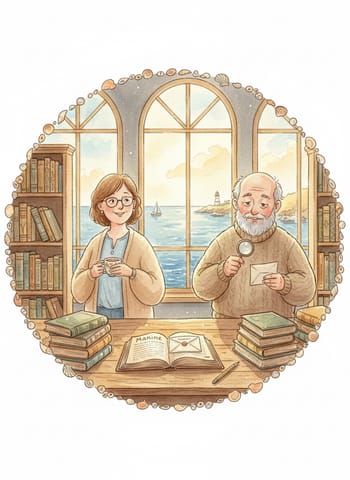
Four days later a different book, a travel memoir marked at a chapter about fog, held an answer in four careful lines, with a diagram. The librarian, asked, would say only that the retired harbourmaster, Zaid, borrowed a great deal and returned things on Thursdays. She said it with the empty face of a woman who has watched several correspondences begin in her returned books. Lydia did not ask to be introduced. Having discovered that she could talk to him without being looked at, she was reluctant to risk the arrangement.
Cuatro días después otro libro, unas memorias de viaje marcadas en un capítulo sobre la niebla, guardaba una respuesta en cuatro líneas cuidadosas, con un diagrama. La bibliotecaria, al preguntarle, solo dijo que el capitán de puerto jubilado, Zaid, pedía prestados muchos libros y devolvía las cosas los jueves. Lo dijo con la cara vacía de una mujer que ha visto empezar varias correspondencias en sus libros devueltos. Lydia no pidió que se los presentaran. Habiendo descubierto que podía hablar con él sin que la miraran, no quería arriesgar el arreglo.
Through the winter the notes multiplied, though only slightly. They discussed weather, mostly, and then lighthouses, and why one stretch of coast made her homesick when it looked nothing like home. Once he left a small drawing of a knot, captioned "this one holds when nothing else will", and she carried it in her coat pocket for a week. What she noticed was how little either of them asked. He never said why he had stopped going to sea, and she never explained what she was failing to write.
Durante el invierno las notas se multiplicaron, aunque apenas. Hablaban del clima, sobre todo, y luego de faros, y de por qué un tramo de costa le daba nostalgia cuando no se parecía en nada a su hogar. Una vez él dejó un pequeño dibujo de un nudo, con la leyenda «este aguanta cuando nada más aguanta», y ella lo llevó en el bolsillo del abrigo durante una semana. Lo que notaba era lo poco que se preguntaban. Él nunca dijo por qué había dejado de navegar, y ella nunca explicó qué era lo que no lograba escribir.
Once, in February, she saw him. She was almost certain: a tall man in a worn blue jacket at the far shelves, running a finger along the spines with the patience of someone who has the whole afternoon. Had she been a braver person, she would have crossed the room. Instead she stayed at her table with her pen hovering, and he left without turning round, and on Thursday the trolley carried a note that said only, "The light is coming back earlier now."
Una vez, en febrero, lo vio. Estaba casi segura: un hombre alto con una chaqueta azul gastada en los estantes del fondo, pasando un dedo por los lomos con la paciencia de quien tiene la tarde entera. Si hubiera sido más valiente, habría cruzado la sala. En cambio se quedó en su mesa con el bolígrafo suspendido, y él se fue sin volverse, y el jueves el carrito llevaba una nota que decía solo: «La luz está volviendo más temprano ahora».
By the end of spring her year was nearly over, and so, she suspected, was the thing she did not know how to name. Only on the fourth attempt did she arrive at a version she could bear. It was short: "I leave on Saturday. Thank you for correcting the sea." She borrowed the first novel again for the purpose, folded the note into the page where the storm began, and set the book on the trolley on Thursday morning.
Hacia el final de la primavera su año casi había terminado, y también, sospechaba, aquello que no sabía nombrar. Solo al cuarto intento llegó a una versión que pudo soportar. Era breve: «Me voy el sábado. Gracias por corregir el mar». Pidió prestada otra vez la primera novela con ese fin, dobló la nota en la página donde empezaba la tormenta y dejó el libro en el carrito el jueves por la mañana.
She did not stay to see who came for it. At the door the librarian, who had said nothing all year, remarked that she would make sure it was shelved with care. It was not what Lydia had asked, and not, she thought, quite what the woman meant. Outside, the wind had turned to the north. Lydia stood for a moment on the steps, looking at the water beyond the harbour wall, and could not tell which way it was running.
No se quedó a ver quién venía por él. En la puerta la bibliotecaria, que no había dicho nada en todo el año, comentó que se aseguraría de acomodarlo con cuidado. No era lo que Lydia había pedido, ni, pensó, exactamente lo que la mujer quería decir. Afuera, el viento había girado al norte. Lydia se quedó un momento en los escalones, mirando el agua más allá del muro del puerto, y no supo decir en qué dirección corría.