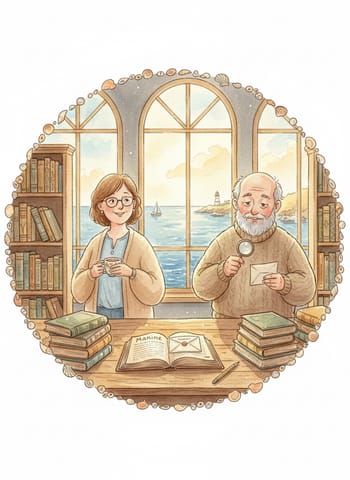
Lydia had come to the coastal town of Harlow Bay for a sabbatical year, and by the third week she had learned that the only dependable heating in the place was the public library's. She worked there in the afternoons, at a long table under a window that rattled in every wind, reading and failing to write. On one of those afternoons she took a novel from the returned-books trolley, the librarian having waved her towards it, and found a slip of paper marking the page where a storm began.
莉迪亚来到海滨小镇哈洛湾,是为了度过一年的休假,到第三个星期,她已经明白,这地方唯一靠得住的暖气在公共图书馆里。下午她就在那里工作,坐在窗下的长桌旁,窗子一刮风就哐啷作响,她读着书,却写不出东西来。其中一个下午,她从还书车上拿起一本小说,是管理员朝她摆手示意的,结果发现书里夹着一张纸条,标记着一场风暴开始的那一页。
The slip was written in pencil, in an upright, slightly old-fashioned hand. "The author has the tide wrong here. It would not run that way against a north wind. Not a criticism of the book, only of the sea." Lydia, who had spent the morning staring at a paragraph she disliked, read it twice and felt, absurdly, that she had been addressed. She wrote underneath, "Then how would it run?" and put the book back on the trolley, telling herself that the librarian would shelve it, the slip would be thrown away, and the experiment would end there.
纸条是用铅笔写的,字迹端正,带着一点老派。“作者把潮水写错了。刮北风的时候,潮水不会这样流。这不是批评这本书,只是批评这片海。”莉迪亚整个上午都在盯着一段自己不喜欢的文字,她把纸条读了两遍,竟荒唐地觉得自己被人搭话了。她在下面写道:“那它会怎么流?”然后把书放回还书车,对自己说:管理员会把它放回书架,纸条会被扔掉,这场小实验到此为止。
Four days later a different book, a travel memoir marked at a chapter about fog, held an answer in four careful lines, with a diagram. The librarian, asked, would say only that the retired harbourmaster, Zaid, borrowed a great deal and returned things on Thursdays. She said it with the empty face of a woman who has watched several correspondences begin in her returned books. Lydia did not ask to be introduced. Having discovered that she could talk to him without being looked at, she was reluctant to risk the arrangement.
四天后,另一本书,一本在雾的那一章夹了标记的游记,里头有了回答,四行工整的字,还配了一幅示意图。管理员被问起时,只肯说退休的港务长扎伊德借书很多,总是星期四还书。她说这话时脸上毫无表情,那是一个见过好几段通信在还回来的书里开始的人的表情。莉迪亚没有请她引见。她发现自己可以和他交谈而不被看见,便不愿冒险打破这个安排。
Through the winter the notes multiplied, though only slightly. They discussed weather, mostly, and then lighthouses, and why one stretch of coast made her homesick when it looked nothing like home. Once he left a small drawing of a knot, captioned "this one holds when nothing else will", and she carried it in her coat pocket for a week. What she noticed was how little either of them asked. He never said why he had stopped going to sea, and she never explained what she was failing to write.
整个冬天,纸条增加了,不过只是一点点。他们多半谈天气,后来谈灯塔,还谈为什么海岸的某一段让她想家,明明它和她的家一点也不像。有一次他留下一幅打结的小画,题着“这个结在别的都不管用时还能撑住”,她把它放在大衣口袋里带了一个星期。她注意到的是,两个人问得多么少。他从没说过自己为什么不再出海,她也从没解释过自己究竟在为什么写不出东西而发愁。
Once, in February, she saw him. She was almost certain: a tall man in a worn blue jacket at the far shelves, running a finger along the spines with the patience of someone who has the whole afternoon. Had she been a braver person, she would have crossed the room. Instead she stayed at her table with her pen hovering, and he left without turning round, and on Thursday the trolley carried a note that said only, "The light is coming back earlier now."
二月里有一次,她看见了他。她几乎可以肯定:一个穿着旧蓝夹克的高个子男人,站在远处的书架旁,手指沿着书脊一本本划过去,带着那种整个下午都属于自己的人才有的耐心。要是她胆子再大一点,就会穿过房间走过去。可她只是坐在桌旁,笔悬在半空,他没有回头就离开了,到了星期四,还书车上带来的纸条只有一句:“天亮得比以前早了。”
By the end of spring her year was nearly over, and so, she suspected, was the thing she did not know how to name. Only on the fourth attempt did she arrive at a version she could bear. It was short: "I leave on Saturday. Thank you for correcting the sea." She borrowed the first novel again for the purpose, folded the note into the page where the storm began, and set the book on the trolley on Thursday morning.
到春末,她的一年就快结束了,她隐隐觉得,那份她不知该如何命名的东西也是。写到第四次,她才写出一个自己能接受的版本。很短:“我星期六走。谢谢你纠正了那片海。”为此她又借了最初那本小说,把纸条折起来夹进风暴开始的那一页,星期四早上把书放在了还书车上。
She did not stay to see who came for it. At the door the librarian, who had said nothing all year, remarked that she would make sure it was shelved with care. It was not what Lydia had asked, and not, she thought, quite what the woman meant. Outside, the wind had turned to the north. Lydia stood for a moment on the steps, looking at the water beyond the harbour wall, and could not tell which way it was running.
她没有留下来看是谁来取这本书。在门口,整整一年一言不发的管理员说,她会确保这本书被小心地放回书架。这不是莉迪亚要求的,她想,大概也不完全是那个女人的本意。外面,风已经转成了北风。莉迪亚在台阶上站了一会儿,望着港口堤坝外的海水,却说不出它正朝哪个方向流。