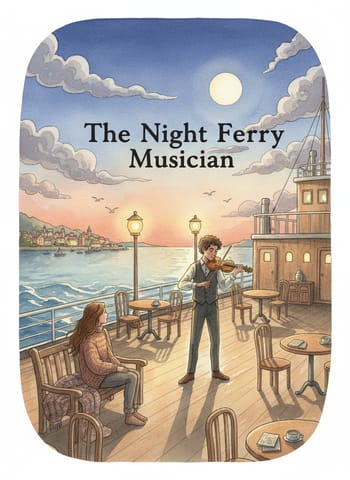
The night ferry leaves at eleven, half empty, and by midnight everyone who is going to sleep has found a bench in the saloon and turned a shoulder to the room. Sonja cannot sleep. She goes out on deck for the cold, which she expects to have to herself, and finds instead, in the lee of a lifeboat, a man playing the violin to the dark.
夜渡轮十一点开船,半空着,到午夜时分,所有打算睡觉的人都在客舱里找到了长椅,把一侧肩膀朝向整个房间。索尼娅睡不着。她走到甲板上想吹吹冷风,原以为只有自己一个人,却在一只救生艇的背风处,看见一个男人正对着黑夜拉小提琴。
He is not busking. There is no case open at his feet, and nobody else is out here. He plays with his eyes shut, in short pieces that begin and then stop, like someone trying a door and finding it locked, and the wind takes half of every phrase. She stands thirty feet away holding her collar closed, a stranger at a rehearsal, and when he lowers the bow she hears herself say, "Don't stop on my account."
他不是在街头卖艺。他脚边没有打开的琴盒,这里也没有别人。他闭着眼睛拉,一小段一小段地,起了头又停下,像是有人试着开一扇门,却发现它锁着,而风带走了每个乐句的一半。她站在三十英尺外,一手拢紧衣领,像个闯进排练现场的陌生人,等他放下琴弓时,她听见自己说:“别因为我停下来。”
"There is no account," he says. He looks pleased, but not surprised. "It's the only time I get to play badly and nobody holds it against me."
“没有什么因为。”他说。他看上去很高兴,但并不意外。“这是我唯一能拉得不好、又没人计较的时候。”
They talk, in the end, because sitting is warmer than standing. He is making the crossing for the last time this year, after a season of weddings, the kind of music people have stopped hearing by the second hour. She tells him, without quite meaning to, that she is on her way to look at a flat in a city where she knows no one. She has not decided whether she is moving or only visiting. He does not tell her which she should do. He asks what she will do if she stands in the flat for an hour and hates it.
他们到底还是聊了起来,因为坐着比站着暖和。他今年最后一次走这条航线,刚忙完一整季的婚礼,那种音乐,到第二个小时人们就已经不再听了。她告诉他,其实自己并没有打算说,她正要去一座没有熟人的城市看一套公寓。她还没想好,是要搬过去,还是只是去看看。他没有告诉她该怎么做。他问的是,如果她在那套公寓里站上一个小时,讨厌它,她会怎么办。
"Take the first ferry back," she says.
“坐第一班渡轮回来。”她说。
"Then you know something already." He considers this, and then, because it sounds too certain, adds, "Or you know nothing, which is also useful."
“那你已经知道一些事了。”他想了想,又因为这话听起来太肯定,补充道:“或者你什么都不知道,那也有用。”
Around three the sea goes flat and black, and the far coast appears as a thin, unsteady line of lights. He plays her the piece he has been circling all night: eight bars that never end properly, because, he says, he has never found the ninth. She hums what she thinks it should be, a rising line, nothing more. He tries it and shakes his head, tries it again a tone lower, and for the length of a bar the whole deck is silent except for the engine.
三点左右,海面变得平坦而漆黑,远处的海岸出现了,是一条细细的、颤颤巍巍的灯火线。他给她拉了那一整晚他一直在绕圈的曲子:八个小节,始终没有好好收尾,他说,因为他一直没找到第九小节。她哼出自己觉得该有的样子,一条上升的旋律,仅此而已。他试了一遍,摇摇头,又低一个音试了一遍,有一个小节的时间,整个甲板除了引擎声,一片寂静。
What strikes her, afterwards, is how easy it was. Not until the sky begins to pale does she realise that they have said nothing about where either of them lives, whom they love, or what they are called. If they had traded names at midnight, she thinks, they would have spent the night being the people those names belonged to.
事后让她印象深刻的是,这一切是那么轻松。直到天空开始泛白,她才意识到,他们一句也没有说起各自住在哪里,爱着谁,又叫什么名字。她想,要是半夜里就交换了名字,他们这一晚就会一直在做那些名字所属的人了。
The harbour comes up out of the grey: cranes, a gull on a bollard, a town not yet awake. Passengers shuffle toward the ramp with their bags and their creased faces. He packs the violin into its case without hurry and stands beside her at the rail while the ropes go across.
港口从灰色的天光中浮现出来:起重机,系缆桩上的一只海鸥,一座尚未醒来的小镇。乘客们拖着包,带着满脸倦容,挪向跳板。他不紧不慢地把小提琴收进琴盒,和她并肩站在栏杆边,看缆绳抛过去。
"Good luck with the flat," he says.
“祝你看房顺利。”他说。
"Good luck with the ninth bar."
“祝你找到第九小节。”
They go down the ramp a few people apart, and at the bottom he turns left along the quay and she turns right. At the end of the quay, behind her, a violin starts up: eight bars, and then a ninth, a tone lower than the one she sang. Sonja keeps walking. She does not turn round, and she does not stop humming.
他们隔着几个人走下跳板,到了底下,他沿着码头向左拐,她向右拐。在码头尽头,身后有一把小提琴响了起来:八个小节,然后是第九个,比她哼的那个低一个音。索尼娅继续往前走。她没有回头,也没有停止哼唱。