The Hearing Aids
Uma história gratuita em inglês de nível B2 para estudantes, para ler online em 5 idiomas, com opção de ouvir no app gratuito Storyteller.
Enrique finds a way to show his stubborn father what he has been missing at the dinner table.
Essa foi a prévia! Ouça a história completa no app gratuito Storyteller. Baixar o app
O áudio não está disponível no momento.
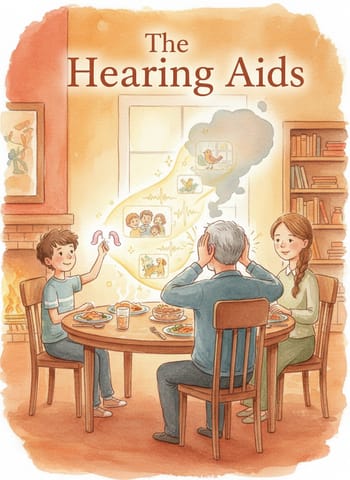
For about two years, Enrique's father had been nodding at the right moments. Enrique noticed it first at family dinners. There was the small, confident "Yes, yes" in reply to questions that had not quite been asked. There was the pause before he laughed, as if he were waiting to see whether everyone else was laughing too.
Havia uns dois anos que o pai de Enrique vinha assentindo nos momentos certos. Enrique reparou primeiro nos jantares em família. Havia o pequeno e confiante "Sim, sim" em resposta a perguntas que não tinham sido bem feitas. Havia a pausa antes de rir, como se ele esperasse para ver se todos os outros também estavam rindo.
Whenever anyone mentioned hearing aids, the old man shook his head. His ears were fine, he said. The rest of the world had simply started mumbling.
Sempre que alguém mencionava aparelhos auditivos, o velho balançava a cabeça. Os ouvidos dele estavam ótimos, dizia. O resto do mundo é que tinha começado a resmungar.
Enrique had tried reasoning with him, and he had tried joking. Neither worked. What finally changed his mind was something much smaller. On a Sunday in March, he asked his father whether he wanted more soup, and his father answered, "Thursday is best for me."
Enrique tentara argumentar e tentara brincar. Nada funcionara. O que finalmente o fez mudar de ideia foi algo muito menor. Num domingo de março, perguntou ao pai se queria mais sopa, e o pai respondeu: "Quinta-feira é melhor para mim."
Enrique said nothing at the time. But that evening, he sat in his car outside the house and wondered how many conversations had been going on without his father. They must have sounded like a radio playing in another room.
Enrique não disse nada na hora. Mas naquela noite, sentado no carro diante da casa, ficou pensando em quantas conversas estavam acontecendo sem o pai. Deviam soar como um rádio tocando em outro cômodo.
The next Sunday, he propped his phone against the salt shaker, with the recorder switched on. Nobody noticed. The table was crowded, as usual, with cousins, a neighbor, and a niece who talked quickly with her mouth full. The recording picked up everything: the clatter of plates, the overlapping voices, and, in the middle of it all, his father's deep, cheerful "Yes, yes."
No domingo seguinte, apoiou o celular no saleiro, com o gravador ligado. Ninguém notou. A mesa estava cheia, como sempre, de primos, uma vizinha e uma sobrinha que falava depressa de boca cheia. A gravação captou tudo: o tilintar dos pratos, as vozes sobrepostas e, no meio de tudo, o "Sim, sim" grave e alegre do pai.
On Monday, Enrique drove over with the phone in his pocket. He made tea, sat across the kitchen table, and said he wanted to play something. His father put on his reading glasses, as though that would help him listen.
Na segunda, Enrique foi de carro até lá com o celular no bolso. Fez chá, sentou-se do outro lado da mesa da cozinha e disse que queria tocar uma coisa. O pai pôs os óculos de leitura, como se isso fosse ajudá-lo a ouvir.
At first, the old man just frowned. He could not make out the voices. Enrique turned up the volume and then played it again, slowly, with the speaker next to his father's good ear.
No começo, o velho apenas franziu a testa. Não conseguia distinguir as vozes. Enrique aumentou o volume e tocou de novo, devagar, com o alto-falante junto ao ouvido bom do pai.
"Is that Sunday?" his father asked.
"Isso é domingo?", perguntou o pai.
"Yes. Listen to the part about the lost suitcase."
"Sim. Ouça a parte da mala perdida."
On the recording, someone told a long, funny story about a lost suitcase, and the whole table burst into laughter. Then his father's voice said, solemnly, "That's terrible." There was a short silence. Then someone, quite kindly, giggled.
Na gravação, alguém contava uma longa e engraçada história sobre uma mala perdida, e a mesa inteira explodia em risos. Então a voz do pai dizia, solene: "Que terrível." Houve um curto silêncio. Então alguém, com muita gentileza, deu uma risadinha.
His father listened to it twice. His face did not change, but his hand, which had been resting on the table, slowly closed.
O pai ouviu duas vezes. O rosto dele não mudou, mas a mão, que repousava sobre a mesa, foi se fechando devagar.
"I thought it was a sad story," he said at last.
"Achei que era uma história triste", disse por fim.
"It wasn't."
"Não era."
"What else did I miss?" His voice was smaller than Enrique had ever heard it. "If I'd heard everything, I would have asked to go home earlier. Or I would have stayed later."
"O que mais eu perdi?" A voz dele estava menor do que Enrique jamais ouvira. "Se eu tivesse ouvido tudo, teria pedido para ir embora mais cedo. Ou teria ficado até mais tarde."
Enrique didn't answer right away. He had not expected to win the argument this way, and he found that he didn't want to.
Enrique não respondeu logo. Não esperava vencer a discussão desse jeito, e descobriu que não queria.
After a long moment, his father took off his glasses and rubbed his eyes. "Make the appointment," he said. "Thursday morning. And write down the time. I'm told I miss things."
Depois de um longo momento, o pai tirou os óculos e esfregou os olhos. "Marque a consulta", disse. "Quinta de manhã. E anote o horário. Dizem que eu perco as coisas."