The Hearing Aids
A free B2-level English story for language learners, readable online in 5 languages, with an option to listen via the free Storyteller app.
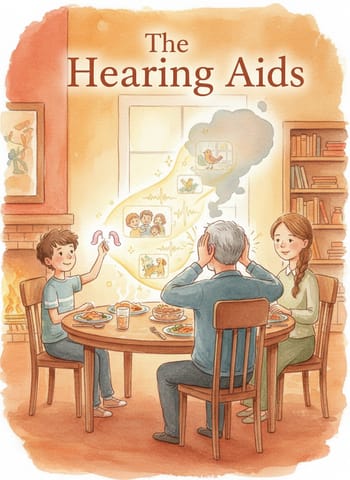
Enrique finds a way to show his stubborn father what he has been missing at the dinner table.
That was the preview! Hear the full story in the free Storyteller app. Get the app
Audio isn't available right now.
For about two years, Enrique's father had been nodding at the right moments. Enrique noticed it first at family dinners. There was the small, confident "Yes, yes" in reply to questions that had not quite been asked. There was the pause before he laughed, as if he were waiting to see whether everyone else was laughing too.
Whenever anyone mentioned hearing aids, the old man shook his head. His ears were fine, he said. The rest of the world had simply started mumbling.
Enrique had tried reasoning with him, and he had tried joking. Neither worked. What finally changed his mind was something much smaller. On a Sunday in March, he asked his father whether he wanted more soup, and his father answered, "Thursday is best for me."
Enrique said nothing at the time. But that evening, he sat in his car outside the house and wondered how many conversations had been going on without his father. They must have sounded like a radio playing in another room.
The next Sunday, he propped his phone against the salt shaker, with the recorder switched on. Nobody noticed. The table was crowded, as usual, with cousins, a neighbor, and a niece who talked quickly with her mouth full. The recording picked up everything: the clatter of plates, the overlapping voices, and, in the middle of it all, his father's deep, cheerful "Yes, yes."
On Monday, Enrique drove over with the phone in his pocket. He made tea, sat across the kitchen table, and said he wanted to play something. His father put on his reading glasses, as though that would help him listen.
At first, the old man just frowned. He could not make out the voices. Enrique turned up the volume and then played it again, slowly, with the speaker next to his father's good ear.
"Is that Sunday?" his father asked.
"Yes. Listen to the part about the lost suitcase."
On the recording, someone told a long, funny story about a lost suitcase, and the whole table burst into laughter. Then his father's voice said, solemnly, "That's terrible." There was a short silence. Then someone, quite kindly, giggled.
His father listened to it twice. His face did not change, but his hand, which had been resting on the table, slowly closed.
"I thought it was a sad story," he said at last.
"It wasn't."
"What else did I miss?" His voice was smaller than Enrique had ever heard it. "If I'd heard everything, I would have asked to go home earlier. Or I would have stayed later."
Enrique didn't answer right away. He had not expected to win the argument this way, and he found that he didn't want to.
After a long moment, his father took off his glasses and rubbed his eyes. "Make the appointment," he said. "Thursday morning. And write down the time. I'm told I miss things."