The False Gems (Les Faux Bijoux)
A free B2-level English story for language learners, readable online in 7 languages, with an option to listen via the free Storyteller app.
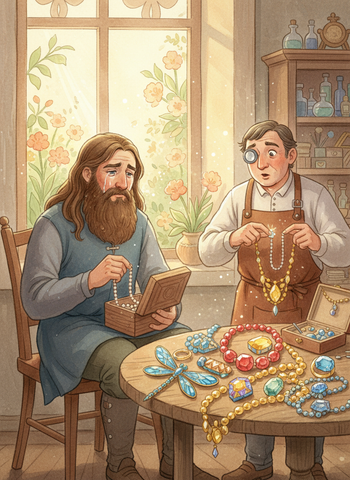
A devoted husband is left grief-stricken when his wife dies suddenly — until a jeweler makes a stunning claim about the "worthless" costume jewelry she loved so much.
Monsieur Lantin had met the young girl at a reception at the house of the second head of his department, and had fallen head over heels in love with her.
O senhor Lantin conhecera a jovem numa recepção na casa do segundo chefe de seu departamento, e se apaixonara perdidamente por ela.
She was the daughter of a provincial tax collector, who had been dead several years. She and her mother came to live in Paris, where the latter, who made the acquaintance of some of the families in her neighborhood, hoped to find a husband for her daughter.
Ela era filha de um coletor de impostos de província, morto havia vários anos. Ela e sua mãe vieram morar em Paris, onde esta última, que fez amizade com algumas famílias da vizinhança, esperava encontrar um marido para a filha.
They had very moderate means, and were honorable, gentle, and quiet.
Tinham recursos muito modestos, e eram honradas, gentis e discretas.
The young girl was a perfect type of the virtuous woman in whose hands every sensible young man dreams of one day intrusting his happiness. Her simple beauty had the charm of angelic modesty, and the imperceptible smile which constantly hovered about the lips seemed to be the reflection of a pure and lovely soul. Her praises resounded on every side. People never tired of repeating: “Happy the man who wins her love! He could not find a better wife.”
A jovem era o tipo perfeito da mulher virtuosa em cujas mãos todo rapaz sensato sonha um dia confiar sua felicidade. Sua beleza simples tinha o encanto de uma modéstia angelical, e o sorriso quase imperceptível que pairava constantemente em seus lábios parecia ser o reflexo de uma alma pura e adorável. Seus elogios ecoavam por toda parte. As pessoas não se cansavam de repetir: "Feliz o homem que conquistar seu amor! Não poderia encontrar esposa melhor."
Monsieur Lantin, then chief clerk in the Department of the Interior, enjoyed a snug little salary of three thousand five hundred francs, and he proposed to this model young girl, and was accepted.
O senhor Lantin, então chefe de seção no Ministério do Interior, desfrutava de um salário confortável de três mil e quinhentos francos, e pediu a mão dessa jovem exemplar, sendo aceito.
He was unspeakably happy with her. She governed his household with such clever economy that they seemed to live in luxury. She lavished the most delicate attentions on her husband, coaxed and fondled him; and so great was her charm that six years after their marriage, Monsieur Lantin discovered that he loved his wife even more than during the first days of their honeymoon.
Foi indescritivelmente feliz com ela. Ela administrava a casa com tamanha e hábil economia que pareciam viver no luxo. Prodigalizava as atenções mais delicadas ao marido, mimava-o e afagava-o; e seu encanto era tão grande que, seis anos depois do casamento, o senhor Lantin descobriu que amava a esposa ainda mais do que nos primeiros dias da lua de mel.
He found fault with only two of her tastes: Her love for the theatre, and her taste for imitation jewelry. Her friends (the wives of some petty officials) frequently procured for her a box at the theatre, often for the first representations of the new plays; and her husband was obliged to accompany her, whether he wished it or not, to these entertainments which bored him excessively after his day's work at the office.
Só encontrava defeito em dois de seus gostos: o amor pelo teatro e o gosto por joias falsas. Suas amigas (esposas de alguns funcionários menores) frequentemente lhe arranjavam um camarote no teatro, muitas vezes para as estreias das novas peças; e o marido era obrigado a acompanhá-la, quisesse ou não, a esses espetáculos que o entediavam profundamente depois de um dia de trabalho no escritório.
After a time, Monsieur Lantin begged his wife to request some lady of her acquaintance to accompany her, and to bring her home after the theatre. She opposed this arrangement, at first; but, after much persuasion, finally consented, to the infinite delight of her husband.
Depois de algum tempo, o senhor Lantin pediu à esposa que solicitasse a alguma dama de suas relações que a acompanhasse, e a trouxesse de volta para casa depois do teatro. Ela se opôs a esse arranjo, a princípio; mas, depois de muita insistência, finalmente consentiu, para infinita alegria do marido.
Now, with her love for the theatre, came also the desire for ornaments. Her costumes remained as before, simple, in good taste, and always modest; but she soon began to adorn her ears with huge rhinestones, which glittered and sparkled like real diamonds. Around her neck she wore strings of false pearls, on her arms bracelets of imitation gold, and combs set with glass jewels.
Ora, junto com o amor pelo teatro veio também o desejo de adornos. Suas roupas continuavam como antes, simples, de bom gosto e sempre modestas; mas ela logo começou a adornar as orelhas com enormes pedras de vidro, que brilhavam e cintilavam como diamantes de verdade. Ao redor do pescoço usava fileiras de pérolas falsas, nos braços pulseiras de ouro imitação, e pentes cravejados de joias de vidro.
Her husband frequently remonstrated with her, saying:
O marido frequentemente a repreendia, dizendo:
“My dear, as you cannot afford to buy real jewelry, you ought to appear adorned with your beauty and modesty alone, which are the rarest ornaments of your sex.”
"Minha querida, já que não podemos comprar joias de verdade, você deveria aparecer adornada apenas por sua beleza e sua modéstia, que são os ornamentos mais raros do seu sexo."
But she would smile sweetly, and say:
Mas ela sorria docemente, e dizia:
“What can I do? I am so fond of jewelry. It is my only weakness. We cannot change our nature.”
"O que posso fazer? Gosto tanto de joias. É minha única fraqueza. Não podemos mudar nossa natureza."
Then she would wind the pearl necklace round her fingers, make the facets of the crystal gems sparkle, and say:
Então enrolava o colar de pérolas nos dedos, fazia as facetas das joias de cristal cintilarem, e dizia:
“Look! are they not lovely? One would swear they were real.”
"Olhe! Não são lindas? Qualquer um juraria que são de verdade."
Monsieur Lantin would then answer, smilingly:
O senhor Lantin então respondia, sorrindo:
“You have bohemian tastes, my dear.”
"Você tem gostos de cigana, minha querida."
Sometimes, of an evening, when they were enjoying a tete-a-tete by the fireside, she would place on the tea table the morocco leather box containing the “trash,” as Monsieur Lantin called it. She would examine the false gems with a passionate attention, as though they imparted some deep and secret joy; and she often persisted in passing a necklace around her husband's neck, and, laughing heartily, would exclaim: “How droll you look!” Then she would throw herself into his arms, and kiss him affectionately.
Às vezes, à noite, quando desfrutavam de um momento a sós junto à lareira, ela colocava sobre a mesa de chá a caixa de couro de marroquino que continha as "quinquilharias", como o senhor Lantin as chamava. Examinava as joias falsas com uma atenção apaixonada, como se lhe trouxessem alguma alegria secreta e profunda; e muitas vezes insistia em passar um colar ao redor do pescoço do marido, e, rindo com gosto, exclamava: "Como você fica engraçado!" Depois se atirava em seus braços, e o beijava com carinho.
One evening, in winter, she had been to the opera, and returned home chilled through and through. The next morning she coughed, and eight days later she died of inflammation of the lungs.
Certa noite de inverno, ela fora à ópera, e voltou para casa gelada até os ossos. Na manhã seguinte tossiu, e oito dias depois morreu de uma inflamação nos pulmões.
Monsieur Lantin's despair was so great that his hair became white in one month. He wept unceasingly; his heart was broken as he remembered her smile, her voice, every charm of his dead wife.
O desespero do senhor Lantin foi tão grande que seu cabelo ficou branco num único mês. Chorava sem cessar; seu coração estava partido ao lembrar-se do sorriso dela, de sua voz, de cada encanto de sua falecida esposa.
Time did not assuage his grief. Often, during office hours, while his colleagues were discussing the topics of the day, his eyes would suddenly fill with tears, and he would give vent to his grief in heartrending sobs. Everything in his wife's room remained as it was during her lifetime; all her furniture, even her clothing, being left as it was on the day of her death. Here he was wont to seclude himself daily and think of her who had been his treasure-the joy of his existence.
O tempo não abrandou sua dor. Muitas vezes, durante o expediente, enquanto os colegas discutiam os assuntos do dia, seus olhos se enchiam subitamente de lágrimas, e ele deixava transbordar sua dor em soluços dilacerantes. Tudo no quarto da esposa permanecia como estava enquanto ela vivia; todos os móveis, até as roupas, ficaram como no dia de sua morte. Ali ele costumava se recolher diariamente e pensar naquela que fora seu tesouro — a alegria de sua existência.
But life soon became a struggle. His income, which, in the hands of his wife, covered all household expenses, was now no longer sufficient for his own immediate wants; and he wondered how she could have managed to buy such excellent wine and the rare delicacies which he could no longer procure with his modest resources.
Mas a vida logo se tornou uma luta. Sua renda, que nas mãos da esposa cobria todas as despesas da casa, já não bastava para as próprias necessidades imediatas; e ele se perguntava como ela conseguira comprar aquele vinho tão excelente e as iguarias raras que ele já não conseguia obter com seus recursos modestos.
He incurred some debts, and was soon reduced to absolute poverty. One morning, finding himself without a cent in his pocket, he resolved to sell something, and immediately the thought occurred to him of disposing of his wife's paste jewels, for he cherished in his heart a sort of rancor against these “deceptions,” which had always irritated him in the past. The very sight of them spoiled, somewhat, the memory of his lost darling.
Contraiu algumas dívidas, e logo se viu reduzido à pobreza absoluta. Certa manhã, encontrando-se sem um centavo no bolso, resolveu vender algo, e imediatamente lhe ocorreu a ideia de se desfazer das joias falsas da esposa, pois guardava no coração uma espécie de rancor contra aqueles "enganos", que sempre o haviam irritado no passado. A simples visão delas estragava, de certo modo, a lembrança de sua querida perdida.
To the last days of her life she had continued to make purchases, bringing home new gems almost every evening, and he turned them over some time before finally deciding to sell the heavy necklace, which she seemed to prefer, and which, he thought, ought to be worth about six or seven francs; for it was of very fine workmanship, though only imitation.
Até os últimos dias de vida ela continuara a fazer compras, trazendo para casa novas joias quase toda noite, e ele as examinou por algum tempo antes de finalmente decidir vender o colar pesado, que ela parecia preferir, e que, ele pensou, deveria valer uns seis ou sete francos; pois era de acabamento muito fino, embora fosse apenas imitação.
He put it in his pocket, and started out in search of what seemed a reliable jeweler's shop. At length he found one, and went in, feeling a little ashamed to expose his misery, and also to offer such a worthless article for sale.
Ele o pôs no bolso e saiu em busca do que lhe parecesse uma joalheria confiável. Por fim encontrou uma, e entrou, sentindo-se um pouco envergonhado de expor sua miséria, e também de oferecer à venda um objeto tão sem valor.
“Sir,” said he to the merchant, “I would like to know what this is worth.”
"Senhor," disse ele ao comerciante, "gostaria de saber quanto vale isto."
The man took the necklace, examined it, called his clerk, and made some remarks in an undertone; he then put the ornament back on the counter, and looked at it from a distance to judge of the effect.
O homem pegou o colar, examinou-o, chamou seu funcionário, e fez alguns comentários em voz baixa; depois recolocou o adorno sobre o balcão, e o observou de certa distância para julgar o efeito.
Monsieur Lantin, annoyed at all these ceremonies, was on the point of saying: “Oh! I know well enough it is not worth anything,” when the jeweler said: “Sir, that necklace is worth from twelve to fifteen thousand francs; but I could not buy it, unless you can tell me exactly where it came from.”
O senhor Lantin, incomodado com todas essas cerimônias, estava a ponto de dizer: "Ah! Eu sei muito bem que não vale nada," quando o joalheiro disse: "Senhor, esse colar vale de doze a quinze mil francos; mas eu não poderia comprá-lo, a menos que o senhor me diga exatamente de onde ele veio."
The widower opened his eyes wide and remained gaping, not comprehending the merchant's meaning. Finally he stammered: “You say—are you sure?” The other replied, drily: “You can try elsewhere and see if any one will offer you more. I consider it worth fifteen thousand at the most. Come back; here, if you cannot do better.”
O viúvo arregalou os olhos e ficou boquiaberto, sem compreender o sentido das palavras do comerciante. Por fim gaguejou: "O senhor diz… tem certeza?" O outro respondeu, secamente: "Pode tentar em outro lugar e ver se alguém lhe oferece mais. Considero que vale quinze mil, no máximo. Volte aqui, se não conseguir melhor preço."
Monsieur Lantin, beside himself with astonishment, took up the necklace and left the store. He wished time for reflection.
O senhor Lantin, fora de si de espanto, pegou o colar e saiu da loja. Precisava de tempo para refletir.
Once outside, he felt inclined to laugh, and said to himself: “The fool! Oh, the fool! Had I only taken him at his word! That jeweler cannot distinguish real diamonds from the imitation article.”
Uma vez na rua, sentiu vontade de rir, e disse a si mesmo: "Que tolo! Ah, que tolo! Se ao menos eu o tivesse tomado pela palavra! Esse joalheiro não sabe distinguir diamantes de verdade de imitações."
A few minutes after, he entered another store, in the Rue de la Paix. As soon as the proprietor glanced at the necklace, he cried out:
Poucos minutos depois, entrou em outra loja, na Rue de la Paix. Assim que o proprietário lançou os olhos sobre o colar, exclamou:
“Ah, parbleu! I know it well; it was bought here.”
"Ah, francamente! Conheço-o bem; foi comprado aqui."
Monsieur Lantin, greatly disturbed, asked:
O senhor Lantin, profundamente perturbado, perguntou:
“How much is it worth?”
"Quanto vale?"
“Well, I sold it for twenty thousand francs. I am willing to take it back for eighteen thousand, when you inform me, according to our legal formality, how it came to be in your possession.”
"Bem, eu o vendi por vinte mil francos. Estou disposto a comprá-lo de volta por dezoito mil, quando o senhor me informar, conforme nossa formalidade legal, como ele veio parar em sua posse."
This time, Monsieur Lantin was dumfounded. He replied:
Dessa vez, o senhor Lantin ficou atônito. Respondeu:
“But—but—examine it well. Until this moment I was under the impression that it was imitation.”
"Mas… mas… examine bem. Até este momento eu estava convencido de que era imitação."
The jeweler asked:
O joalheiro perguntou:
“What is your name, sir?”
"Qual é o seu nome, senhor?"
“Lantin—I am in the employ of the Minister of the Interior. I live at number sixteen Rue des Martyrs.”
"Lantin… trabalho a serviço do Ministério do Interior. Moro no número dezesseis da Rue des Martyrs."
The merchant looked through his books, found the entry, and said: “That necklace was sent to Madame Lantin's address, sixteen Rue des Martyrs, July 20, 1876.”
O comerciante consultou seus registros, encontrou a anotação, e disse: "Esse colar foi enviado ao endereço da senhora Lantin, número dezesseis da Rue des Martyrs, em 20 de julho de 1876."
The two men looked into each other's eyes—the widower speechless with astonishment; the jeweler scenting a thief. The latter broke the silence.
Os dois homens se entreolharam — o viúvo mudo de espanto; o joalheiro farejando um ladrão. Este último quebrou o silêncio.
“Will you leave this necklace here for twenty-four hours?” said he; “I will give you a receipt.”
"O senhor deixaria este colar aqui por vinte e quatro horas?" disse ele; "eu lhe darei um recibo."
Monsieur Lantin answered hastily: “Yes, certainly.” Then, putting the ticket in his pocket, he left the store.
O senhor Lantin respondeu apressadamente: "Sim, com certeza." Então, guardando o recibo no bolso, saiu da loja.
He wandered aimlessly through the streets, his mind in a state of dreadful confusion. He tried to reason, to understand. His wife could not afford to purchase such a costly ornament. Certainly not.
Vagou sem rumo pelas ruas, a mente num estado de terrível confusão. Tentou raciocinar, compreender. Sua esposa não podia se dar ao luxo de comprar um adorno tão caro. Certamente não.
But, then, it must have been a present!—a present!—a present, from whom? Why was it given her?
Mas, então, devia ter sido um presente! — um presente! — um presente, de quem? Por que lho teriam dado?
He stopped, and remained standing in the middle of the street. A horrible doubt entered his mind—She? Then, all the other jewels must have been presents, too! The earth seemed to tremble beneath him—the tree before him to be falling; he threw up his arms, and fell to the ground, unconscious. He recovered his senses in a pharmacy, into which the passers-by had borne him. He asked to be taken home, and, when he reached the house, he shut himself up in his room, and wept until nightfall. Finally, overcome with fatigue, he went to bed and fell into a heavy sleep.
Ele parou, e ficou imóvel no meio da rua. Uma dúvida horrível lhe entrou na mente — Ela? Então todas as outras joias também deviam ser presentes! A terra pareceu tremer sob seus pés — a árvore diante dele parecia desabar; ergueu os braços e caiu ao chão, desacordado. Recobrou os sentidos numa farmácia, para onde os transeuntes o haviam carregado. Pediu para ser levado para casa, e, ao chegar, trancou-se no quarto e chorou até o anoitecer. Por fim, vencido pelo cansaço, foi para a cama e caiu num sono pesado.
The sun awoke him next morning, and he began to dress slowly to go to the office. It was hard to work after such shocks. He sent a letter to his employer, requesting to be excused. Then he remembered that he had to return to the jeweler's. He did not like the idea; but he could not leave the necklace with that man. He dressed and went out.
O sol o acordou na manhã seguinte, e ele começou a se vestir devagar para ir ao escritório. Era difícil trabalhar depois de tais choques. Enviou uma carta ao patrão, pedindo para ser dispensado. Então se lembrou de que precisava voltar à joalheria. Não gostava da ideia; mas não podia deixar o colar com aquele homem. Vestiu-se e saiu.
It was a lovely day; a clear, blue sky smiled on the busy city below. Men of leisure were strolling about with their hands in their pockets.
Era um dia lindo; um céu claro e azul sorria sobre a cidade movimentada lá embaixo. Homens de vida ociosa passeavam com as mãos nos bolsos.
Monsieur Lantin, observing them, said to himself: “The rich, indeed, are happy. With money it is possible to forget even the deepest sorrow. One can go where one pleases, and in travel find that distraction which is the surest cure for grief. Oh if I were only rich!”
O senhor Lantin, observando-os, disse a si mesmo: "Os ricos, de fato, são felizes. Com dinheiro é possível esquecer até a dor mais profunda. Pode-se ir aonde se quiser, e na viagem encontrar aquela distração que é o remédio mais certo para o sofrimento. Ah, se eu ao menos fosse rico!"
He perceived that he was hungry, but his pocket was empty. He again remembered the necklace. Eighteen thousand francs! Eighteen thousand francs! What a sum!
Percebeu que estava com fome, mas seu bolso estava vazio. Lembrou-se novamente do colar. Dezoito mil francos! Dezoito mil francos! Que soma!
He soon arrived in the Rue de la Paix, opposite the jeweler's. Eighteen thousand francs! Twenty times he resolved to go in, but shame kept him back. He was hungry, however—very hungry—and not a cent in his pocket. He decided quickly, ran across the street, in order not to have time for reflection, and rushed into the store.
Logo chegou à Rue de la Paix, em frente à joalheria. Dezoito mil francos! Vinte vezes decidiu entrar, mas a vergonha o deteve. Estava com fome, porém — muita fome — e sem um centavo no bolso. Decidiu-se rapidamente, atravessou a rua correndo, para não ter tempo de refletir, e entrou correndo na loja.
The proprietor immediately came forward, and politely offered him a chair; the clerks glanced at him knowingly.
O proprietário logo veio ao seu encontro, e educadamente lhe ofereceu uma cadeira; os funcionários o olhavam com ar de cumplicidade.
“I have made inquiries, Monsieur Lantin,” said the jeweler, “and if you are still resolved to dispose of the gems, I am ready to pay you the price I offered.”
"Fiz algumas averiguações, senhor Lantin," disse o joalheiro, "e se o senhor ainda está decidido a se desfazer das joias, estou pronto para lhe pagar o preço que ofereci."
“Certainly, sir,” stammered Monsieur Lantin.
"Certamente, senhor," gaguejou o senhor Lantin.
Whereupon the proprietor took from a drawer eighteen large bills, counted, and handed them to Monsieur Lantin, who signed a receipt; and, with trembling hand, put the money into his pocket.
Diante disso, o proprietário tirou de uma gaveta dezoito notas grandes, contou-as, e as entregou ao senhor Lantin, que assinou um recibo; e, com a mão trêmula, guardou o dinheiro no bolso.
As he was about to leave the store, he turned toward the merchant, who still wore the same knowing smile, and lowering his eyes, said:
Quando estava prestes a sair da loja, virou-se para o comerciante, que ainda usava o mesmo sorriso de cumplicidade, e, baixando os olhos, disse:
“I have—I have other gems, which came from the same source. Will you buy them, also?”
"Tenho… tenho outras joias, vindas da mesma origem. O senhor as compraria também?"
The merchant bowed: “Certainly, sir.”
O comerciante fez uma reverência: "Certamente, senhor."
Monsieur Lantin said gravely: “I will bring them to you.” An hour later, he returned with the gems.
O senhor Lantin disse gravemente: "Vou trazê-las ao senhor." Uma hora depois, voltou com as joias.
The large diamond earrings were worth twenty thousand francs; the bracelets, thirty-five thousand; the rings, sixteen thousand; a set of emeralds and sapphires, fourteen thousand; a gold chain with solitaire pendant, forty thousand—making the sum of one hundred and forty-three thousand francs.
Os grandes brincos de diamante valiam vinte mil francos; as pulseiras, trinta e cinco mil; os anéis, dezesseis mil; um conjunto de esmeraldas e safiras, quatorze mil; uma corrente de ouro com pingente solitário, quarenta mil — somando a quantia de cento e quarenta e três mil francos.
The jeweler remarked, jokingly:
O joalheiro observou, em tom de brincadeira:
“There was a person who invested all her savings in precious stones.”
"Havia alguém que investiu todas as economias em pedras preciosas."
Monsieur Lantin replied, seriously:
O senhor Lantin respondeu, seriamente:
“It is only another way of investing one's money.”
"É apenas outra maneira de investir o dinheiro."
That day he lunched at Voisin's, and drank wine worth twenty francs a bottle. Then he hired a carriage and made a tour of the Bois. He gazed at the various turnouts with a kind of disdain, and could hardly refrain from crying out to the occupants:
Naquele dia almoçou no Voisin's, e bebeu vinho que custava vinte francos a garrafa. Depois alugou uma carruagem e fez um passeio pelo Bois. Olhava as diversas equipagens com uma espécie de desdém, e mal conseguia se conter de gritar aos ocupantes:
“I, too, am rich!—I am worth two hundred thousand francs.”
"Eu também sou rico! — Valho duzentos mil francos."
Suddenly he thought of his employer. He drove up to the bureau, and entered gaily, saying:
De repente lembrou-se de seu patrão. Foi de carruagem até o escritório, e entrou alegremente, dizendo:
“Sir, I have come to resign my position. I have just inherited three hundred thousand francs.”
"Senhor, vim pedir demissão do meu cargo. Acabo de herdar trezentos mil francos."
He shook hands with his former colleagues, and confided to them some of his projects for the future; he then went off to dine at the Cafe Anglais.
Apertou as mãos dos antigos colegas, e confiou a eles alguns de seus planos para o futuro; depois foi jantar no Café Anglais.
He seated himself beside a gentleman of aristocratic bearing; and, during the meal, informed the latter confidentially that he had just inherited a fortune of four hundred thousand francs.
Sentou-se ao lado de um cavalheiro de porte aristocrático; e, durante a refeição, informou a este, em confidência, que acabara de herdar uma fortuna de quatrocentos mil francos.
For the first time in his life, he was not bored at the theatre, and spent the remainder of the night in a gay frolic.
Pela primeira vez na vida, não se entediou no teatro, e passou o resto da noite numa animada farra.
Six months afterward, he married again. His second wife was a very virtuous woman; but had a violent temper. She caused him much sorrow.
Seis meses depois, casou-se novamente. Sua segunda esposa era uma mulher muito virtuosa; mas tinha um temperamento violento. Causou-lhe muito sofrimento.
