The False Gems (Les Faux Bijoux)
A free B2-level English story for language learners, readable online in 7 languages, with an option to listen via the free Storyteller app.
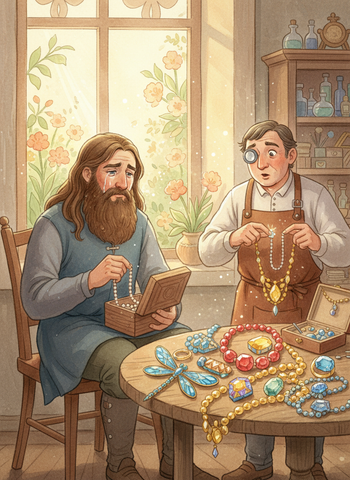
A devoted husband is left grief-stricken when his wife dies suddenly — until a jeweler makes a stunning claim about the "worthless" costume jewelry she loved so much.
Monsieur Lantin had met the young girl at a reception at the house of the second head of his department, and had fallen head over heels in love with her.
El señor Lantin había conocido a la joven en una recepción en casa del segundo jefe de su departamento, y se había enamorado perdidamente de ella.
She was the daughter of a provincial tax collector, who had been dead several years. She and her mother came to live in Paris, where the latter, who made the acquaintance of some of the families in her neighborhood, hoped to find a husband for her daughter.
Ella era hija de un recaudador de impuestos de provincia, muerto varios años atrás. Ella y su madre se habían mudado a vivir a París, donde esta última, que trabó amistad con algunas familias del vecindario, esperaba encontrar marido para su hija.
They had very moderate means, and were honorable, gentle, and quiet.
Tenían recursos muy modestos, y eran honorables, apacibles y discretas.
The young girl was a perfect type of the virtuous woman in whose hands every sensible young man dreams of one day intrusting his happiness. Her simple beauty had the charm of angelic modesty, and the imperceptible smile which constantly hovered about the lips seemed to be the reflection of a pure and lovely soul. Her praises resounded on every side. People never tired of repeating: “Happy the man who wins her love! He could not find a better wife.”
La joven era el tipo perfecto de la mujer virtuosa en cuyas manos todo joven sensato sueña algún día confiar su felicidad. Su belleza sencilla tenía el encanto de una modestia angelical, y la sonrisa apenas perceptible que siempre rondaba sus labios parecía el reflejo de un alma pura y encantadora. Sus alabanzas resonaban por todas partes. La gente no se cansaba de repetir: "¡Feliz el hombre que gane su amor! No podría encontrar mejor esposa".
Monsieur Lantin, then chief clerk in the Department of the Interior, enjoyed a snug little salary of three thousand five hundred francs, and he proposed to this model young girl, and was accepted.
El señor Lantin, entonces oficial mayor en el Ministerio del Interior, gozaba de un cómodo sueldo de tres mil quinientos francos, y le propuso matrimonio a esta joven modélica, siendo aceptado.
He was unspeakably happy with her. She governed his household with such clever economy that they seemed to live in luxury. She lavished the most delicate attentions on her husband, coaxed and fondled him; and so great was her charm that six years after their marriage, Monsieur Lantin discovered that he loved his wife even more than during the first days of their honeymoon.
Fue con ella indeciblemente feliz. Ella gobernaba su hogar con tal hábil economía que parecían vivir con lujo. Colmaba a su esposo de las atenciones más delicadas, lo mimaba y lo consentía; y tan grande era su encanto que, seis años después de casados, el señor Lantin descubrió que amaba a su esposa incluso más que en los primeros días de su luna de miel.
He found fault with only two of her tastes: Her love for the theatre, and her taste for imitation jewelry. Her friends (the wives of some petty officials) frequently procured for her a box at the theatre, often for the first representations of the new plays; and her husband was obliged to accompany her, whether he wished it or not, to these entertainments which bored him excessively after his day's work at the office.
Solo le reprochaba dos de sus gustos: su afición al teatro, y su gusto por la bisutería falsa. Sus amistades (esposas de algunos funcionarios menores) le conseguían con frecuencia un palco en el teatro, a menudo para los estrenos de las nuevas obras; y su marido se veía obligado a acompañarla, quisiera o no, a esas veladas que le resultaban sumamente aburridas después de su jornada de trabajo en la oficina.
After a time, Monsieur Lantin begged his wife to request some lady of her acquaintance to accompany her, and to bring her home after the theatre. She opposed this arrangement, at first; but, after much persuasion, finally consented, to the infinite delight of her husband.
Con el tiempo, el señor Lantin le rogó a su esposa que pidiera a alguna dama de su amistad que la acompañara, y que la trajera a casa después del teatro. Ella se opuso a ese arreglo, al principio; pero, tras mucha insistencia, terminó por consentir, para infinito deleite de su marido.
Now, with her love for the theatre, came also the desire for ornaments. Her costumes remained as before, simple, in good taste, and always modest; but she soon began to adorn her ears with huge rhinestones, which glittered and sparkled like real diamonds. Around her neck she wore strings of false pearls, on her arms bracelets of imitation gold, and combs set with glass jewels.
Ahora bien, junto con su amor por el teatro, llegó también el deseo de adornarse. Sus vestidos seguían siendo, como antes, sencillos, de buen gusto y siempre modestos; pero pronto comenzó a adornarse las orejas con enormes piedras de fantasía, que relucían y centelleaban como diamantes verdaderos. Alrededor del cuello llevaba hilos de perlas falsas, en los brazos pulseras de oro de imitación, y peinetas engastadas con vidrios de colores.
Her husband frequently remonstrated with her, saying:
Su marido le reprochaba con frecuencia, diciéndole:
“My dear, as you cannot afford to buy real jewelry, you ought to appear adorned with your beauty and modesty alone, which are the rarest ornaments of your sex.”
—Querida, ya que no puedes permitirte comprar joyas verdaderas, deberías presentarte adornada solo con tu belleza y tu modestia, que son los adornos más raros de tu sexo.
But she would smile sweetly, and say:
Pero ella sonreía con dulzura, y decía:
“What can I do? I am so fond of jewelry. It is my only weakness. We cannot change our nature.”
—¿Qué quieres que haga? Me encantan las joyas. Es mi única debilidad. No podemos cambiar nuestra naturaleza.
Then she would wind the pearl necklace round her fingers, make the facets of the crystal gems sparkle, and say:
Entonces enrollaba el collar de perlas en sus dedos, hacía centellear las facetas de las piedras de cristal, y decía:
“Look! are they not lovely? One would swear they were real.”
—¡Mira! ¿No son preciosas? Cualquiera juraría que son de verdad.
Monsieur Lantin would then answer, smilingly:
El señor Lantin le respondía entonces, sonriendo:
“You have bohemian tastes, my dear.”
—Tienes gustos de bohemia, querida.
Sometimes, of an evening, when they were enjoying a tete-a-tete by the fireside, she would place on the tea table the morocco leather box containing the “trash,” as Monsieur Lantin called it. She would examine the false gems with a passionate attention, as though they imparted some deep and secret joy; and she often persisted in passing a necklace around her husband's neck, and, laughing heartily, would exclaim: “How droll you look!” Then she would throw herself into his arms, and kiss him affectionately.
A veces, por la noche, cuando disfrutaban de un rato a solas junto a la chimenea, ella colocaba sobre la mesa del té el estuche de piel de Marruecos que contenía la "baratija", como la llamaba el señor Lantin. Examinaba las piedras falsas con una atención apasionada, como si le procuraran una alegría profunda y secreta; y con frecuencia insistía en pasarle un collar alrededor del cuello a su marido, y, riendo de buena gana, exclamaba: "¡Qué gracioso te ves!". Luego se arrojaba a sus brazos y lo besaba con cariño.
One evening, in winter, she had been to the opera, and returned home chilled through and through. The next morning she coughed, and eight days later she died of inflammation of the lungs.
Una noche de invierno, había ido a la ópera, y regresó a casa helada hasta los huesos. A la mañana siguiente tosió, y ocho días después murió de una inflamación de los pulmones.
Monsieur Lantin's despair was so great that his hair became white in one month. He wept unceasingly; his heart was broken as he remembered her smile, her voice, every charm of his dead wife.
La desesperación del señor Lantin fue tan grande que su cabello encaneció en un solo mes. Lloraba sin cesar; el corazón se le partía al recordar su sonrisa, su voz, cada encanto de su esposa muerta.
Time did not assuage his grief. Often, during office hours, while his colleagues were discussing the topics of the day, his eyes would suddenly fill with tears, and he would give vent to his grief in heartrending sobs. Everything in his wife's room remained as it was during her lifetime; all her furniture, even her clothing, being left as it was on the day of her death. Here he was wont to seclude himself daily and think of her who had been his treasure-the joy of his existence.
El tiempo no aliviaba su pena. A menudo, durante las horas de oficina, mientras sus colegas discutían los temas del día, sus ojos se llenaban de pronto de lágrimas, y él daba rienda suelta a su dolor con sollozos desgarradores. Todo en la habitación de su esposa permanecía tal como estaba en vida de ella; todos sus muebles, incluso su ropa, quedaron como el día de su muerte. Allí solía encerrarse a diario y pensar en quien había sido su tesoro, la alegría de su existencia.
But life soon became a struggle. His income, which, in the hands of his wife, covered all household expenses, was now no longer sufficient for his own immediate wants; and he wondered how she could have managed to buy such excellent wine and the rare delicacies which he could no longer procure with his modest resources.
Pero la vida pronto se convirtió en una lucha. Sus ingresos, que en manos de su esposa cubrían todos los gastos del hogar, ya no bastaban para sus propias necesidades inmediatas; y se preguntaba cómo ella había logrado comprar aquel excelente vino y las exquisiteces raras que él ya no podía procurarse con sus modestos recursos.
He incurred some debts, and was soon reduced to absolute poverty. One morning, finding himself without a cent in his pocket, he resolved to sell something, and immediately the thought occurred to him of disposing of his wife's paste jewels, for he cherished in his heart a sort of rancor against these “deceptions,” which had always irritated him in the past. The very sight of them spoiled, somewhat, the memory of his lost darling.
Contrajo algunas deudas, y pronto se vio reducido a la más absoluta pobreza. Una mañana, al encontrarse sin un céntimo en el bolsillo, resolvió vender algo, y de inmediato se le ocurrió la idea de deshacerse de las joyas de fantasía de su esposa, pues guardaba en el corazón una especie de rencor contra esos "engaños", que siempre lo habían irritado en el pasado. La sola vista de ellas empañaba, en cierto modo, el recuerdo de su amada perdida.
To the last days of her life she had continued to make purchases, bringing home new gems almost every evening, and he turned them over some time before finally deciding to sell the heavy necklace, which she seemed to prefer, and which, he thought, ought to be worth about six or seven francs; for it was of very fine workmanship, though only imitation.
Hasta los últimos días de su vida ella había seguido haciendo compras, trayendo a casa joyas nuevas casi todas las noches, y él las estuvo dando vueltas un buen rato antes de decidirse finalmente a vender el collar pesado que ella parecía preferir, y que, pensó, debía de valer unos seis o siete francos; pues estaba muy bien hecho, aunque fuera solo imitación.
He put it in his pocket, and started out in search of what seemed a reliable jeweler's shop. At length he found one, and went in, feeling a little ashamed to expose his misery, and also to offer such a worthless article for sale.
Se lo guardó en el bolsillo y salió en busca de lo que le pareciera una joyería de confianza. Al fin encontró una, y entró, sintiéndose algo avergonzado de exponer su miseria, y también de ofrecer en venta un artículo tan sin valor.
“Sir,” said he to the merchant, “I would like to know what this is worth.”
—Señor —le dijo al comerciante—, quisiera saber cuánto vale esto.
The man took the necklace, examined it, called his clerk, and made some remarks in an undertone; he then put the ornament back on the counter, and looked at it from a distance to judge of the effect.
El hombre tomó el collar, lo examinó, llamó a su empleado, e hizo algunos comentarios en voz baja; luego volvió a poner el adorno sobre el mostrador, y lo miró desde lejos para juzgar el efecto.
Monsieur Lantin, annoyed at all these ceremonies, was on the point of saying: “Oh! I know well enough it is not worth anything,” when the jeweler said: “Sir, that necklace is worth from twelve to fifteen thousand francs; but I could not buy it, unless you can tell me exactly where it came from.”
El señor Lantin, molesto por todas esas ceremonias, estaba a punto de decir: "¡Oh! Ya sé bien que no vale nada", cuando el joyero dijo: —Señor, ese collar vale entre doce y quince mil francos; pero no podría comprarlo a menos que me diga exactamente de dónde proviene.
The widower opened his eyes wide and remained gaping, not comprehending the merchant's meaning. Finally he stammered: “You say—are you sure?” The other replied, drily: “You can try elsewhere and see if any one will offer you more. I consider it worth fifteen thousand at the most. Come back; here, if you cannot do better.”
El viudo abrió los ojos como platos y se quedó boquiabierto, sin comprender el sentido de las palabras del comerciante. Por fin balbuceó: —Usted dice… ¿está seguro? El otro respondió, secamente: —Puede probar en otra parte y ver si alguien le ofrece más. Yo lo considero valorado en quince mil como máximo. Vuelva aquí si no consigue mejor precio.
Monsieur Lantin, beside himself with astonishment, took up the necklace and left the store. He wished time for reflection.
El señor Lantin, fuera de sí de asombro, tomó el collar y salió de la tienda. Necesitaba tiempo para reflexionar.
Once outside, he felt inclined to laugh, and said to himself: “The fool! Oh, the fool! Had I only taken him at his word! That jeweler cannot distinguish real diamonds from the imitation article.”
Ya en la calle, sintió ganas de reír, y se dijo a sí mismo: "¡El necio! ¡Ay, el necio! ¡Si tan solo lo hubiera tomado la palabra! Ese joyero no puede distinguir los diamantes verdaderos de los falsos".
A few minutes after, he entered another store, in the Rue de la Paix. As soon as the proprietor glanced at the necklace, he cried out:
Pocos minutos después, entró en otra tienda, en la Rue de la Paix. En cuanto el propietario echó un vistazo al collar, exclamó:
“Ah, parbleu! I know it well; it was bought here.”
—¡Ah, caramba! Lo conozco bien; se compró aquí.
Monsieur Lantin, greatly disturbed, asked:
El señor Lantin, muy turbado, preguntó:
“How much is it worth?”
—¿Cuánto vale?
“Well, I sold it for twenty thousand francs. I am willing to take it back for eighteen thousand, when you inform me, according to our legal formality, how it came to be in your possession.”
—Bueno, yo lo vendí en veinte mil francos. Estoy dispuesto a recomprarlo por dieciocho mil, en cuanto usted me informe, conforme a nuestra formalidad legal, cómo llegó a su poder.
This time, Monsieur Lantin was dumfounded. He replied:
Esta vez, el señor Lantin quedó estupefacto. Respondió:
“But—but—examine it well. Until this moment I was under the impression that it was imitation.”
—Pero… pero… examínelo bien. Hasta este momento tenía la certeza de que era imitación.
The jeweler asked:
El joyero preguntó:
“What is your name, sir?”
—¿Cuál es su nombre, señor?
“Lantin—I am in the employ of the Minister of the Interior. I live at number sixteen Rue des Martyrs.”
—Lantin. Estoy empleado en el Ministerio del Interior. Vivo en el número dieciséis de la Rue des Martyrs.
The merchant looked through his books, found the entry, and said: “That necklace was sent to Madame Lantin's address, sixteen Rue des Martyrs, July 20, 1876.”
El comerciante repasó sus libros, encontró el registro, y dijo: —Ese collar se envió a la dirección de la señora Lantin, número dieciséis de la Rue des Martyrs, el 20 de julio de 1876.
The two men looked into each other's eyes—the widower speechless with astonishment; the jeweler scenting a thief. The latter broke the silence.
Los dos hombres se miraron a los ojos: el viudo mudo de asombro; el joyero olfateando a un ladrón. Este último rompió el silencio.
“Will you leave this necklace here for twenty-four hours?” said he; “I will give you a receipt.”
—¿Dejaría este collar aquí durante veinticuatro horas? —dijo—; le daré un recibo.
Monsieur Lantin answered hastily: “Yes, certainly.” Then, putting the ticket in his pocket, he left the store.
El señor Lantin respondió apresuradamente: —Sí, por supuesto. Luego, guardándose el resguardo en el bolsillo, salió de la tienda.
He wandered aimlessly through the streets, his mind in a state of dreadful confusion. He tried to reason, to understand. His wife could not afford to purchase such a costly ornament. Certainly not.
Vagó sin rumbo por las calles, la mente sumida en una espantosa confusión. Trató de razonar, de comprender. Su esposa no podía permitirse comprar un adorno tan costoso. Por supuesto que no.
But, then, it must have been a present!—a present!—a present, from whom? Why was it given her?
Pero, entonces, ¡debía de haber sido un regalo! ¡Un regalo, un regalo, de quién? ¿Por qué se lo habían dado?
He stopped, and remained standing in the middle of the street. A horrible doubt entered his mind—She? Then, all the other jewels must have been presents, too! The earth seemed to tremble beneath him—the tree before him to be falling; he threw up his arms, and fell to the ground, unconscious. He recovered his senses in a pharmacy, into which the passers-by had borne him. He asked to be taken home, and, when he reached the house, he shut himself up in his room, and wept until nightfall. Finally, overcome with fatigue, he went to bed and fell into a heavy sleep.
Se detuvo, y quedó parado en medio de la calle. Una duda horrible entró en su mente: ¿Ella? Entonces, ¡todas las demás joyas también debían de haber sido regalos! La tierra pareció temblar bajo sus pies, el árbol frente a él pareció desplomarse; alzó los brazos y cayó al suelo, sin sentido. Recobró el conocimiento en una farmacia, adonde lo habían llevado los transeúntes. Pidió que lo llevaran a su casa, y, al llegar, se encerró en su habitación y lloró hasta el anochecer. Por fin, vencido por el cansancio, se acostó y cayó en un sueño profundo.
The sun awoke him next morning, and he began to dress slowly to go to the office. It was hard to work after such shocks. He sent a letter to his employer, requesting to be excused. Then he remembered that he had to return to the jeweler's. He did not like the idea; but he could not leave the necklace with that man. He dressed and went out.
El sol lo despertó a la mañana siguiente, y comenzó a vestirse despacio para ir a la oficina. Era duro trabajar después de semejantes golpes. Envió una carta a su superior, pidiendo que lo excusara. Luego recordó que tenía que volver a la joyería. No le agradaba la idea; pero no podía dejar el collar en manos de aquel hombre. Se vistió y salió.
It was a lovely day; a clear, blue sky smiled on the busy city below. Men of leisure were strolling about with their hands in their pockets.
Era un día hermoso; un cielo claro y azul sonreía sobre la ciudad bulliciosa allá abajo. Hombres ociosos paseaban con las manos en los bolsillos.
Monsieur Lantin, observing them, said to himself: “The rich, indeed, are happy. With money it is possible to forget even the deepest sorrow. One can go where one pleases, and in travel find that distraction which is the surest cure for grief. Oh if I were only rich!”
El señor Lantin, al observarlos, se dijo a sí mismo: "Los ricos, en verdad, son felices. Con dinero es posible olvidar hasta la pena más honda. Uno puede ir adonde le plazca, y en los viajes encontrar esa distracción que es el remedio más seguro contra el dolor. ¡Ay, si tan solo yo fuera rico!".
He perceived that he was hungry, but his pocket was empty. He again remembered the necklace. Eighteen thousand francs! Eighteen thousand francs! What a sum!
Se dio cuenta de que tenía hambre, pero el bolsillo lo tenía vacío. Volvió a recordar el collar. ¡Dieciocho mil francos! ¡Dieciocho mil francos! ¡Qué suma!
He soon arrived in the Rue de la Paix, opposite the jeweler's. Eighteen thousand francs! Twenty times he resolved to go in, but shame kept him back. He was hungry, however—very hungry—and not a cent in his pocket. He decided quickly, ran across the street, in order not to have time for reflection, and rushed into the store.
Pronto llegó a la Rue de la Paix, frente a la joyería. ¡Dieciocho mil francos! Veinte veces se decidió a entrar, pero la vergüenza lo detenía. Sin embargo, tenía hambre, mucha hambre, y ni un céntimo en el bolsillo. Se decidió rápidamente, cruzó la calle corriendo, para no darse tiempo de reflexionar, y se precipitó dentro de la tienda.
The proprietor immediately came forward, and politely offered him a chair; the clerks glanced at him knowingly.
El propietario se adelantó de inmediato, y cortésmente le ofreció una silla; los empleados lo miraron con complicidad.
“I have made inquiries, Monsieur Lantin,” said the jeweler, “and if you are still resolved to dispose of the gems, I am ready to pay you the price I offered.”
—He hecho averiguaciones, señor Lantin —dijo el joyero—, y si sigue decidido a deshacerse de las joyas, estoy dispuesto a pagarle el precio que le ofrecí.
“Certainly, sir,” stammered Monsieur Lantin.
—Ciertamente, señor —balbuceó el señor Lantin.
Whereupon the proprietor took from a drawer eighteen large bills, counted, and handed them to Monsieur Lantin, who signed a receipt; and, with trembling hand, put the money into his pocket.
Ante lo cual el propietario sacó de un cajón dieciocho billetes grandes, los contó, y se los entregó al señor Lantin, quien firmó un recibo; y, con mano temblorosa, se guardó el dinero en el bolsillo.
As he was about to leave the store, he turned toward the merchant, who still wore the same knowing smile, and lowering his eyes, said:
Cuando estaba a punto de salir de la tienda, se volvió hacia el comerciante, que aún lucía la misma sonrisa cómplice, y, bajando los ojos, dijo:
“I have—I have other gems, which came from the same source. Will you buy them, also?”
—Tengo… tengo otras joyas, que provienen de la misma fuente. ¿Se las compraría también?
The merchant bowed: “Certainly, sir.”
El comerciante hizo una reverencia: —Ciertamente, señor.
Monsieur Lantin said gravely: “I will bring them to you.” An hour later, he returned with the gems.
El señor Lantin dijo con gravedad: —Se las traeré. Una hora después, regresó con las joyas.
The large diamond earrings were worth twenty thousand francs; the bracelets, thirty-five thousand; the rings, sixteen thousand; a set of emeralds and sapphires, fourteen thousand; a gold chain with solitaire pendant, forty thousand—making the sum of one hundred and forty-three thousand francs.
Los grandes pendientes de diamantes valían veinte mil francos; las pulseras, treinta y cinco mil; los anillos, dieciséis mil; un juego de esmeraldas y zafiros, catorce mil; una cadena de oro con un solitario colgante, cuarenta mil, sumando en total ciento cuarenta y tres mil francos.
The jeweler remarked, jokingly:
El joyero comentó, en tono de broma:
“There was a person who invested all her savings in precious stones.”
—Había una persona que invertía todos sus ahorros en piedras preciosas.
Monsieur Lantin replied, seriously:
El señor Lantin respondió, con seriedad:
“It is only another way of investing one's money.”
—No es más que otra forma de invertir el dinero.
That day he lunched at Voisin's, and drank wine worth twenty francs a bottle. Then he hired a carriage and made a tour of the Bois. He gazed at the various turnouts with a kind of disdain, and could hardly refrain from crying out to the occupants:
Ese día almorzó en Voisin's, y bebió un vino de veinte francos la botella. Luego alquiló un carruaje e hizo un recorrido por el Bosque de Bolonia. Miraba los distintos coches con cierto desdén, y apenas podía contenerse de gritarles a sus ocupantes:
“I, too, am rich!—I am worth two hundred thousand francs.”
—¡Yo también soy rico! Tengo un patrimonio de doscientos mil francos.
Suddenly he thought of his employer. He drove up to the bureau, and entered gaily, saying:
De pronto pensó en su jefe. Se dirigió en carruaje hasta la oficina, y entró alegremente, diciendo:
“Sir, I have come to resign my position. I have just inherited three hundred thousand francs.”
—Señor, vengo a presentar mi renuncia. Acabo de heredar trescientos mil francos.
He shook hands with his former colleagues, and confided to them some of his projects for the future; he then went off to dine at the Cafe Anglais.
Estrechó la mano de sus antiguos colegas, y les confió algunos de sus proyectos para el futuro; luego se fue a cenar al Café Anglais.
He seated himself beside a gentleman of aristocratic bearing; and, during the meal, informed the latter confidentially that he had just inherited a fortune of four hundred thousand francs.
Se sentó junto a un caballero de porte aristocrático; y, durante la comida, le informó confidencialmente que acababa de heredar una fortuna de cuatrocientos mil francos.
For the first time in his life, he was not bored at the theatre, and spent the remainder of the night in a gay frolic.
Por primera vez en su vida, no se aburrió en el teatro, y pasó el resto de la noche en una alegre juerga.
Six months afterward, he married again. His second wife was a very virtuous woman; but had a violent temper. She caused him much sorrow.
Seis meses después, volvió a casarse. Su segunda esposa era una mujer muy virtuosa; pero de carácter violento. Le causó muchos sinsabores.
