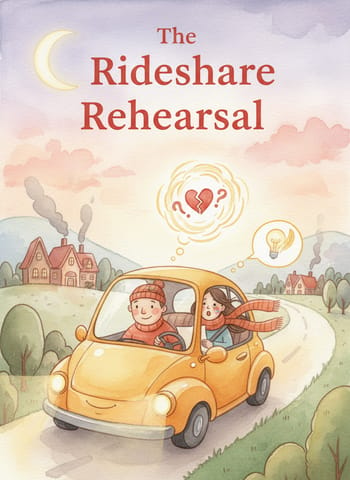
The Rideshare Rehearsal
Una historia gratuita en inglés de nivel B2 para estudiantes, para leer en línea en 5 idiomas, con opción de escucharla en la app gratuita Storyteller.
A rideshare driver overhears a passenger practicing a breakup speech and offers a piece of advice that changes what she says.
¡Ese fue el avance! Escucha la historia completa en la app gratuita Storyteller. Descargar la app
El audio no está disponible en este momento.
Fadi has been driving since six, and the evening's first fare is the first one to talk to herself. The woman in the back seat, a green scarf pulled up to her chin, is whispering at the window. Then she clears her throat and says, quite loudly, "Dear friend, this is very hard for me."
Fadi lleva manejando desde las seis, y la primera pasajera de la noche es la primera que habla sola. La mujer del asiento trasero, con una bufanda verde subida hasta la barbilla, le susurra a la ventanilla. Luego se aclara la garganta y dice, bastante fuerte: «Querido amigo, esto es muy difícil para mí».
Fadi glances at the mirror. She does not look up. He understands that he is not being addressed; he is simply the audience.
Fadi mira de reojo el espejo. Ella no levanta la vista. Entiende que no se dirige a él; es simplemente el público.
"I have thought about this for weeks," she goes on. "It's not you, it's me. We want different things. I will always remember the good times." She stops. "No. Too much like a greeting card."
«Lo he pensado durante semanas», prosigue ella. «No eres tú, soy yo. Queremos cosas distintas. Siempre recordaré los buenos momentos». Se detiene. «No. Demasiado de tarjeta de felicitación».
By the second traffic light, she has started again four times. The opening changes. The ending changes. The sentence "I'm not angry, just disappointed" survives every version. Fadi counts it quietly and decides that if he had to grade the speech, he would give it four out of ten. He keeps his eyes on the road and a bag of mints in the door pocket. At the next red light he holds the bag over his shoulder without a word. She takes one.
Para el segundo semáforo, ha empezado de nuevo cuatro veces. El comienzo cambia. El final cambia. La frase «No estoy enojada, solo decepcionada» sobrevive a todas las versiones. Fadi la cuenta en silencio y decide que, si tuviera que calificar el discurso, le pondría un cuatro sobre diez. Mantiene los ojos en la calle y una bolsa de mentas en el bolsillo de la puerta. En el siguiente semáforo en rojo extiende la bolsa por encima del hombro, sin una palabra. Ella toma una.
"Sorry," she says. "I'm practicing. I'm ending something tonight."
«Disculpe», dice ella. «Estoy practicando. Esta noche voy a terminar con algo».
"I noticed," Fadi says. "It was hard to miss. May I say one thing? You don't have to answer."
«Ya me di cuenta», dice Fadi. «Era difícil no darse cuenta. ¿Puedo decirle algo? No tiene que contestar».
"Go ahead. You've heard all of it by now anyway."
«Adelante. Ya lo ha oído todo de todos modos».
"When my wife and I nearly split up, I wrote a speech too. It was perfect. Every sentence had a lock on it, so she couldn't argue." He signals and turns into a narrow street. "She listened to the whole thing. Then she asked me one question: what do you actually want?"
«Cuando mi esposa y yo casi nos separamos, yo también escribí un discurso. Era perfecto. Cada frase tenía un candado, para que ella no pudiera discutir». Pone el intermitente y entra en una calle angosta. «Ella lo escuchó entero. Luego me hizo una sola pregunta: ¿qué es lo que realmente quieres?».
"What did you say?"
«¿Y qué le respondió?».
"Nothing. I had no line for that. I had only prepared the part where I was right."
«Nada. No tenía frase para eso. Solo había preparado la parte en que yo tenía la razón».
The woman laughs, then stops. She holds up her phone, and the notes screen glows with a long block of text. "Eleven paragraphs. I've been polishing them since Sunday."
La mujer se ríe, luego se detiene. Levanta su teléfono, y la pantalla de notas brilla con un largo bloque de texto. «Once párrafos. Los llevo puliendo desde el domingo».
"A speech is a good way to avoid a conversation," Fadi says. "But I'm only a driver. What do I know?"
«Un discurso es una buena manera de evitar una conversación», dice Fadi. «Pero yo solo soy conductor. ¿Qué sé yo?».
"More than my friends. They all said, 'Just be firm.'" She holds her thumb over the screen, hesitates and deletes the whole note.
«Más que mis amigas. Todas me dijeron: “Sé firme”». Sostiene el pulgar sobre la pantalla, duda y borra la nota entera.
"What will you say instead?" he asks.
«¿Qué va a decirle en su lugar?», pregunta él.
"That I'm unhappy. That I think he is too. That I want to talk about it properly, and that I'm scared." She says it quickly, as if testing the sentences. "That's all I've got."
«Que soy infeliz. Que creo que él también lo es. Que quiero hablarlo bien, y que tengo miedo». Lo dice rápido, como probando las frases. «Eso es todo lo que tengo».
"That's nine out of ten," says Fadi.
«Eso es un nueve sobre diez», dice Fadi.
They stop in front of a narrow house with a lamp in the window. She sits still for a moment, one hand on the door handle. "Could you wait?" she asks. "Ten minutes. If it goes badly, I'd rather not stand alone on the street."
Se detienen frente a una casa angosta con una lámpara en la ventana. Ella permanece quieta un instante, con una mano en la manija de la puerta. «¿Podría esperar?», pregunta. «Diez minutos. Si sale mal, preferiría no quedarme sola en la calle».
Fadi presses the button on the meter, and the numbers stop. "Take your time," he says, and he turns off the engine.
Fadi aprieta el botón del taxímetro, y los números se detienen. «Tómese su tiempo», dice, y apaga el motor.