The Roots Under the Driveway
Una historia gratuita en inglés de nivel B2 para estudiantes, para leer en línea en 5 idiomas, con opción de escucharla en la app gratuita Storyteller.
Agathe's driveway is cracking because of her neighbor's old oak, and instead of sending a lawyer's letter she decides to knock on the door.
¡Ese fue el avance! Escucha la historia completa en la app gratuita Storyteller. Descargar la app
El audio no está disponible en este momento.
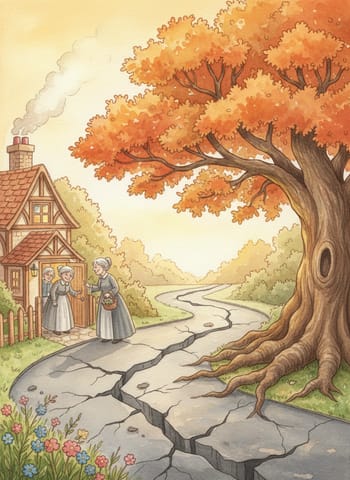
Agathe stands on her driveway with a cup of tea, looking at a crack she has privately named the River. It runs from the garage door to the street and gets wider every spring.
Agathe está de pie en su entrada para autos con una taza de té, mirando una grieta a la que en privado ha bautizado el Río. Va desde la puerta del garaje hasta la calle y cada primavera se ensancha más.
The cause is no mystery. Her neighbor's oak, which is older than the street itself, has been pushing a thick root under the concrete for years.
La causa no es ningún misterio. El roble de su vecina, más viejo que la calle misma, lleva años empujando una gruesa raíz bajo el concreto.
"If it were my driveway, I would have sent a lawyer's letter months ago," her brother says on the phone. He has even drafted one for her. It begins with the words "Pursuant to," and it makes her stomach hurt.
«Si fuera mi entrada, hace meses que habría mandado una carta de abogado», dice su hermano por teléfono. Incluso le ha redactado una. Empieza con las palabras «En virtud de», y a ella le da dolor de estómago.
"Hedwig hasn't done anything wrong," Agathe says. "It's a tree."
«Hedwig no ha hecho nada malo», dice Agathe. «Es un árbol.»
"The tree belongs to her, though. That's the whole point."
«Pero el árbol es de ella. Ese es justamente el punto.»
Agathe thinks about Hedwig, who has lived next door for forty years. Once, after a storm, Hedwig left a jar of plum jam on Agathe's step. Then Agathe folds the draft, puts it in a drawer, and crosses the grass in her slippers.
Agathe piensa en Hedwig, que lleva cuarenta años viviendo al lado. Una vez, después de una tormenta, Hedwig le dejó un frasco de mermelada de ciruela en el escalón. Entonces Agathe dobla el borrador, lo guarda en un cajón y cruza el césped en pantuflas.
Hedwig opens the door with flour up to her elbows. "It's the driveway, isn't it?" she says before Agathe can speak. "I've been lying awake about it all week. I should have knocked on your door first."
Hedwig abre la puerta con harina hasta los codos. «Es por la entrada, ¿verdad?», dice antes de que Agathe pueda hablar. «Llevo toda la semana sin dormir por eso. Debí haber tocado a tu puerta primero.»
It turns out that both of them have been rehearsing speeches. Hedwig admits that she looked up the price of cutting the oak down, and then closed the page as if it had bitten her.
Resulta que las dos han estado ensayando discursos. Hedwig admite que buscó cuánto costaría talar el roble, y luego cerró la página como si le hubiera mordido.
"Nobody has ever cut that tree," she says, "and nobody will while I'm here."
«Nadie ha cortado nunca ese árbol», dice, «y nadie lo hará mientras yo esté aquí.»
"I don't want it cut," Agathe says. "I just want to open my car door without checking where my feet are."
«No quiero que lo corten», dice Agathe. «Solo quiero abrir la puerta de mi auto sin fijarme dónde pongo los pies.»
A week later a paving contractor crouches over the root, whistling quietly through his teeth. The concrete could be laid in a curve, he explains, with flexible slabs that would rise and fall with the root. It would cost more than a straight pour, although the tree would never be harmed.
Una semana después, un contratista de pavimentos se agacha sobre la raíz, silbando bajito entre los dientes. El concreto podría colocarse en curva, explica, con losas flexibles que subirían y bajarían con la raíz. Costaría más que un vaciado recto, aunque el árbol nunca sufriría daño.
"Half each," Hedwig says at once. "And I'll bring the tea."
«Mitad y mitad», dice Hedwig de inmediato. «Y yo traigo el té.»
When Agathe reports all this by phone, her brother is silent for a moment. "So you saved a tree, kept a neighbor and spent less money than a lawyer would have cost?"
Cuando Agathe le cuenta todo esto por teléfono, su hermano guarda silencio un momento. «¿Así que salvaste un árbol, conservaste a una vecina y gastaste menos de lo que habría costado un abogado?»
"Yes."
«Sí.»
"I wrote a very good letter, you know."
«Yo escribí una carta muy buena, ¿sabes?»
In the autumn, the contractor leaves behind a stack of spare timber. Agathe and Hedwig build a bench from it, directly under the oak. Hedwig lays a spirit level across the seat and frowns, because the bench leans a little, one leg resting on a root. Agathe sits down anyway, and the bench rocks once. Neither of them reaches for a tool.
En otoño, el contratista deja un montón de madera sobrante. Agathe y Hedwig construyen con ella una banca, justo debajo del roble. Hedwig coloca un nivel de burbuja sobre el asiento y frunce el ceño, porque la banca se inclina un poco, con una pata apoyada en una raíz. Agathe se sienta de todos modos, y la banca se mece una vez. Ninguna de las dos busca una herramienta.