The Piano Tuner's Visits
Una historia gratuita en inglés de nivel C1 para estudiantes, para leer en línea en 5 idiomas, con opción de escucharla en la app gratuita Storyteller.
Twenty-five yearly visits to tune the same family's piano trace the household's growth, absences and quiet changes.
¡Ese fue el avance! Escucha la historia completa en la app gratuita Storyteller. Descargar la app
El audio no está disponible en este momento.
Lucien first tuned the upright in the front room the spring the family moved in, when the walls still smelled of paint. The piano stood on the wrong side of the room, against the wall that the radiator warmed. He mentioned this, and Veronika, the woman of the house, ignored him. It was a good instrument that had been neglected, flat by almost half a semitone. While he worked, a small boy lay on the floor beneath the keyboard with his ear against the wood, announcing each note as it changed. "That one's finished," he said whenever a string came into tune. Lucien, who had never been thanked so precisely, left a card on the lid.
Lucien afinó por primera vez el piano vertical de la sala la primavera en que la familia se mudó, cuando las paredes aún olían a pintura. El piano estaba en el lado equivocado de la habitación, contra la pared que calentaba el radiador. Se lo hizo notar, y Veronika, la dueña de la casa, lo ignoró. Era un buen instrumento descuidado, desafinado casi medio semitono. Mientras trabajaba, un niño pequeño se tendió en el suelo bajo el teclado con la oreja pegada a la madera, anunciando cada nota a medida que cambiaba. «Esa ya está lista», decía cada vez que una cuerda entraba en tono. Lucien, a quien nunca habían agradecido con tanta precisión, dejó una tarjeta sobre la tapa.
By the fifth year the boy had a sister, and the lid was crowded with drawings and a bowl of keys. The sound had grown a little brash, the way a piano does when it is played hard with the windows open, the treble bright and forward. He softened the hammers, and Veronika, listening from the doorway, said it sounded like the house taking a breath, then apologised for the phrase. Lucien had learned long ago that people said their truest things about pianos and apologised for them afterwards.
Al quinto año el niño tenía una hermana, y la tapa estaba abarrotada de dibujos y de un cuenco con llaves. El sonido se había vuelto algo estridente, como les ocurre a los pianos que se tocan con fuerza y con las ventanas abiertas, con los agudos brillantes y adelantados. Suavizó los macillos, y Veronika, escuchando desde la puerta, dijo que sonaba como si la casa respirara hondo, y luego se disculpó por la frase. Lucien había aprendido hacía mucho que la gente decía sus cosas más verdaderas sobre los pianos y después se disculpaba por ellas.
By the tenth year it was the girl who practised, scales mostly, with a fury that Lucien came to recognise by the loose screws it left behind. The boy played only in the evenings now, badly at first and then not badly at all. In the thirteenth year the piano was in tune but the house was not: the father's coat no longer hung by the door, and nobody explained. Lucien, who had always understood that his work concerned the instrument and not the weather, tuned a little more slowly than he needed to.
Al décimo año era la niña quien practicaba, escalas sobre todo, con un furor que Lucien llegó a reconocer por los tornillos flojos que dejaba. El niño solo tocaba por las tardes ahora, mal al principio y luego nada mal. En el año trece el piano estaba afinado, pero la casa no: el abrigo del padre ya no colgaba junto a la puerta, y nadie lo explicó. Lucien, que siempre había entendido que su trabajo concernía al instrumento y no al clima, afinó un poco más despacio de lo necesario.
Having let two winters pass without calling him, Veronika met him at the door in the nineteenth year with an apology that she delivered like a confession. Rarely had he found a piano so far out of tune and so little the worse for it; the silence had cost it pitch but nothing else. The children's names on the lid had been scrubbed down to ghosts. He said that pianos were more forgiving than people supposed, and she looked at him as if he had said something about herself.
Tras dejar pasar dos inviernos sin llamarlo, Veronika lo recibió en la puerta en el año diecinueve con una disculpa que pronunció como una confesión. Pocas veces había encontrado un piano tan desafinado y tan poco dañado; el silencio le había costado el tono, pero nada más. Los nombres de los niños en la tapa habían sido restregados hasta quedar como fantasmas. Dijo que los pianos eran más indulgentes de lo que la gente creía, y ella lo miró como si hubiera dicho algo sobre ella misma.
The girl came home once, in the twenty-second year, and played something slow while he packed his tools. He waited in the hall until the last chord had faded and said nothing about the C sharp that had always been slightly sour. The boy lived somewhere else now. What Lucien noticed in these later years was not that the piano sounded sadder, because it didn't, but that it sounded rounder. It was like a voice that has stopped trying to be heard from the back of the room.
La hija volvió a casa una vez, en el año veintidós, y tocó algo lento mientras él guardaba sus herramientas. Esperó en el pasillo hasta que se apagó el último acorde y no dijo nada del do sostenido que siempre había sonado un poco agrio. El hijo vivía ahora en otra parte. Lo que Lucien notó en esos últimos años no era que el piano sonara más triste, porque no era así, sino que sonaba más redondo. Era como una voz que ha dejado de esforzarse por ser oída desde el fondo de la sala.
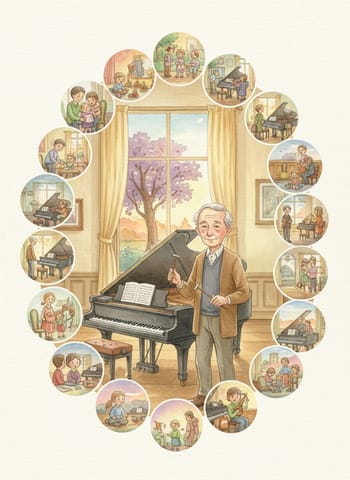
On the twenty-fifth visit there was almost nothing to do. Had anyone told him in that first spring that he would still be coming a quarter of a century later, he would have laughed. He had planned, then, to be tuning concert instruments in a bigger city by now. The piano had been played a little every day, he guessed, and then closed again. Veronika made tea and sat at the kitchen table while he worked, and the house had the quiet of a place that has been thoroughly used.
En la visita veinticinco casi no había nada que hacer. Si alguien le hubiera dicho aquella primera primavera que seguiría yendo un cuarto de siglo después, se habría reído. Entonces había planeado estar a estas alturas afinando instrumentos de concierto en una ciudad más grande. El piano se había tocado un poco cada día, supuso, y luego se había cerrado de nuevo. Veronika preparó té y se sentó a la mesa de la cocina mientras él trabajaba, y la casa tenía la quietud de un lugar que se ha usado a fondo.
He finished in an hour and ten minutes, twenty less than the first year had taken. When he played a single octave, up and down, she called through from the kitchen without coming in: "That's the one." At the door she handed him the cheque. He saw that she had already written next year's date at the top, in blue ink, with the care of someone who did not intend it as a question.
Terminó en una hora y diez minutos, veinte menos de lo que le había tomado el primer año. Cuando tocó una sola octava, subiendo y bajando, ella gritó desde la cocina sin entrar: «Esa es». En la puerta le entregó el cheque. Vio que ya había escrito la fecha del año siguiente en la parte superior, con tinta azul, con el cuidado de quien no pretendía que fuera una pregunta.