The Quiet Carriage
Una historia gratuita en inglés de nivel C1 para estudiantes, para leer en línea en 5 idiomas, con opción de escucharla en la app gratuita Storyteller.
A commuter who silently judges every rule-breaker in the quiet carriage overhears a whispered phone call that undermines her certainty.
¡Ese fue el avance! Escucha la historia completa en la app gratuita Storyteller. Descargar la app
El audio no está disponible en este momento.
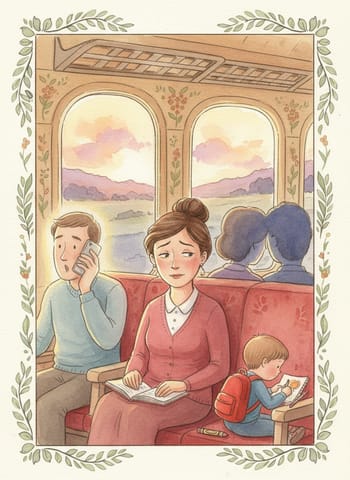
Liv has chosen the quiet carriage for the same reason she chooses most things: it promises that other people will behave. The sign above the door shows a face with a finger across its lips, and she settles beneath it with the satisfaction of someone who has, for once, read the instructions. Before the train has cleared the platform she has opened a mental file on the man opposite, who is eating crisps with the slow, wet commitment of a person alone in his kitchen.
Liv ha elegido el vagón silencioso por la misma razón por la que elige casi todo: promete que los demás se portarán bien. El cartel sobre la puerta muestra una cara con un dedo sobre los labios, y ella se acomoda debajo con la satisfacción de quien, por una vez, ha leído las instrucciones. Antes de que el tren salga del andén ya ha abierto un expediente mental sobre el hombre de enfrente, que come papas fritas con el compromiso lento y húmedo de quien está solo en su cocina.
The file grows. A woman across the aisle types as though she were arguing with her keyboard; a student's headphones leak a thin, insect hiss; somebody's bag occupies a seat as if it had paid for the ticket. Liv says nothing, naturally. Saying something would make her one of the people who cause scenes, and what she prefers, always, is the superior silence of the person keeping score.
El expediente crece. Una mujer al otro lado del pasillo teclea como si discutiera con su teclado; los audífonos de un estudiante dejan escapar un siseo fino, como de insecto; la bolsa de alguien ocupa un asiento como si hubiera pagado el boleto. Liv no dice nada, naturalmente. Decir algo la convertiría en una de esas personas que arman escándalos, y lo que ella prefiere, siempre, es el silencio superior de quien lleva la cuenta.
Forty minutes in, a man two rows ahead lifts a phone to his ear. Her stomach tightens in advance, and she is already composing the look she will give him when he speaks. But he cups his hand around the mouthpiece and, in a voice so low that she has to lean in against her own principles, he says, "Hello, bear. Is it story time already?"
A los cuarenta minutos, un hombre dos filas más adelante se lleva un teléfono a la oreja. A ella se le tensa el estómago de antemano, y ya está componiendo la mirada que le dirigirá cuando hable. Pero él se cubre la boca con la mano y, con una voz tan baja que ella debe inclinarse contra sus propios principios, dice: «Hola, osito. ¿Ya es hora del cuento?».
There is a pause while he listens, nodding at the seat in front of him. He explains, in a murmur that barely reaches her, that he is on the train and that the carriage has a rule about voices. Tonight, therefore, the story will be told in the small voice, the one bears use in winter. It would seem that somebody at the other end has agreed to these terms.
Hay una pausa mientras escucha, asintiendo hacia el asiento de enfrente. Explica, en un murmullo que apenas llega hasta ella, que está en el tren y que el vagón tiene una norma sobre las voces. Esta noche, por lo tanto, el cuento se contará con la voz pequeña, la que usan los osos en invierno. Parece que alguien al otro lado ha aceptado esas condiciones.
What strikes Liv is not the tenderness, which she would have expected to find irritating, but the care with which he is obeying the rule. He could have walked to the end of the carriage, where nothing forbids a phone call. Instead he has stayed in his seat, bent towards the window, spending an entire evening's voice through the narrowest possible channel. If she had been asked an hour earlier who in this carriage was breaking the rules, she would have named him first.
Lo que sorprende a Liv no es la ternura, que habría esperado encontrar irritante, sino el cuidado con que él obedece la norma. Podría haber caminado hasta el final del vagón, donde nada prohíbe una llamada. En cambio se ha quedado en su asiento, inclinado hacia la ventana, gastando la voz de toda una noche por el canal más estrecho posible. Si una hora antes le hubieran preguntado quién en ese vagón estaba infringiendo las reglas, lo habría nombrado a él primero.
The bear in the story, it turns out, is lost in a snowstorm and keeps arriving at the same fallen tree. Listening in against her will, Liv catches this in fragments, a word here, a rustle there. Only when the bear reaches home does she realise that she has stopped composing anything at all. The man opposite has folded his empty packet into a neat square. Even the woman with the keyboard has paused, hands hovering over the keys, in what might well be the first silence she has kept all journey.
El oso del cuento, resulta, está perdido en una tormenta de nieve y sigue llegando al mismo árbol caído. Escuchando a su pesar, Liv capta esto en fragmentos: una palabra aquí, un roce allá. Solo cuando el oso llega a casa se da cuenta de que ha dejado de componer cosa alguna. El hombre de enfrente ha doblado su bolsa vacía en un cuadrado perfecto. Hasta la mujer del teclado se ha detenido, con las manos suspendidas sobre las teclas, en lo que bien podría ser el primer silencio que guarda en todo el viaje.
Then the man ahead says goodnight three times, each one smaller than the last, and lowers the phone. Liv looks at her own phone, face down on the table, and at the note on it titled "Carriage offences", which runs to nine entries. At the next station he stands, collects his coat without a sound, and is gone.
Entonces el hombre de adelante dice buenas noches tres veces, cada una más pequeña que la anterior, y baja el teléfono. Liv mira el suyo, boca abajo sobre la mesa, y la nota que lleva por título «Faltas del vagón», que ya suma nueve entradas. En la siguiente estación él se levanta, recoge su abrigo sin hacer ruido y desaparece.
Liv watches the door close behind him. Then she turns to the man opposite and, in the smallest voice she owns, asks whether she might have one of his crisps.
Liv ve cerrarse la puerta tras él. Luego se vuelve hacia el hombre de enfrente y, con la voz más pequeña que tiene, le pregunta si podría aceptarle una de sus papas.