The Piano Tuner's Visits
A free C1-level English story for language learners, readable online in 5 languages, with an option to listen via the free Storyteller app.
Twenty-five yearly visits to tune the same family's piano trace the household's growth, absences and quiet changes.
That was the preview! Hear the full story in the free Storyteller app. Get the app
Audio isn't available right now.
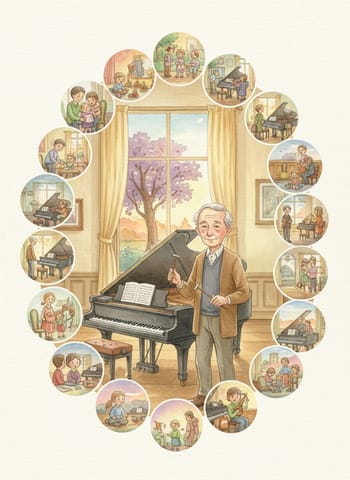
Lucien first tuned the upright in the front room the spring the family moved in, when the walls still smelled of paint. The piano stood on the wrong side of the room, against the wall that the radiator warmed. He mentioned this, and Veronika, the woman of the house, ignored him. It was a good instrument that had been neglected, flat by almost half a semitone. While he worked, a small boy lay on the floor beneath the keyboard with his ear against the wood, announcing each note as it changed. "That one's finished," he said whenever a string came into tune. Lucien, who had never been thanked so precisely, left a card on the lid.
By the fifth year the boy had a sister, and the lid was crowded with drawings and a bowl of keys. The sound had grown a little brash, the way a piano does when it is played hard with the windows open, the treble bright and forward. He softened the hammers, and Veronika, listening from the doorway, said it sounded like the house taking a breath, then apologised for the phrase. Lucien had learned long ago that people said their truest things about pianos and apologised for them afterwards.
By the tenth year it was the girl who practised, scales mostly, with a fury that Lucien came to recognise by the loose screws it left behind. The boy played only in the evenings now, badly at first and then not badly at all. In the thirteenth year the piano was in tune but the house was not: the father's coat no longer hung by the door, and nobody explained. Lucien, who had always understood that his work concerned the instrument and not the weather, tuned a little more slowly than he needed to.
Having let two winters pass without calling him, Veronika met him at the door in the nineteenth year with an apology that she delivered like a confession. Rarely had he found a piano so far out of tune and so little the worse for it; the silence had cost it pitch but nothing else. The children's names on the lid had been scrubbed down to ghosts. He said that pianos were more forgiving than people supposed, and she looked at him as if he had said something about herself.
The girl came home once, in the twenty-second year, and played something slow while he packed his tools. He waited in the hall until the last chord had faded and said nothing about the C sharp that had always been slightly sour. The boy lived somewhere else now. What Lucien noticed in these later years was not that the piano sounded sadder, because it didn't, but that it sounded rounder. It was like a voice that has stopped trying to be heard from the back of the room.
On the twenty-fifth visit there was almost nothing to do. Had anyone told him in that first spring that he would still be coming a quarter of a century later, he would have laughed. He had planned, then, to be tuning concert instruments in a bigger city by now. The piano had been played a little every day, he guessed, and then closed again. Veronika made tea and sat at the kitchen table while he worked, and the house had the quiet of a place that has been thoroughly used.
He finished in an hour and ten minutes, twenty less than the first year had taken. When he played a single octave, up and down, she called through from the kitchen without coming in: "That's the one." At the door she handed him the cheque. He saw that she had already written next year's date at the top, in blue ink, with the care of someone who did not intend it as a question.