The One-Line Review
Una historia gratuita en inglés de nivel C1 para estudiantes, para leer en línea en 5 idiomas, con opción de escucharla en la app gratuita Storyteller.
An exhausted restaurant critic files a one-line review that makes a tiny restaurant famous, then visits to see what he has done.
¡Ese fue el avance! Escucha la historia completa en la app gratuita Storyteller. Descargar la app
El audio no está disponible en este momento.
At two in the morning, with the deadline behind him and nothing ahead but a blank page and nine years of adjectives, Sindre files a review of a restaurant in exactly one line. "The soup was the only honest thing I was served this year." He reads it back, decides it is a kind of resignation letter, and sends it. Then he goes to bed.
A las dos de la madrugada, con la fecha de entrega a sus espaldas y nada por delante salvo una página en blanco y nueve años de adjetivos, Sindre entrega la reseña de un restaurante en exactamente una línea. «La sopa fue lo único honesto que me sirvieron este año». La relee, decide que es una especie de carta de renuncia y la envía. Luego se va a la cama.
Had he been less tired, he would have written six hundred words on texture, service and the lighting, and nobody would have read past the second paragraph. Never had so few words cost so much. By Wednesday strangers are quoting the line to him on the tram. By Friday the little place behind the fish market, nine tables, one cook, a pot of beans, has a queue around the block, and a television crew is filming the soup from three angles. What he had meant as a shrug has been received as a verdict.
De haber estado menos cansado, habría escrito seiscientas palabras sobre texturas, servicio e iluminación, y nadie habría pasado del segundo párrafo. Nunca tan pocas palabras habían costado tanto. El miércoles, desconocidos le citan la frase en el tranvía. El viernes, el pequeño local detrás de la lonja de pescado, nueve mesas, una cocinera, una olla de frijoles, tiene una cola que da la vuelta a la manzana, y un equipo de televisión filma la sopa desde tres ángulos. Lo que él había querido como un encogimiento de hombros ha sido recibido como un veredicto.
Sindre follows the news on his phone with the uneasy fascination of a man who coughed and set off an avalanche. Reservations at the Little Kettle are full until spring. A website has ranked the soup against other soups. His editor sends one message, in capitals, that says only: MORE OF THESE.
Sindre sigue las noticias en el teléfono con la inquieta fascinación de un hombre que tosió y desencadenó un alud. Las reservas en el Little Kettle están completas hasta la primavera. Un sitio web ha clasificado la sopa frente a otras sopas. Su editor le manda un solo mensaje, en mayúsculas, que dice únicamente: MÁS DE ESTOS.
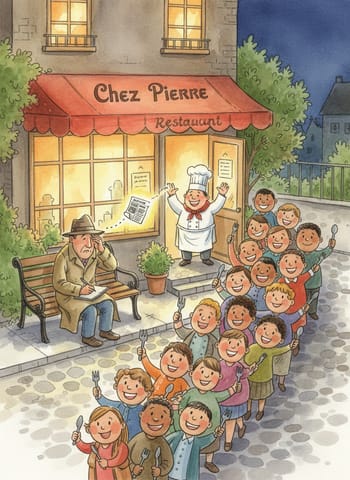
Three weeks later he goes to see what his line has done, in a scarf and a hat that make him look exactly like a critic in disguise. The queue is forty people long. A handwritten sign on the door says, NO PHOTOS OF THE SOUP, PLEASE, and beneath it, in a different pen, WE MEAN IT. Inside, twenty-six chairs have been wedged into a room built for nine. The soup now comes from a pot the size of a bathtub, and a young man in an apron carries bowls over his head like a waiter in a flood.
Tres semanas después va a ver lo que ha hecho su frase, con una bufanda y un sombrero que lo hacen parecer exactamente un crítico disfrazado. La cola es de cuarenta personas. Un cartel escrito a mano en la puerta dice: NO FOTOGRAFÍEN LA SOPA, POR FAVOR, y debajo, con otro bolígrafo: LO DECIMOS EN SERIO. Dentro, veintiséis sillas han sido embutidas en una sala construida para nueve. La sopa sale ahora de una olla del tamaño de una bañera, y un joven con delantal lleva los tazones por encima de la cabeza como un mesero en una inundación.
He waits two hours and eats. The soup is the same soup: plain, patient, a little salty, tasting of something that was cooked slowly by someone who did not expect to be watched. It is also, he suspects, tireder. Around him, people photograph it anyway, with a kind of reverent guilt, and he cannot decide whether he has done a good thing or merely a loud one.
Espera dos horas y come. La sopa es la misma sopa: sencilla, paciente, algo salada, con sabor a algo cocinado despacio por alguien que no esperaba ser observado. También está, sospecha, más cansada. A su alrededor, la gente la fotografía de todos modos, con una especie de culpa reverente, y él no logra decidir si ha hecho algo bueno o solo algo ruidoso.
When he puts down the spoon, the cook is standing beside the table. She is small and grey with fatigue, and she holds a ladle the way some people hold a handrail on a moving bus. "You're the one who wrote it," she says.
Cuando deja la cuchara, la cocinera está de pie junto a la mesa. Es pequeña y está gris de fatiga, y sostiene un cucharón como algunos se agarran de un pasamanos en un autobús en marcha. «Usted es el que lo escribió», dice.
"How did you know?"
«¿Cómo lo supo?»
"Nobody in nine years has finished a bowl looking that guilty." She pulls out the chair opposite and sits without asking. "I'm sold out until April. My nephew has quit twice. My mother has framed your line and hung it above the stove, where it gets splashed."
«En nueve años nadie ha terminado un plato con tanta cara de culpa». Saca la silla de enfrente y se sienta sin pedir permiso. «Estoy agotada hasta abril. Mi sobrino ha renunciado dos veces. Mi madre enmarcó su frase y la colgó sobre la cocina, donde se salpica».
"I'm sorry," Sindre says. "It was meant to be a throwaway."
«Lo siento», dice Sindre. «Se suponía que era algo sin importancia».
"Don't be sorry. I haven't slept since the first Tuesday."
«No lo sienta. No duermo desde el primer martes».
"Nor have I. That's why it was only one line."
«Yo tampoco. Por eso fue una sola línea».
The cook looks at him for a long moment, and something at the corner of her mouth gives way. Then she stands, takes an apron from a hook, and drops it into his lap along with a small, sharp knife.
La cocinera lo mira un largo momento, y algo se le afloja en la comisura de los labios. Luego se levanta, toma un delantal de un gancho y se lo deja caer en el regazo junto con un cuchillo pequeño y afilado.
"If it's honest you want," she says, "there's a sack of potatoes in the back."
«Si lo que quiere es honestidad», dice, «atrás hay un saco de papas».
He ties the apron on and follows her through the swing door.
Se ata el delantal y la sigue por la puerta batiente.