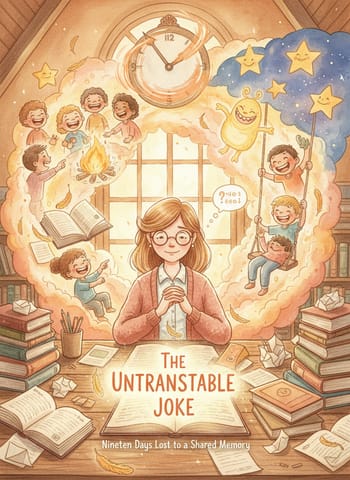
The Untranslatable Joke
Una historia gratuita en inglés de nivel C1 para estudiantes, para leer en línea en 5 idiomas, con opción de escucharla en la app gratuita Storyteller.
A literary translator loses nineteen days to a joke that depends on a shared childhood memory her readers do not have.
¡Ese fue el avance! Escucha la historia completa en la app gratuita Storyteller. Descargar la app
El audio no está disponible en este momento.
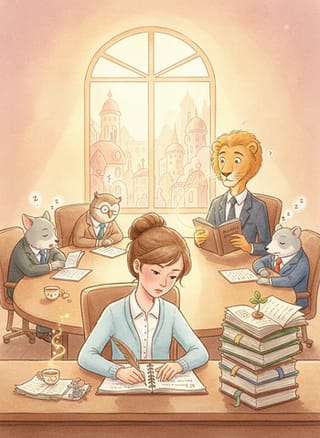
For nineteen days Maia has been stuck on a single line. It is not a long line: a character in the novel she is translating says three words to a bank clerk, and every reader of the original laughs. But the laugh depends on something her language does not contain. The three words are the opening of a children's radio programme that every child in that country heard at the same hour for forty years. The clerk, a stern woman, answers by humming the next phrase without noticing that she has done it.
Desde hace diecinueve días Maia está atascada en una sola línea. No es una línea larga: un personaje de la novela que traduce le dice tres palabras a un empleado de banco, y todos los lectores del original se ríen. Pero la risa depende de algo que su idioma no contiene. Las tres palabras son el inicio de un programa infantil de radio que todos los niños de ese país oyeron a la misma hora durante cuarenta años. La empleada, una mujer severa, responde tarareando la frase siguiente sin darse cuenta de que lo ha hecho.
Maia has tried the obvious things. A footnote explaining the programme kills the joke, which is rather like explaining an echo. A local equivalent, a jingle or a catchphrase or a nursery rhyme, feels false, because her readers' own childhoods would have to be moved into a foreign bank. She has tried leaving the line out, and the whole scene, which hangs from it, sags like a tent with one pole missing.
Maia ha probado lo obvio. Una nota al pie que explique el programa mata el chiste, lo cual es algo así como explicar un eco. Un equivalente local, un jingle o una muletilla o una canción de cuna, suena falso, porque la infancia de sus lectores tendría que trasladarse a un banco extranjero. Ha probado a omitir la línea, y toda la escena, que cuelga de ella, se hunde como una carpa a la que le falta un poste.
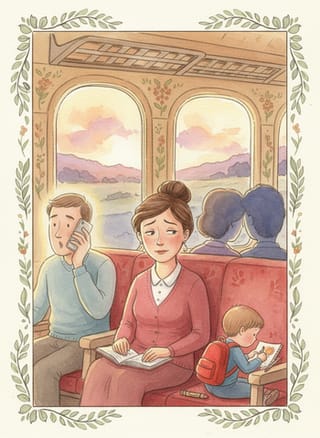
The obsession has begun to leak. She hums the theme tune, learned from a scratchy recording, in the supermarket queue, and watches the people around her with the odd hope that one of them will answer. On the bus she asks the driver whether any sentence makes him finish it automatically. After some thought he offers, "Please move down inside the vehicle," and looks startled by how quickly it came out. Rarely has a bus driver been thanked so warmly. Maia goes home to a page that has not changed.
La obsesión ha empezado a filtrarse. Tararea la melodía de apertura, aprendida de una grabación rayada, en la fila del supermercado, y observa a la gente a su alrededor con la rara esperanza de que alguien le responda. En el autobús le pregunta al conductor si hay alguna frase que lo haga completarla automáticamente. Tras pensarlo un momento ofrece: «Por favor, avancen hacia el fondo del vehículo», y parece asombrado de la rapidez con que le salió. Pocas veces se habrá agradecido tan calurosamente a un conductor de autobús. Maia vuelve a casa ante una página que no ha cambiado.
Her editor, on the phone, is kind and no help at all.
Su editor, por teléfono, es amable y no sirve de nada.
"It's one joke, Maia. Readers will survive."
«Es un solo chiste, Maia. Los lectores sobrevivirán».
"I know they will," Maia says. "It's not the readers I'm worried about."
«Lo sé», dice Maia. «No son los lectores lo que me preocupa».
What finally moves her is, absurdly, the memory of the supermarket. Standing in the queue on the twentieth morning, she understands that what made the original funny was never the programme itself. It was the instant of recognition passing through a room, the sudden proof that these strangers had once been the same child. Her readers will never have that proof, but they can watch it happen to somebody else. Had she been less tired, she might have seen it on the second day.
Lo que por fin la mueve es, absurdamente, el recuerdo del supermercado. De pie en la fila la mañana veinte, comprende que lo que hacía gracioso al original nunca fue el programa en sí. Fue el instante de reconocimiento recorriendo una sala, la prueba repentina de que esos desconocidos habían sido alguna vez el mismo niño. Sus lectores nunca tendrán esa prueba, pero pueden ver cómo le ocurre a otra persona. Si hubiera estado menos cansada, tal vez lo habría visto el segundo día.
So she leaves the three words exactly as they are, unexplained, and adds only what the room does next. The clerk hums. A man behind the speaker sets down his pen. A woman stops in the middle of a sentence, and for a moment the whole bank is perfectly silent, like a congregation that has been reminded of something. The English reader will not know why. The English reader will know only that a thing has passed between strangers that they were not invited to share. That, she suspects, is the joke's real mechanism; the laughing was only one way of showing it.
Así que deja las tres palabras exactamente como están, sin explicar, y añade solo lo que hace la sala a continuación. La empleada tararea. Un hombre detrás del que habla deja su pluma. Una mujer se interrumpe a mitad de una frase, y por un momento todo el banco queda en perfecto silencio, como una congregación a la que le han recordado algo. El lector no sabrá por qué. Sabrá solamente que algo ha pasado entre desconocidos y que no estaba invitado a compartirlo. Ese, sospecha, es el verdadero mecanismo del chiste; la risa era solo una forma de mostrarlo.
It takes forty minutes to type. Having lost nineteen days to the problem, she is faintly insulted that the solution takes less time than a kettle. She sends the page to her editor with a single line beneath it: "It is not as funny as the original. It is, I think, as accurate, and I'm beginning to suspect that comes to the same thing."
Le toma cuarenta minutos teclearlo. Habiendo perdido diecinueve días con el problema, se siente ligeramente insultada de que la solución lleve menos tiempo que una tetera. Envía la página a su editor con una sola línea debajo: «No es tan graciosa como el original. Es, creo, igual de exacta, y empiezo a sospechar que viene a ser lo mismo».