The One-Line Review
A free C1-level English story for language learners, readable online in 5 languages, with an option to listen via the free Storyteller app.
An exhausted restaurant critic files a one-line review that makes a tiny restaurant famous, then visits to see what he has done.
That was the preview! Hear the full story in the free Storyteller app. Get the app
Audio isn't available right now.
At two in the morning, with the deadline behind him and nothing ahead but a blank page and nine years of adjectives, Sindre files a review of a restaurant in exactly one line. "The soup was the only honest thing I was served this year." He reads it back, decides it is a kind of resignation letter, and sends it. Then he goes to bed.
Had he been less tired, he would have written six hundred words on texture, service and the lighting, and nobody would have read past the second paragraph. Never had so few words cost so much. By Wednesday strangers are quoting the line to him on the tram. By Friday the little place behind the fish market, nine tables, one cook, a pot of beans, has a queue around the block, and a television crew is filming the soup from three angles. What he had meant as a shrug has been received as a verdict.
Sindre follows the news on his phone with the uneasy fascination of a man who coughed and set off an avalanche. Reservations at the Little Kettle are full until spring. A website has ranked the soup against other soups. His editor sends one message, in capitals, that says only: MORE OF THESE.
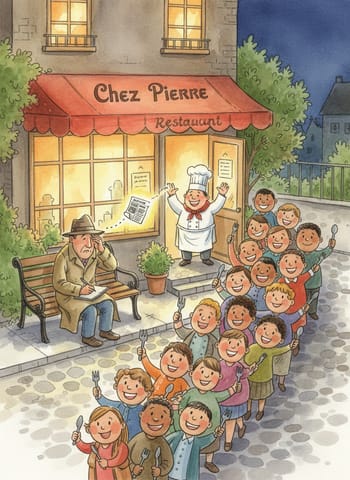
Three weeks later he goes to see what his line has done, in a scarf and a hat that make him look exactly like a critic in disguise. The queue is forty people long. A handwritten sign on the door says, NO PHOTOS OF THE SOUP, PLEASE, and beneath it, in a different pen, WE MEAN IT. Inside, twenty-six chairs have been wedged into a room built for nine. The soup now comes from a pot the size of a bathtub, and a young man in an apron carries bowls over his head like a waiter in a flood.
He waits two hours and eats. The soup is the same soup: plain, patient, a little salty, tasting of something that was cooked slowly by someone who did not expect to be watched. It is also, he suspects, tireder. Around him, people photograph it anyway, with a kind of reverent guilt, and he cannot decide whether he has done a good thing or merely a loud one.
When he puts down the spoon, the cook is standing beside the table. She is small and grey with fatigue, and she holds a ladle the way some people hold a handrail on a moving bus. "You're the one who wrote it," she says.
"How did you know?"
"Nobody in nine years has finished a bowl looking that guilty." She pulls out the chair opposite and sits without asking. "I'm sold out until April. My nephew has quit twice. My mother has framed your line and hung it above the stove, where it gets splashed."
"I'm sorry," Sindre says. "It was meant to be a throwaway."
"Don't be sorry. I haven't slept since the first Tuesday."
"Nor have I. That's why it was only one line."
The cook looks at him for a long moment, and something at the corner of her mouth gives way. Then she stands, takes an apron from a hook, and drops it into his lap along with a small, sharp knife.
"If it's honest you want," she says, "there's a sack of potatoes in the back."
He ties the apron on and follows her through the swing door.