The Lifeguard Test
Una historia gratuita en inglés de nivel B1 para estudiantes, para leer en línea en 5 idiomas, con opción de escucharla en la app gratuita Storyteller.
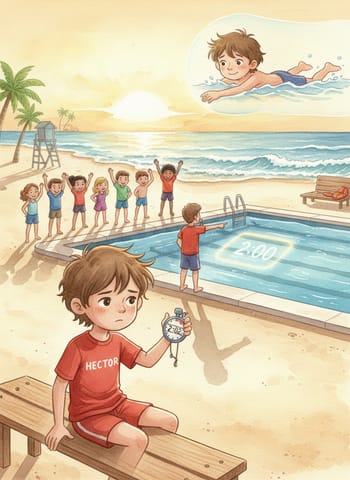
Hector misses the lifeguard swim test by two seconds and learns to pace himself for a second try.
¡Ese fue el avance! Escucha la historia completa en la app gratuita Storyteller. Descargar la app
El audio no está disponible en este momento.
Hector had practiced all spring for the lifeguard swim test. The summer job at the town pool needed three hundred meters in under six minutes. In training, he had done it easily. On the day of the test, he wanted to start strong. When the whistle blew, he pushed off the wall like a rocket.
Hector había practicado toda la primavera para la prueba de natación de salvavidas. El trabajo de verano en la piscina del pueblo exigía trescientos metros en menos de seis minutos. En los entrenamientos lo había logrado con facilidad. El día de la prueba quiso empezar con fuerza. Cuando sonó el silbato, se impulsó desde la pared como un cohete.
The first lap felt great. By the second, his arms were heavy. By the last one, he was barely moving, and his breath burned in his chest. He touched the wall and looked up at the instructor.
La primera vuelta se sintió genial. En la segunda, los brazos ya le pesaban. En la última apenas se movía, y la respiración le ardía en el pecho. Tocó la pared y miró a la instructora.
"Six minutes and two seconds," she said, holding up her stopwatch. "Two seconds too slow. You can try again in three weeks."
«Seis minutos y dos segundos», dijo ella, levantando su cronómetro. «Dos segundos de más. Puedes intentarlo de nuevo en tres semanas».
His friends had all passed. They left for the snack stand, laughing. Hector sat on a bench with a wet towel over his shoulders. He felt like he had lost the whole summer because of two seconds.
Todos sus amigos habían aprobado. Se fueron al puesto de bocadillos, riéndose. Hector se sentó en una banca con una toalla mojada sobre los hombros. Sentía que había perdido todo el verano por dos segundos.
"You swam the first lap like someone was chasing you," said a voice behind him. It was Signe, one of the older lifeguards, who was putting away the pool ropes. "Then you spent the last lap holding on for dear life."
«Nadaste la primera vuelta como si alguien te persiguiera», dijo una voz detrás de él. Era Signe, una de las salvavidas mayores, que estaba guardando las cuerdas de la piscina. «Y luego pasaste la última vuelta agarrándote como pudiste».
"I wanted a good start," Hector said.
«Quería empezar bien», dijo Hector.
"A good start is the easy part. Pace is a skill, and nobody ever teaches it." She sat down next to him. "Split the swim into three equal parts. Breathe every third stroke. And if the first lap feels too easy, it means you are doing it right."
«Empezar bien es lo fácil. Dosificar el esfuerzo es una habilidad, y nadie la enseña». Se sentó a su lado. «Divide la nadada en tres partes iguales. Respira cada tres brazadas. Y si la primera vuelta te parece demasiado fácil, significa que lo estás haciendo bien».
For the next three weeks, Hector came to the pool at seven every morning. He borrowed a cheap stopwatch from his father's drawer. At first, he hated the new method. Swimming slowly felt like losing on purpose, and he had to fight the urge to speed up.
Durante las siguientes tres semanas, Hector llegó a la piscina todas las mañanas a las siete. Tomó prestado un cronómetro barato del cajón de su padre. Al principio odiaba el nuevo método. Nadar despacio se sentía como perder a propósito, y tenía que luchar contra las ganas de acelerar.
Signe watched from the lifeguard chair and called out his times. By the second week, his laps were almost the same. By the third, they were within three seconds of each other. He wrote his target times on his wrist with a pen. That way, he could check them at every wall.
Signe lo observaba desde la silla de salvavidas y le gritaba sus tiempos. Para la segunda semana, sus vueltas eran casi iguales. Para la tercera, había menos de tres segundos de diferencia entre ellas. Escribió sus tiempos objetivo en la muñeca con un bolígrafo. Así podía revisarlos en cada pared.
On the day of the second test, the first lap felt too easy again. His arms wanted to go faster. He looked at his wrist, took a breath, and stayed calm. In the final lap, he still had energy left. He used all of it in the last fifty meters.
El día de la segunda prueba, la primera vuelta volvió a sentirse demasiado fácil. Sus brazos querían ir más rápido. Miró su muñeca, respiró y se mantuvo tranquilo. En la última vuelta todavía le quedaba energía. La usó toda en los últimos cincuenta metros.
"Five minutes and forty-one seconds," the instructor said.
«Cinco minutos y cuarenta y un segundos», dijo la instructora.
Hector climbed out of the water, shaking. High up in the chair, Signe held up a thumb. Later, she threw him a red whistle. "Welcome to the chair," she said.
Hector salió del agua, temblando. Arriba, en la silla, Signe levantó el pulgar. Más tarde le lanzó un silbato rojo. «Bienvenido a la silla», dijo.