The Lifeguard Test
A free B1-level English story for language learners, readable online in 5 languages, with an option to listen via the free Storyteller app.
Hector misses the lifeguard swim test by two seconds and learns to pace himself for a second try.
That was the preview! Hear the full story in the free Storyteller app. Get the app
Audio isn't available right now.
Hector had practiced all spring for the lifeguard swim test. The summer job at the town pool needed three hundred meters in under six minutes. In training, he had done it easily. On the day of the test, he wanted to start strong. When the whistle blew, he pushed off the wall like a rocket.
The first lap felt great. By the second, his arms were heavy. By the last one, he was barely moving, and his breath burned in his chest. He touched the wall and looked up at the instructor.
"Six minutes and two seconds," she said, holding up her stopwatch. "Two seconds too slow. You can try again in three weeks."
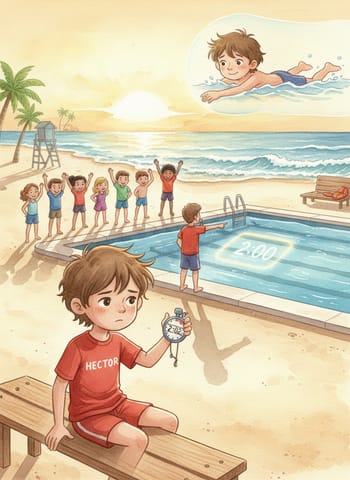
His friends had all passed. They left for the snack stand, laughing. Hector sat on a bench with a wet towel over his shoulders. He felt like he had lost the whole summer because of two seconds.
"You swam the first lap like someone was chasing you," said a voice behind him. It was Signe, one of the older lifeguards, who was putting away the pool ropes. "Then you spent the last lap holding on for dear life."
"I wanted a good start," Hector said.
"A good start is the easy part. Pace is a skill, and nobody ever teaches it." She sat down next to him. "Split the swim into three equal parts. Breathe every third stroke. And if the first lap feels too easy, it means you are doing it right."
For the next three weeks, Hector came to the pool at seven every morning. He borrowed a cheap stopwatch from his father's drawer. At first, he hated the new method. Swimming slowly felt like losing on purpose, and he had to fight the urge to speed up.
Signe watched from the lifeguard chair and called out his times. By the second week, his laps were almost the same. By the third, they were within three seconds of each other. He wrote his target times on his wrist with a pen. That way, he could check them at every wall.
On the day of the second test, the first lap felt too easy again. His arms wanted to go faster. He looked at his wrist, took a breath, and stayed calm. In the final lap, he still had energy left. He used all of it in the last fifty meters.
"Five minutes and forty-one seconds," the instructor said.
Hector climbed out of the water, shaking. High up in the chair, Signe held up a thumb. Later, she threw him a red whistle. "Welcome to the chair," she said.