A Burlesque Biography
A free B2-level English story for language learners, readable online in 7 languages, with an option to listen via the free Storyteller app.
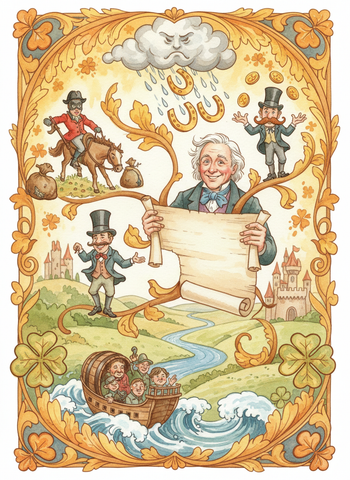
Mark Twain traces his 'noble' family tree through a parade of highwaymen, con men, and stowaways — proving his ancestors' criminal talents were matched only by their spectacularly bad luck.
Two or three persons having at different times intimated that if I would write an autobiography they would read it when they got leisure, I yield at last to this frenzied public demand and herewith tender my history.
Habiendo dos o tres personas insinuado en distintas ocasiones que si yo escribiera una autobiografía la leerían cuando tuvieran tiempo libre, cedo al fin a esta enfebrecida demanda pública y presento aquí mi historia.
Ours is a noble house, and stretches a long way back into antiquity. The earliest ancestor the Twains have any record of was a friend of the family by the name of Higgins. This was in the eleventh century, when our people were living in Aberdeen, county of Cork, England. Why it is that our long line has ever since borne the maternal name (except when one of them now and then took a playful refuge in an alias to avert foolishness), instead of Higgins, is a mystery which none of us has ever felt much desire to stir. It is a kind of vague, pretty romance, and we leave it alone. All the old families do that way.
La nuestra es una casa noble, y se remonta muy atrás en la antigüedad. El antepasado más antiguo del que los Twain tienen registro fue un amigo de la familia llamado Higgins. Esto fue en el siglo XI, cuando nuestra gente vivía en Aberdeen, condado de Cork, Inglaterra. Por qué nuestro largo linaje ha llevado desde entonces el apellido materno (salvo cuando alguno de ellos, de vez en cuando, tomaba refugio jocoso en un alias para evitar tonterías), en lugar de Higgins, es un misterio que ninguno de nosotros ha sentido gran deseo de remover. Es una especie de romance vago y bonito, y lo dejamos en paz. Todas las familias antiguas hacen lo mismo.
Arthour Twain was a man of considerable note—a solicitor on the highway in William Rufus's time. At about the age of thirty he went to one of those fine old English places of resort called Newgate, to see about something, and never returned again. While there he died suddenly.
Arthour Twain fue un hombre de considerable renombre—un procurador de camino en tiempos de Guillermo el Rojo. A eso de los treinta años fue a uno de esos hermosos y antiguos lugares de recreo ingleses llamado Newgate, para ver sobre algún asunto, y nunca regresó. Mientras estuvo allí, murió repentinamente.
Augustus Twain seems to have made something of a stir about the year 1160. He was as full of fun as he could be, and used to take his old saber and sharpen it up, and get in a convenient place on a dark night, and stick it through people as they went by, to see them jump. He was a born humorist.
Augustus Twain parece haber causado cierto revuelo hacia el año 1160. Era tan divertido como se pueda imaginar, y solía tomar su vieja sable y afilarla, y ponerse en un lugar conveniente en una noche oscura, y atravesar con ella a la gente que pasaba, para verlos dar un salto. Era un humorista nato.
But he got to going too far with it; and the first time he was found stripping one of these parties, the authorities removed one end of him, and put it up on a nice high place on Temple Bar, where it could contemplate the people and have a good time. He never liked any situation so much or stuck to it so long.
Pero llegó a excederse con esto; y la primera vez que lo sorprendieron despojando a una de estas personas, las autoridades le quitaron un extremo, y lo pusieron en un buen lugar elevado en Temple Bar, donde podía contemplar a la gente y pasarlo bien. Nunca le gustó tanto ninguna situación ni se aferró a ella tanto tiempo.
Then for the next two hundred years the family tree shows a succession of soldiers—noble, high-spirited fellows, who always went into battle singing, right behind the army, and always went out a-whooping, right ahead of it.
Luego, durante los siguientes doscientos años, el árbol genealógico muestra una sucesión de soldados—nobles muchachos de gran ánimo, que siempre entraban en batalla cantando, justo detrás del ejército, y siempre salían dando alaridos, justo delante de él.
This is a scathing rebuke to old dead Froissart's poor witticism that our family tree never had but one limb to it, and that that one stuck out at right angles, and bore fruit winter and summer.
Esto es un reproche mordaz a la pobre ocurrencia del viejo y difunto Froissart, de que nuestro árbol genealógico nunca tuvo más que una sola rama, y que esa sobresalía en ángulo recto, y daba fruto tanto en invierno como en verano.
Early in the fifteenth century we have Beau Twain, called “the Scholar.” He wrote a beautiful, beautiful hand. And he could imitate anybody's hand so closely that it was enough to make a person laugh his head off to see it. He had infinite sport with his talent. But by and by he took a contract to break stone for a road, and the roughness of the work spoiled his hand. Still, he enjoyed life all the time he was in the stone business, which, with inconsiderable intervals, was some forty-two years. In fact, he died in harness.
A principios del siglo XV tenemos a Beau Twain, llamado «el Erudito». Escribía una letra hermosa, hermosísima. Y podía imitar la letra de cualquiera con tanta precisión que era suficiente para hacer que uno se muriera de risa al verlo. Se divertía muchísimo con su talento. Pero al poco tiempo tomó un contrato para picar piedra para un camino, y la aspereza del trabajo le echó a perder la mano. Aun así, disfrutó de la vida todo el tiempo que estuvo en el negocio de la piedra, que, con intervalos insignificantes, fueron unos cuarenta y dos años. De hecho, murió en el arnés.
During all those long years he gave such satisfaction that he never was through with one contract a week till the government gave him another. He was a perfect pet. And he was always a favorite with his fellow-artists, and was a conspicuous member of their benevolent secret society, called the Chain Gang. He always wore his hair short, had a preference for striped clothes, and died lamented by the government. He was a sore loss to his country. For he was so regular.
Durante todos esos largos años dio tanta satisfacción que nunca terminaba un contrato en una semana sin que el gobierno le diera otro. Era una auténtica mascota. Y siempre fue muy apreciado por sus compañeros artistas, y fue un miembro destacado de su benévola sociedad secreta, llamada la Cuadrilla de Cadenas. Siempre llevaba el cabello corto, tenía preferencia por la ropa a rayas, y murió llorado por el gobierno. Fue una gran pérdida para su país. Pues era tan puntual.
Some years later we have the illustrious John Morgan Twain. He came over to this country with Columbus in 1492 as a passenger. He appears to have been of a crusty, uncomfortable disposition. He complained of the food all the way over, and was always threatening to go ashore unless there was a change. He wanted fresh shad.
Algunos años después tenemos al ilustre John Morgan Twain. Vino a este país con Colón en 1492 como pasajero. Parece haber tenido un carácter huraño e incómodo. Se quejó de la comida durante toda la travesía, y siempre amenazaba con desembarcar si no había un cambio. Quería sábalo fresco.
Hardly a day passed over his head that he did not go idling about the ship with his nose in the air, sneering about the commander, and saying he did not believe Columbus knew where he was going to or had ever been there before. The memorable cry of “Land ho!” thrilled every heart in the ship but his. He gazed awhile through a piece of smoked glass at the penciled line lying on the distant water, and then said: “Land be hanged—it's a raft!”
Apenas pasaba un día sin que anduviera ocioso por el barco con la nariz levantada, burlándose del comandante, y diciendo que no creía que Colón supiera adónde se dirigía ni que hubiera estado allí antes. El memorable grito de «¡Tierra a la vista!» estremeció todos los corazones del barco menos el suyo. Miró un rato a través de un trozo de vidrio ahumado la línea trazada sobre el agua distante, y luego dijo: «Al diablo con la tierra—¡es una balsa!».
When this questionable passenger came on board the ship, he brought nothing with him but an old newspaper containing a handkerchief marked “B. G.,” one cotton sock marked “L. W. C.,” one woolen one marked “D. F.,” and a night-shirt marked “O. M. R.” And yet during the voyage he worried more about his “trunk,” and gave himself more airs about it, than all the rest of the passengers put together. If the ship was “down by the head,” and would not steer, he would go and move his “trunk” further aft, and then watch the effect. If the ship was “by the stern,” he would suggest to Columbus to detail some men to “shift that baggage.”
Cuando este dudoso pasajero subió a bordo del barco, no trajo consigo más que un viejo periódico que contenía un pañuelo marcado «B. G.», un calcetín de algodón marcado «L. W. C.», uno de lana marcado «D. F.», y un camisón de dormir marcado «O. M. R.». Y sin embargo, durante el viaje se preocupó más por su «baúl», y se dio más aires al respecto, que todos los demás pasajeros juntos. Si el barco iba «hundido de proa» y no obedecía al timón, iba y movía su «baúl» más hacia la popa, y luego observaba el efecto. Si el barco iba «hundido de popa», le sugería a Colón que destinara a algunos hombres a «cambiar ese equipaje».
In storms he had to be gagged, because his wailings about his “trunk” made it impossible for the men to hear the orders. The man does not appear to have been openly charged with any gravely unbecoming thing, but it is noted in the ship's log as a “curious circumstance” that albeit he brought his baggage on board the ship in a newspaper, he took it ashore in four trunks, a queensware crate, and a couple of champagne baskets. But when he came back insinuating, in an insolent, swaggering way, that some of this things were missing, and was going to search the other passengers' baggage, it was too much, and they threw him overboard.
En las tormentas había que amordazarlo, porque sus lamentos por su «baúl» hacían imposible que los hombres oyeran las órdenes. El hombre no parece haber sido acusado abiertamente de nada gravemente indecoroso, pero se anota en el diario de a bordo, como una «curiosa circunstancia», que aunque llevó su equipaje a bordo del barco en un periódico, lo bajó a tierra en cuatro baúles, un cajón de loza y un par de canastas de champán. Pero cuando volvió insinuando, de manera insolente y fanfarrona, que le faltaban algunas de sus cosas, y se disponía a registrar el equipaje de los demás pasajeros, ya fue demasiado, y lo arrojaron por la borda.
They watched long and wonderingly for him to come up, but not even a bubble rose on the quietly ebbing tide. But while every one was most absorbed in gazing over the side, and the interest was momentarily increasing, it was observed with consternation that the vessel was adrift and the anchor-cable hanging limp from the bow. Then in the ship's dimmed and ancient log we find this quaint note:
Vigilaron durante largo rato y con asombro esperando que subiera a la superficie, pero ni siquiera una burbuja se alzó en la marea que bajaba tranquilamente. Pero mientras todos estaban más absortos mirando por la borda, y el interés aumentaba por momentos, se observó con consternación que el barco iba a la deriva y el cable del ancla colgaba flojo desde la proa. Entonces, en el diario de a bordo, viejo y desvaído, encontramos esta curiosa nota:
“In time it was discouvered yt ye troblesome passenger hadde gone downe and got ye anchor, and toke ye same and solde it to ye dam sauvages from ye interior, saying yt he hadde founde it, ye sonne of a ghun!”
«En su momento se descubrió que el molesto pasajero había bajado y sacado el ancla, y la había tomado y vendido a los malditos salvajes del interior, diciendo que la había encontrado, ¡el muy sinvergüenza!».
Yet this ancestor had good and noble instincts, and it is with pride that we call to mind the fact that he was the first white person who ever interested himself in the work of elevating and civilizing our Indians. He built a commodious jail and put up a gallows, and to his dying day he claimed with satisfaction that he had had a more restraining and elevating influence on the Indians than any other reformer that ever labored among them.
Sin embargo, este antepasado tenía buenos y nobles instintos, y es con orgullo que recordamos el hecho de que fue la primera persona blanca que se interesó en la obra de elevar y civilizar a nuestros indios. Construyó una espaciosa cárcel y levantó una horca, y hasta el día de su muerte afirmaba con satisfacción que había tenido una influencia más moderadora y edificante sobre los indios que cualquier otro reformador que jamás hubiera trabajado entre ellos.
At this point the chronicle becomes less frank and chatty, and closes abruptly by saying that the old voyager went to see his gallows perform on the first white man ever hanged in America, and while there received injuries which terminated in his death.
En este punto la crónica se vuelve menos franca y locuaz, y termina abruptamente diciendo que el viejo navegante fue a ver funcionar su horca con el primer hombre blanco ahorcado en América, y que allí sufrió heridas que terminaron en su muerte.
The great-grandson of the “Reformer” flourished in sixteen hundred and something, and was known in our annals as “the old Admiral,” though in history he had other titles. He was long in command of fleets of swift vessels, well armed and manned, and did great service in hurrying up merchantmen. Vessels which he followed and kept his eagle eye on, always made good fair time across the ocean. But if a ship still loitered in spite of all he could do, his indignation would grow till he could contain himself no longer—and then he would take that ship home where he lived and keep it there carefully, expecting the owners to come for it, but they never did.
El bisnieto del «Reformador» floreció en mil seiscientos y tantos, y fue conocido en nuestros anales como «el viejo Almirante», aunque en la historia tuvo otros títulos. Estuvo largo tiempo al mando de flotas de veloces naves, bien armadas y tripuladas, y prestó gran servicio apresurando a los buques mercantes. Los navíos que perseguía y a los que no quitaba su ojo de águila, siempre hacían una travesía rápida y decente por el océano. Pero si un barco seguía rezagándose a pesar de todo lo que él pudiera hacer, su indignación crecía hasta que ya no podía contenerse—y entonces se llevaba ese barco a casa, donde vivía, y lo guardaba allí con esmero, esperando que los dueños vinieran a buscarlo, pero nunca lo hacían.
And he would try to get the idleness and sloth out of the sailors of that ship by compelling them to take invigorating exercise and a bath. He called it “walking a plank.” All the pupils liked it. At any rate, they never found any fault with it after trying it. When the owners were late coming for their ships, the Admiral always burned them, so that the insurance money should not be lost. At last this fine old tar was cut down in the fullness of his years and honors. And to her dying day, his poor heart-broken widow believed that if he had been cut down fifteen minutes sooner he might have been resuscitated.
Y trataba de sacarles la ociosidad y la pereza a los marineros de ese barco obligándolos a tomar un vigorizante ejercicio y un baño. Él lo llamaba «caminar por la tabla». A todos los alumnos les gustaba. En todo caso, nunca le encontraron ningún defecto después de probarlo. Cuando los dueños tardaban en venir por sus barcos, el Almirante siempre los quemaba, para que no se perdiera el dinero del seguro. Al fin este buen y viejo lobo de mar fue derribado en la plenitud de sus años y honores. Y hasta el día de su muerte, su pobre y desconsolada viuda creyó que si lo hubieran descolgado quince minutos antes, quizás lo habrían resucitado.
Charles Henry Twain lived during the latter part of the seventeenth century, and was a zealous and distinguished missionary. He converted sixteen thousand South Sea islanders, and taught them that a dog-tooth necklace and a pair of spectacles was not enough clothing to come to divine service in. His poor flock loved him very, very dearly; and when his funeral was over, they got up in a body (and came out of the restaurant) with tears in their eyes, and saying, one to another, that he was a good tender missionary, and they wished they had some more of him.
Charles Henry Twain vivió durante la última parte del siglo XVII, y fue un misionero celoso y distinguido. Convirtió a dieciséis mil isleños de los Mares del Sur, y les enseñó que un collar de dientes de perro y un par de anteojos no era suficiente ropa para presentarse a los oficios divinos. Su pobre rebaño lo amaba muchísimo, muchísimo; y cuando terminó su funeral, se levantaron en grupo (y salieron del restaurante) con lágrimas en los ojos, y diciéndose unos a otros que había sido un misionero bueno y tierno, y que ojalá tuvieran otro como él.
Pah-go-to-wah-wah-pukketekeewis (Mighty-Hunter-with-a-Hog-Eye-Twain) adorned the middle of the eighteenth century, and aided General Braddock with all his heart to resist the oppressor Washington. It was this ancestor who fired seventeen times at our Washington from behind a tree. So far the beautiful romantic narrative in the moral story-books is correct; but when that narrative goes on to say that at the seventeenth round the awe-stricken savage said solemnly that that man was being reserved by the Great Spirit for some mighty mission, and he dared not lift his sacrilegious rifle against him again, the narrative seriously impairs the integrity of history. What he did say was:
Pah-go-to-wah-wah-pukketekeewis (Cazador-Poderoso-de-Ojo-de-Cerdo-Twain) adornó a mediados del siglo XVIII, y ayudó al General Braddock con todo su corazón a resistir al opresor Washington. Fue este antepasado quien disparó diecisiete veces contra nuestro Washington desde detrás de un árbol. Hasta aquí, el hermoso y romántico relato de los libros morales de historias es correcto; pero cuando ese relato continúa diciendo que en el disparo número diecisiete el salvaje, sobrecogido de temor, dijo solemnemente que aquel hombre estaba siendo reservado por el Gran Espíritu para alguna misión poderosa, y que no se atrevía a levantar su sacrílego fusil contra él de nuevo, el relato compromete seriamente la integridad de la historia. Lo que en realidad dijo fue:
“It ain't no (hic) no use. 'At man's so drunk he can't stan' still long enough for a man to hit him. I (hic) I can't 'ford to fool away any more am'nition on him.”
«No sirve de (hip) de nada. Ese hombre está tan borracho que no puede estarse quieto lo suficiente como para que un hombre le dé. Yo (hip) no puedo darme el lujo de malgastar más munición en él».
That was why he stopped at the seventeenth round, and it was a good, plain, matter-of-fact reason, too, and one that easily commends itself to us by the eloquent, persuasive flavor of probability there is about it.
Por eso se detuvo en el disparo número diecisiete, y esa fue una razón buena, sencilla, práctica, además, y una que fácilmente se nos recomienda por el elocuente y persuasivo sabor de probabilidad que tiene.
I also enjoyed the story-book narrative, but I felt a marring misgiving that every Indian at Braddock's Defeat who fired at a soldier a couple of times (two easily grows to seventeen in a century), and missed him, jumped to the conclusion that the Great Spirit was reserving that soldier for some grand mission; and so I somehow feared that the only reason why Washington's case is remembered and the others forgotten is, that in his the prophecy came true, and in that of the others it didn't.
Yo también disfruté del relato de los libros de historias, pero sentí un recelo perturbador: que todo indio en la Derrota de Braddock que disparó contra un soldado un par de veces (dos fácilmente se convierten en diecisiete al cabo de un siglo), y falló, saltó a la conclusión de que el Gran Espíritu estaba reservando a ese soldado para alguna gran misión; y así, de alguna manera, temí que la única razón por la que el caso de Washington se recuerda y los demás se olvidan es que en el suyo la profecía se cumplió, y en el de los demás no.
There are not books enough on earth to contain the record of the prophecies Indians and other unauthorized parties have made; but one may carry in his overcoat pockets the record of all the prophecies that have been fulfilled.
No hay libros suficientes en la tierra para contener el registro de las profecías que los indios y otras partes no autorizadas han hecho; pero uno puede llevar en los bolsillos del abrigo el registro de todas las profecías que se han cumplido.
I will remark here, in passing, that certain ancestors of mine are so thoroughly well-known in history by their aliases, that I have not felt it to be worth while to dwell upon them, or even mention them in the order of their birth.
Señalaré aquí, de paso, que ciertos antepasados míos son tan plenamente conocidos en la historia por sus alias, que no he sentido que valiera la pena detenerme en ellos, ni siquiera mencionarlos en el orden de su nacimiento.
Among these may be mentioned Richard Brinsley Twain, alias Guy Fawkes; John Wentworth Twain, alias Sixteen-String Jack; William Hogarth Twain, alias Jack Sheppard; Ananias Twain, alias Baron Munchausen; John George Twain, alias Captain Kydd; and then there are George Francis Twain, Tom Pepper, Nebuchadnezzar, and Baalam's Ass—they all belong to our family, but to a branch of it somewhat distinctly removed from the honorable direct line—in fact, a collateral branch, whose members chiefly differ from the ancient stock in that, in order to acquire the notoriety we have always yearned and hungered for, they have got into a low way of going to jail instead of getting hanged.
Entre ellos se pueden mencionar a Richard Brinsley Twain, alias Guy Fawkes; John Wentworth Twain, alias Jack Dieciséis-Cordones; William Hogarth Twain, alias Jack Sheppard; Ananías Twain, alias el Barón de Münchhausen; John George Twain, alias el Capitán Kydd; y luego están George Francis Twain, Tom Pepper, Nabucodonosor, y la Burra de Balaam—todos pertenecen a nuestra familia, pero a una rama de ella algo distintamente alejada de la honorable línea directa—de hecho, una rama colateral, cuyos miembros se diferencian principalmente del tronco antiguo en que, a fin de alcanzar la notoriedad que siempre hemos ansiado y anhelado, han adoptado la baja costumbre de ir a la cárcel en lugar de terminar ahorcados.
It is not well, when writing an autobiography, to follow your ancestry down too close to your own time—it is safest to speak only vaguely of your great-grandfather, and then skip from there to yourself, which I now do.
No conviene, al escribir una autobiografía, seguir la propia ascendencia demasiado cerca de la propia época—lo más seguro es hablar solo vagamente de tu bisabuelo, y luego saltar de ahí a ti mismo, lo cual hago ahora.
I was born without teeth—and there Richard III. had the advantage of me; but I was born without a humpback, likewise, and there I had the advantage of him. My parents were neither very poor nor conspicuously honest.
Nací sin dientes—y en eso Ricardo III me llevaba ventaja a mí; pero nací sin joroba también, y en eso yo le llevaba ventaja a él. Mis padres no eran ni muy pobres ni notoriamente honestos.
But now a thought occurs to me. My own history would really seem so tame contrasted with that of my ancestors, that it is simply wisdom to leave it unwritten until I am hanged. If some other biographies I have read had stopped with the ancestry until a like event occurred, it would have been a felicitous thing for the reading public. How does it strike you?
Pero ahora se me ocurre un pensamiento. Mi propia historia parecería en verdad tan sosa comparada con la de mis antepasados, que sencillamente sería sabio dejarla sin escribir hasta que me ahorquen. Si algunas otras biografías que he leído se hubieran detenido en la ascendencia hasta que ocurriera un suceso semejante, habría sido algo muy afortunado para el público lector. ¿Qué opinan ustedes?
