A Burlesque Biography
A free B2-level English story for language learners, readable online in 7 languages, with an option to listen via the free Storyteller app.
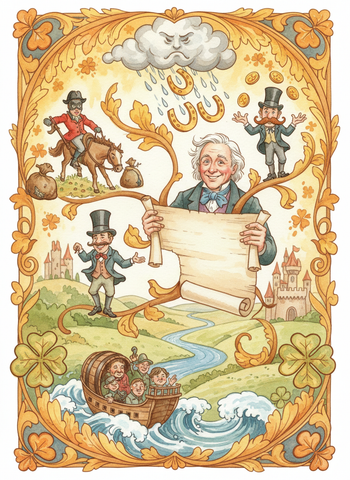
Mark Twain traces his 'noble' family tree through a parade of highwaymen, con men, and stowaways — proving his ancestors' criminal talents were matched only by their spectacularly bad luck.
Two or three persons having at different times intimated that if I would write an autobiography they would read it when they got leisure, I yield at last to this frenzied public demand and herewith tender my history.
Duas ou três pessoas tendo, em ocasiões diferentes, insinuado que se eu escrevesse uma autobiografia elas a leriam quando tivessem tempo, eu cedo por fim a essa demanda pública frenética e ofereço aqui minha história.
Ours is a noble house, and stretches a long way back into antiquity. The earliest ancestor the Twains have any record of was a friend of the family by the name of Higgins. This was in the eleventh century, when our people were living in Aberdeen, county of Cork, England. Why it is that our long line has ever since borne the maternal name (except when one of them now and then took a playful refuge in an alias to avert foolishness), instead of Higgins, is a mystery which none of us has ever felt much desire to stir. It is a kind of vague, pretty romance, and we leave it alone. All the old families do that way.
A nossa é uma casa nobre, que se estende bem longe na antiguidade. O ancestral mais antigo de que os Twain têm registro foi um amigo da família chamado Higgins. Isso foi no século onze, quando nosso povo vivia em Aberdeen, condado de Cork, Inglaterra. Por que nossa longa linhagem desde então carrega o nome materno (exceto quando um deles, de vez em quando, se refugiava de brincadeira num pseudônimo para evitar tolices), em vez de Higgins, é um mistério que nenhum de nós jamais sentiu muita vontade de investigar. É uma espécie de romance vago e bonito, e o deixamos em paz. Todas as famílias antigas fazem assim.
Arthour Twain was a man of considerable note—a solicitor on the highway in William Rufus's time. At about the age of thirty he went to one of those fine old English places of resort called Newgate, to see about something, and never returned again. While there he died suddenly.
Arthour Twain foi um homem de considerável renome — um assaltante de estrada na época de Guilherme Rufo. Por volta dos trinta anos foi a um daqueles belos e antigos lugares de retiro ingleses chamados Newgate, para ver sobre alguma coisa, e nunca mais voltou. Enquanto estava lá, morreu subitamente.
Augustus Twain seems to have made something of a stir about the year 1160. He was as full of fun as he could be, and used to take his old saber and sharpen it up, and get in a convenient place on a dark night, and stick it through people as they went by, to see them jump. He was a born humorist.
Augustus Twain parece ter causado certo alvoroço por volta do ano 1160. Era tão brincalhão quanto podia ser, e costumava pegar sua velha espada e afiá-la, e se colocar num lugar conveniente numa noite escura, e enfiá-la nas pessoas que passavam, só para vê-las pular. Era um humorista nato.
But he got to going too far with it; and the first time he was found stripping one of these parties, the authorities removed one end of him, and put it up on a nice high place on Temple Bar, where it could contemplate the people and have a good time. He never liked any situation so much or stuck to it so long.
Mas foi longe demais com isso; e na primeira vez que o pegaram despindo uma dessas vítimas, as autoridades removeram uma ponta dele, e a colocaram num belo lugar bem alto em Temple Bar, onde podia contemplar as pessoas e se divertir bastante. Ele nunca gostou tanto de uma situação nem ficou nela por tanto tempo.
Then for the next two hundred years the family tree shows a succession of soldiers—noble, high-spirited fellows, who always went into battle singing, right behind the army, and always went out a-whooping, right ahead of it.
Então, pelos duzentos anos seguintes, a árvore genealógica mostra uma sucessão de soldados — sujeitos nobres e cheios de brio, que sempre iam para a batalha cantando, logo atrás do exército, e sempre saíam gritando de alegria, bem à frente dele.
This is a scathing rebuke to old dead Froissart's poor witticism that our family tree never had but one limb to it, and that that one stuck out at right angles, and bore fruit winter and summer.
Isso é uma refutação contundente à pobre piada do velho e falecido Froissart de que nossa árvore genealógica nunca teve mais de um galho, e que esse único galho se projetava em ângulo reto, e dava frutos no inverno e no verão.
Early in the fifteenth century we have Beau Twain, called “the Scholar.” He wrote a beautiful, beautiful hand. And he could imitate anybody's hand so closely that it was enough to make a person laugh his head off to see it. He had infinite sport with his talent. But by and by he took a contract to break stone for a road, and the roughness of the work spoiled his hand. Still, he enjoyed life all the time he was in the stone business, which, with inconsiderable intervals, was some forty-two years. In fact, he died in harness.
No início do século quinze temos Beau Twain, chamado "o Erudito". Ele escrevia uma letra linda, linda. E conseguia imitar a letra de qualquer um com tanta perfeição que era o bastante para fazer alguém morrer de rir ao ver aquilo. Ele se divertiu infinitamente com seu talento. Mas com o tempo assumiu um contrato para quebrar pedra para uma estrada, e a rudeza do trabalho estragou sua letra. Ainda assim, aproveitou a vida o tempo todo em que esteve no ramo das pedras, o que, com poucos intervalos, durou uns quarenta e dois anos. De fato, morreu no posto.
During all those long years he gave such satisfaction that he never was through with one contract a week till the government gave him another. He was a perfect pet. And he was always a favorite with his fellow-artists, and was a conspicuous member of their benevolent secret society, called the Chain Gang. He always wore his hair short, had a preference for striped clothes, and died lamented by the government. He was a sore loss to his country. For he was so regular.
Durante todos aqueles longos anos ele deu tanta satisfação que nunca ficava sem um contrato por uma semana até que o governo lhe desse outro. Era um verdadeiro queridinho. E era sempre favorito entre seus colegas artistas, e um membro conspícuo de sua sociedade secreta beneficente, chamada A Corrente de Prisioneiros. Sempre usava o cabelo curto, tinha preferência por roupas listradas, e morreu lamentado pelo governo. Foi uma perda dolorosa para seu país. Pois era tão regular.
Some years later we have the illustrious John Morgan Twain. He came over to this country with Columbus in 1492 as a passenger. He appears to have been of a crusty, uncomfortable disposition. He complained of the food all the way over, and was always threatening to go ashore unless there was a change. He wanted fresh shad.
Alguns anos depois temos o ilustre John Morgan Twain. Ele veio para este país com Colombo em 1492 como passageiro. Parece ter tido um temperamento rabugento e difícil. Reclamava da comida o tempo todo da viagem, e sempre ameaçava desembarcar a menos que houvesse uma mudança. Ele queria arenque fresco.
Hardly a day passed over his head that he did not go idling about the ship with his nose in the air, sneering about the commander, and saying he did not believe Columbus knew where he was going to or had ever been there before. The memorable cry of “Land ho!” thrilled every heart in the ship but his. He gazed awhile through a piece of smoked glass at the penciled line lying on the distant water, and then said: “Land be hanged—it's a raft!”
Quase não passava um dia sem que ele andasse à toa pelo navio com o nariz empinado, zombando do comandante, e dizendo que não acreditava que Colombo soubesse para onde estava indo nem que já tivesse estado lá antes. O célebre grito de "Terra à vista!" emocionou todos os corações do navio, menos o dele. Ele olhou um pouco através de um pedaço de vidro fumê para a linha traçada a lápis na água distante, e então disse: "Terra uma ova — é uma jangada!"
When this questionable passenger came on board the ship, he brought nothing with him but an old newspaper containing a handkerchief marked “B. G.,” one cotton sock marked “L. W. C.,” one woolen one marked “D. F.,” and a night-shirt marked “O. M. R.” And yet during the voyage he worried more about his “trunk,” and gave himself more airs about it, than all the rest of the passengers put together. If the ship was “down by the head,” and would not steer, he would go and move his “trunk” further aft, and then watch the effect. If the ship was “by the stern,” he would suggest to Columbus to detail some men to “shift that baggage.”
Quando esse passageiro questionável embarcou no navio, não trouxe nada consigo além de um jornal velho contendo um lenço marcado "B. G.", uma meia de algodão marcada "L. W. C.", uma de lã marcada "D. F.", e uma camisola marcada "O. M. R.". E ainda assim, durante a viagem, ele se preocupou mais com seu "baú", e se deu mais ares a respeito dele, do que todos os outros passageiros juntos. Se o navio estava "afundado na proa" e não obedecia ao leme, ele ia mover seu "baú" mais para trás, e então observava o efeito. Se o navio estava "afundado na popa", sugeria a Colombo que designasse alguns homens para "deslocar aquela bagagem".
In storms he had to be gagged, because his wailings about his “trunk” made it impossible for the men to hear the orders. The man does not appear to have been openly charged with any gravely unbecoming thing, but it is noted in the ship's log as a “curious circumstance” that albeit he brought his baggage on board the ship in a newspaper, he took it ashore in four trunks, a queensware crate, and a couple of champagne baskets. But when he came back insinuating, in an insolent, swaggering way, that some of this things were missing, and was going to search the other passengers' baggage, it was too much, and they threw him overboard.
Nas tempestades tinham que amordaçá-lo, porque suas lamúrias sobre o "baú" tornavam impossível que os homens ouvissem as ordens. O homem não parece ter sido abertamente acusado de nada gravemente impróprio, mas está anotado no diário de bordo como uma "circunstância curiosa" que, embora tivesse trazido sua bagagem para o navio dentro de um jornal, ele a levou para terra em quatro baús, uma caixa de louça e um par de cestas de champanhe. Mas quando ele voltou insinuando, de modo insolente e arrogante, que algumas de suas coisas estavam faltando, e disse que ia revistar a bagagem dos outros passageiros, foi demais, e o jogaram ao mar.
They watched long and wonderingly for him to come up, but not even a bubble rose on the quietly ebbing tide. But while every one was most absorbed in gazing over the side, and the interest was momentarily increasing, it was observed with consternation that the vessel was adrift and the anchor-cable hanging limp from the bow. Then in the ship's dimmed and ancient log we find this quaint note:
Ficaram observando por muito tempo, maravilhados, esperando que ele voltasse à tona, mas nem uma bolha subiu na maré que baixava tranquilamente. Mas enquanto todos estavam mais absortos olhando por sobre a amurada, e o interesse aumentava a cada momento, observou-se com consternação que o navio estava à deriva e o cabo da âncora pendia frouxo da proa. Então, no diário desbotado e antigo do navio, encontramos esta nota curiosa:
“In time it was discouvered yt ye troblesome passenger hadde gone downe and got ye anchor, and toke ye same and solde it to ye dam sauvages from ye interior, saying yt he hadde founde it, ye sonne of a ghun!”
"Com o tempo descobriu-se que o incômodo passageiro tinha descido e pegado a âncora, e a tinha levado e vendido para os malditos selvagens do interior, dizendo que a tinha encontrado, o filho de uma arma!"
Yet this ancestor had good and noble instincts, and it is with pride that we call to mind the fact that he was the first white person who ever interested himself in the work of elevating and civilizing our Indians. He built a commodious jail and put up a gallows, and to his dying day he claimed with satisfaction that he had had a more restraining and elevating influence on the Indians than any other reformer that ever labored among them.
Contudo, esse ancestral tinha instintos bons e nobres, e é com orgulho que lembramos o fato de que ele foi a primeira pessoa branca que se interessou pela obra de elevar e civilizar nossos índios. Ele construiu uma prisão espaçosa e ergueu uma forca, e até o dia de sua morte afirmava com satisfação que tinha exercido uma influência mais restritiva e elevadora sobre os índios do que qualquer outro reformador que jamais trabalhou entre eles.
At this point the chronicle becomes less frank and chatty, and closes abruptly by saying that the old voyager went to see his gallows perform on the first white man ever hanged in America, and while there received injuries which terminated in his death.
Nesse ponto a crônica se torna menos franca e tagarela, e se encerra abruptamente dizendo que o velho navegador foi ver sua forca funcionar no primeiro homem branco enforcado na América, e que lá, enquanto assistia, recebeu ferimentos que resultaram em sua morte.
The great-grandson of the “Reformer” flourished in sixteen hundred and something, and was known in our annals as “the old Admiral,” though in history he had other titles. He was long in command of fleets of swift vessels, well armed and manned, and did great service in hurrying up merchantmen. Vessels which he followed and kept his eagle eye on, always made good fair time across the ocean. But if a ship still loitered in spite of all he could do, his indignation would grow till he could contain himself no longer—and then he would take that ship home where he lived and keep it there carefully, expecting the owners to come for it, but they never did.
O bisneto do "Reformador" prosperou por volta de mil e seiscentos e alguma coisa, e era conhecido em nossos anais como "o velho Almirante", embora na história tivesse outros títulos. Ele comandou por muito tempo frotas de navios velozes, bem armados e tripulados, e prestou grande serviço apressando navios mercantes. Os navios que ele seguia e mantinha sob seu olhar de águia sempre faziam boa travessia pelo oceano. Mas se um navio ainda assim demorasse apesar de tudo o que ele fizesse, sua indignação crescia até que ele não conseguia mais se conter — e então levava aquele navio para casa, onde morava, e o mantinha ali cuidadosamente, esperando que os donos viessem buscá-lo, mas eles nunca vinham.
And he would try to get the idleness and sloth out of the sailors of that ship by compelling them to take invigorating exercise and a bath. He called it “walking a plank.” All the pupils liked it. At any rate, they never found any fault with it after trying it. When the owners were late coming for their ships, the Admiral always burned them, so that the insurance money should not be lost. At last this fine old tar was cut down in the fullness of his years and honors. And to her dying day, his poor heart-broken widow believed that if he had been cut down fifteen minutes sooner he might have been resuscitated.
E ele tentava tirar a preguiça e o ócio dos marinheiros daquele navio, obrigando-os a fazer exercícios revigorantes e um banho. Ele chamava isso de "caminhar na prancha". Todos os alunos gostavam disso. De qualquer forma, nunca reclamaram depois de experimentar. Quando os donos demoravam para vir buscar seus navios, o Almirante sempre os queimava, para que o dinheiro do seguro não se perdesse. Por fim esse bom e velho marinheiro foi ceifado na plenitude de seus anos e honras. E até o dia de sua morte, sua pobre viúva de coração partido acreditou que se ele tivesse sido cortado quinze minutos antes, poderia ter sido ressuscitado.
Charles Henry Twain lived during the latter part of the seventeenth century, and was a zealous and distinguished missionary. He converted sixteen thousand South Sea islanders, and taught them that a dog-tooth necklace and a pair of spectacles was not enough clothing to come to divine service in. His poor flock loved him very, very dearly; and when his funeral was over, they got up in a body (and came out of the restaurant) with tears in their eyes, and saying, one to another, that he was a good tender missionary, and they wished they had some more of him.
Charles Henry Twain viveu durante a última parte do século dezessete, e foi um missionário zeloso e distinto. Converteu dezesseis mil ilhéus dos Mares do Sul, e lhes ensinou que um colar de dentes de cachorro e um par de óculos não eram roupa suficiente para comparecer ao culto divino. Seu pobre rebanho o amava muito, muito profundamente; e quando o funeral terminou, todos se levantaram juntos (e saíram do restaurante) com lágrimas nos olhos, e diziam uns aos outros que ele tinha sido um missionário bom e terno, e que gostariam de ter mais um pouco dele.
Pah-go-to-wah-wah-pukketekeewis (Mighty-Hunter-with-a-Hog-Eye-Twain) adorned the middle of the eighteenth century, and aided General Braddock with all his heart to resist the oppressor Washington. It was this ancestor who fired seventeen times at our Washington from behind a tree. So far the beautiful romantic narrative in the moral story-books is correct; but when that narrative goes on to say that at the seventeenth round the awe-stricken savage said solemnly that that man was being reserved by the Great Spirit for some mighty mission, and he dared not lift his sacrilegious rifle against him again, the narrative seriously impairs the integrity of history. What he did say was:
Pah-go-to-wah-wah-pukketekeewis (Grande-Caçador-de-Olho-de-Porco-Twain) prosperou em meados do século dezoito, e ajudou o General Braddock com todo o coração a resistir ao opressor Washington. Foi esse ancestral quem atirou dezessete vezes em nosso Washington de trás de uma árvore. Até aqui a bela narrativa romântica dos livros de moral está correta; mas quando essa narrativa continua dizendo que na décima sétima rodada o selvagem, tomado de espanto, disse solenemente que aquele homem estava sendo reservado pelo Grande Espírito para alguma missão poderosa, e que ele não ousava erguer novamente seu rifle sacrílego contra ele, a narrativa compromete seriamente a integridade da história. O que ele de fato disse foi:
“It ain't no (hic) no use. 'At man's so drunk he can't stan' still long enough for a man to hit him. I (hic) I can't 'ford to fool away any more am'nition on him.”
"Não adianta (soluço) não adianta nada. Aquele homem está tão bêbado que não consegue ficar parado tempo o bastante para alguém acertá-lo. Eu (soluço) não posso desperdiçar mais nenhuma munição com ele."
That was why he stopped at the seventeenth round, and it was a good, plain, matter-of-fact reason, too, and one that easily commends itself to us by the eloquent, persuasive flavor of probability there is about it.
Foi por isso que ele parou na décima sétima rodada, e essa era uma razão boa, simples e objetiva, também, e uma que facilmente se recomenda por si mesma pelo tom eloquente e persuasivo de probabilidade que tem.
I also enjoyed the story-book narrative, but I felt a marring misgiving that every Indian at Braddock's Defeat who fired at a soldier a couple of times (two easily grows to seventeen in a century), and missed him, jumped to the conclusion that the Great Spirit was reserving that soldier for some grand mission; and so I somehow feared that the only reason why Washington's case is remembered and the others forgotten is, that in his the prophecy came true, and in that of the others it didn't.
Eu também gostei da narrativa dos livros de história, mas senti um receio incômodo de que todo índio na Derrota de Braddock que atirou num soldado umas duas vezes (dois facilmente vira dezessete num século), e errou, saltou à conclusão de que o Grande Espírito estava reservando aquele soldado para alguma grande missão; e assim, de algum modo, temi que a única razão pela qual o caso de Washington é lembrado e os outros esquecidos é que, no dele, a profecia se cumpriu, e no dos outros não.
There are not books enough on earth to contain the record of the prophecies Indians and other unauthorized parties have made; but one may carry in his overcoat pockets the record of all the prophecies that have been fulfilled.
Não há livros suficientes na terra para conter o registro das profecias que índios e outras partes não autorizadas fizeram; mas dá para carregar nos bolsos do sobretudo o registro de todas as profecias que se cumpriram.
I will remark here, in passing, that certain ancestors of mine are so thoroughly well-known in history by their aliases, that I have not felt it to be worth while to dwell upon them, or even mention them in the order of their birth.
Observarei aqui, de passagem, que certos ancestrais meus são tão bem conhecidos na história por seus pseudônimos, que não achei que valesse a pena me deter neles, nem sequer mencioná-los na ordem de seu nascimento.
Among these may be mentioned Richard Brinsley Twain, alias Guy Fawkes; John Wentworth Twain, alias Sixteen-String Jack; William Hogarth Twain, alias Jack Sheppard; Ananias Twain, alias Baron Munchausen; John George Twain, alias Captain Kydd; and then there are George Francis Twain, Tom Pepper, Nebuchadnezzar, and Baalam's Ass—they all belong to our family, but to a branch of it somewhat distinctly removed from the honorable direct line—in fact, a collateral branch, whose members chiefly differ from the ancient stock in that, in order to acquire the notoriety we have always yearned and hungered for, they have got into a low way of going to jail instead of getting hanged.
Entre esses podem-se mencionar Richard Brinsley Twain, apelidado Guy Fawkes; John Wentworth Twain, apelidado Jack das Dezesseis Cordas; William Hogarth Twain, apelidado Jack Sheppard; Ananias Twain, apelidado Barão de Munchausen; John George Twain, apelidado Capitão Kydd; e há também George Francis Twain, Tom Pepper, Nabucodonosor, e a Jumenta de Balaão — todos pertencem à nossa família, mas a um ramo dela um tanto distintamente afastado da honrada linha direta — na verdade, um ramo colateral, cujos membros diferem principalmente do tronco antigo em que, para alcançar a notoriedade que sempre almejamos e desejamos ardentemente, adotaram o hábito humilde de ir para a cadeia em vez de serem enforcados.
It is not well, when writing an autobiography, to follow your ancestry down too close to your own time—it is safest to speak only vaguely of your great-grandfather, and then skip from there to yourself, which I now do.
Não é bom, ao escrever uma autobiografia, seguir sua ascendência tão perto do próprio tempo — o mais seguro é falar apenas vagamente sobre seu bisavô, e então pular dele para si mesmo, o que faço agora.
I was born without teeth—and there Richard III. had the advantage of me; but I was born without a humpback, likewise, and there I had the advantage of him. My parents were neither very poor nor conspicuously honest.
Nasci sem dentes — e aí Ricardo III levou vantagem sobre mim; mas nasci sem corcunda, também, e aí levei a vantagem sobre ele. Meus pais não eram nem muito pobres nem conspicuamente honestos.
But now a thought occurs to me. My own history would really seem so tame contrasted with that of my ancestors, that it is simply wisdom to leave it unwritten until I am hanged. If some other biographies I have read had stopped with the ancestry until a like event occurred, it would have been a felicitous thing for the reading public. How does it strike you?
Mas agora me ocorre um pensamento. Minha própria história pareceria realmente tão sem graça em contraste com a de meus ancestrais, que é simplesmente sabedoria deixá-la não escrita até que eu seja enforcado. Se algumas outras biografias que li tivessem parado na ascendência até que um evento semelhante ocorresse, teria sido uma coisa feliz para o público leitor. O que acham disso?
