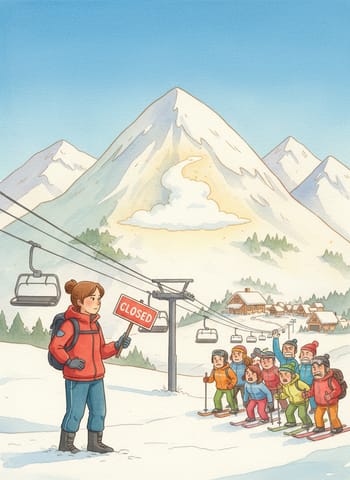
The Avalanche Forecast
A free C1-level English story for language learners, readable online in 5 languages, with an option to listen via the free Storyteller app.
An avalanche forecaster closes a ski area on a perfect blue-sky day and faces the backlash before the mountain answers for her.
That was the preview! Hear the full story in the free Storyteller app. Get the app
Audio isn't available right now.
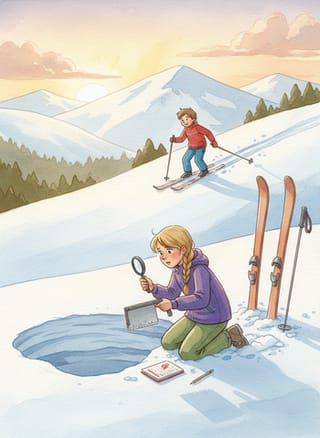
At six in the morning the sky above the ski area is the hard, flawless blue that brings people up from the valley in their thousands. Regina, standing at the top of the main lift with a shovel in one hand and a radio in the other, knows she is about to ruin everyone's day.
The storm that passed through four nights ago left a metre of new snow on top of an older, thinner layer of sugary crystals. They are the kind that look beautiful in a pit and hold nothing together. She has spent two hours digging, tapping and sawing through blocks of snow with a length of cord, and every test has ended in the same flat, clean break. On the way up, the whole slope settled under her skis with a deep, hollow whump that she felt more in her stomach than in her ears.
By seven she has written the bulletin, and by seven-fifteen she has come to regret the word "closed." The resort manager is on the radio before she has finished her tea.
"There's not a cloud out there," he says. "People have paid for this."
"I know," she says. "It isn't the weather I'm forecasting."
He says something short and unhelpful and signs off. Within an hour the car park is full, and a line of skiers at the rope below the bowl is looking at her as though she had personally invented gravity. Seldom has she been so unpopular before nine in the morning. A man in a bright yellow jacket tells the patrol, loudly and not for the first time, that forecasters sit in offices and have never seen real snow. Regina, who has slept in a snow hole on that very ridge, says nothing.
Elif, who runs the patrol, takes the rope line without being asked. She has worked on this mountain for fifteen years and knows better than to argue with a pit. All morning she turns people back with a cheerfulness that Regina, watching from the hut window, envies and could not manage herself.
At ten past two, the radio crackles. Elif's voice, very flat and very calm, says that a slide has come down the main bowl: the closed slope, the one with the rope across it. Regina is at the window before the sentence is finished. From the hut she can see it, a long grey tongue of broken blocks, some as big as cars, spread across the run. At eleven o'clock, a hundred people had been asking to be let through there. Nobody was on it. Elif is already counting heads, and the count, when it comes, is exactly right.
What Regina feels is not triumph. Had the sky been grey, nobody would have questioned her at all; it was the blue that made her wrong, in everyone's eyes, until two o'clock. Her hands, she notices, are not quite steady on the radio.
The manager arrives at the hut without knocking and stands for a while, looking at the slope and then at her. He does not apologise, and she does not expect him to. Behind him, the man in the yellow jacket is standing very still in the doorway, his goggles pushed up on his forehead.
"Tomorrow," the manager says at last. "Will it be the same?"
"Not until the layer settles," Regina says, "and I can't tell you when that will be."
She pulls the keyboard toward her, types tomorrow's date at the top of a blank bulletin, and begins with the same word she used today.