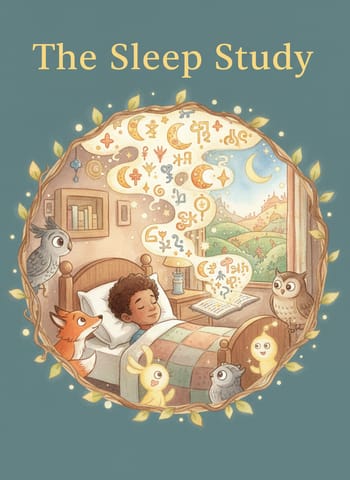
The Sleep Study
A free B2-level English story for language learners, readable online in 5 languages, with an option to listen via the free Storyteller app.
A sleep study reports that Amadou speaks an unknown language at night, and he becomes obsessed with finding out where it comes from.
That was the preview! Hear the full story in the free Storyteller app. Get the app
Audio isn't available right now.
Amadou signs up for the sleep study because it pays for a month of groceries. All he has to do is spend three nights in a quiet room at the university, wired to a machine that watches him breathe.
The report arrives by email on Friday. Most of it is ordinary: his sleep cycles are normal, his heart rate is calm. Then he reaches the last line. "Sleep speech detected: 47 episodes. Language: unidentified. Confidence that speech is structured language rather than noise: 94 percent."
He reads it three times. Then he phones the lab. "Maybe the machine made a mistake," he says.
"The analysis software compares your speech with thousands of recordings," the technician says. "It found no match. I'm sorry, I can't tell you more than that."
After that, Amadou can think of nothing else. He asks for the audio clips and listens to them on his laptop, wearing headphones. His own voice, thick with sleep, produces slow, rhythmic phrases that rise at the end like questions.
He plays them for a friend who studies languages. "It has real grammar," she says, frowning. "Or something that behaves like it. But I've never heard it before."
For a week, Amadou fills a notebook with spellings of the sounds. He wonders whether he picked up a forgotten language from a grandparent, and he phones his mother to ask. She says that nobody in the family ever spoke anything but the usual two languages, and that he should go to bed earlier.
Of course, he cannot sleep. The more he thinks about it, the less he rests, and the less he rests, the more he lies awake in the dark, listening.
On Thursday night, he sets his phone to record, mostly out of stubbornness. At twenty to midnight, he hears a calm voice coming through the wall beside his bed. It speaks one slow phrase, then pauses. A different voice answers it, then the first voice repeats the phrase, a little faster.
Amadou sits up very slowly. He opens the notebook. The phrase on the other side of the wall is one of the phrases he has written down.
The next morning he knocks on his neighbor's door. She opens it in a bathrobe, holding a mug. "Sorry," he says. "This is strange. Do you play language lessons at night?"
"Every night," she says, surprised. "It's a small language, and the course is the only one I could find. I play it while I fall asleep. Why?"
"Because I have been repeating them in my sleep. A university machine says I speak an unknown language."
She stares at him, and then she bursts out laughing. "So you're the one who answers back! For two weeks I've been hearing someone mumble the lessons through the wall. I thought I was losing my mind."
"Well," Amadou says, "my pronunciation must be excellent."
"That depends," she says. "Can you tell me which one of us has been getting the vowels right?"