The Night Ferry Musician
A free C1-level English story for language learners, readable online in 5 languages, with an option to listen via the free Storyteller app.
On a night ferry, a woman who cannot sleep finds a man playing the violin to an empty deck, and they talk until the harbour appears.
That was the preview! Hear the full story in the free Storyteller app. Get the app
Audio isn't available right now.
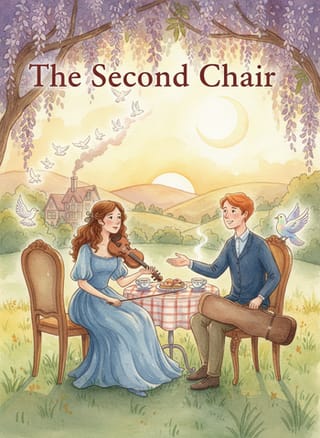
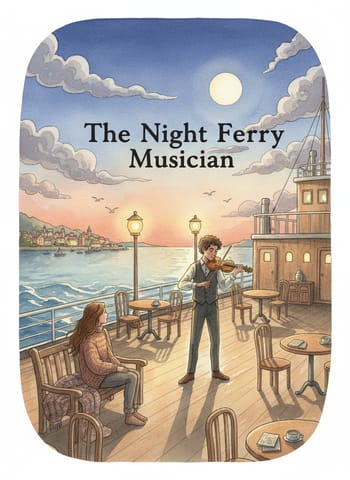
The night ferry leaves at eleven, half empty, and by midnight everyone who is going to sleep has found a bench in the saloon and turned a shoulder to the room. Sonja cannot sleep. She goes out on deck for the cold, which she expects to have to herself, and finds instead, in the lee of a lifeboat, a man playing the violin to the dark.
He is not busking. There is no case open at his feet, and nobody else is out here. He plays with his eyes shut, in short pieces that begin and then stop, like someone trying a door and finding it locked, and the wind takes half of every phrase. She stands thirty feet away holding her collar closed, a stranger at a rehearsal, and when he lowers the bow she hears herself say, "Don't stop on my account."
"There is no account," he says. He looks pleased, but not surprised. "It's the only time I get to play badly and nobody holds it against me."
They talk, in the end, because sitting is warmer than standing. He is making the crossing for the last time this year, after a season of weddings, the kind of music people have stopped hearing by the second hour. She tells him, without quite meaning to, that she is on her way to look at a flat in a city where she knows no one. She has not decided whether she is moving or only visiting. He does not tell her which she should do. He asks what she will do if she stands in the flat for an hour and hates it.
"Take the first ferry back," she says.
"Then you know something already." He considers this, and then, because it sounds too certain, adds, "Or you know nothing, which is also useful."
Around three the sea goes flat and black, and the far coast appears as a thin, unsteady line of lights. He plays her the piece he has been circling all night: eight bars that never end properly, because, he says, he has never found the ninth. She hums what she thinks it should be, a rising line, nothing more. He tries it and shakes his head, tries it again a tone lower, and for the length of a bar the whole deck is silent except for the engine.
What strikes her, afterwards, is how easy it was. Not until the sky begins to pale does she realise that they have said nothing about where either of them lives, whom they love, or what they are called. If they had traded names at midnight, she thinks, they would have spent the night being the people those names belonged to.
The harbour comes up out of the grey: cranes, a gull on a bollard, a town not yet awake. Passengers shuffle toward the ramp with their bags and their creased faces. He packs the violin into its case without hurry and stands beside her at the rail while the ropes go across.
"Good luck with the flat," he says.
"Good luck with the ninth bar."
They go down the ramp a few people apart, and at the bottom he turns left along the quay and she turns right. At the end of the quay, behind her, a violin starts up: eight bars, and then a ninth, a tone lower than the one she sang. Sonja keeps walking. She does not turn round, and she does not stop humming.