The Last Telephone Box
A free C1-level English story for language learners, readable online in 5 languages, with an option to listen via the free Storyteller app.
A woman who has never used the village's last telephone box finds herself leading a fiercely committed campaign to save it.
That was the preview! Hear the full story in the free Storyteller app. Get the app
Audio isn't available right now.
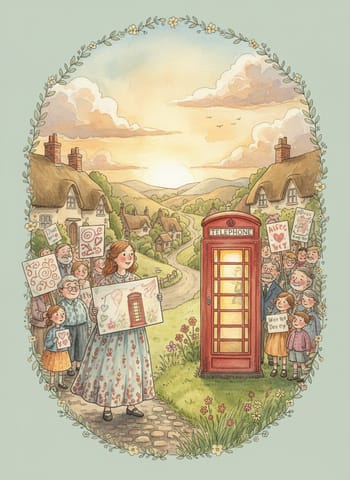
The village's last red telephone box is due to be taken away on the first of the month. Perpetua, who has not used it once in forty-one years of living across the road from it, is somehow the person chairing the meeting to save it. How this happened she cannot entirely reconstruct. She went to the village hall for the raffle, she tells herself, and came away with a clipboard.
The campaign has by now acquired a committee of eleven, a logo (a telephone receiver wearing a small crown), and a secretary who writes everything down even when nobody is speaking. Gustav, the retired postman, has brought a folder of photographs showing the box in snow. A woman from the flower-arranging group has proposed filling it with geraniums, and has been voted down: a telephone box that looks like a florist's, the committee feels, is half removed already. Perpetua listens to all of it with the grave attention of someone who has just realised that she is the only person in the room without a telephone-box story.
The telephone company's letter, which she has read so often she can recite it, says the box recorded no calls at all last year. This is the sticking point. "Zero," says Gustav, tapping the page. "We need forty before the inspector comes."
So the rota is born. For three weeks, villagers queue in the lane with their coins, each handed a slip of paper bearing a number to ring. The box, which for a decade has been mostly a shelter for wasps, becomes the most telephoned object in the county. A retired teacher rings his own landline and lets it ring. A boy rings the speaking clock and thanks it. A man stands inside for twenty minutes, calling the brother he has not spoken to since the last parish election, and the conversation is, by all accounts, productive.
The inspector, when he arrives, is a young man with a tablet and a damp collar, and Perpetua has prepared a speech. He listens to the whole of it, which she finds unnerving. What strikes him as odd, he says, is that the counter shows forty-three calls in one month, none of them longer than ninety seconds.
"Short calls," he says. "Why short?"
"Because there was a queue," says Perpetua, which is true, and which ends the conversation. Not until the inspector has driven away does she notice that her hands are shaking.
The decision arrives by post: the box is reprieved for one year, pending a review of its heritage value. The committee celebrates in the village hall with a cake in the shape of a telephone box, and Perpetua, who is given the first slice, finds she cannot eat it. If she had known in March where a raffle would lead, she would have stayed at home and watered her plants. She suspects she would have been wrong.
That evening she lets herself into the box for the first time in her life. It smells of rain and old coins, and the shelf holds a single swollen directory. She lifts the receiver. The dial tone is longer and lower than she expected, a sound with distance in it. There is no one she needs to call, so after a while she dials her own mobile number, simply to find out what it feels like to be someone the box can reach.
In her coat pocket, the phone begins to buzz. She lets it ring.