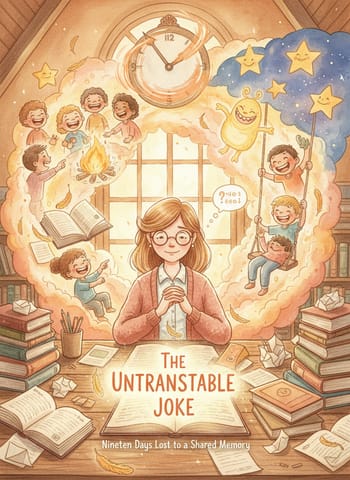
The Untranslatable Joke
A free C1-level English story for language learners, readable online in 5 languages, with an option to listen via the free Storyteller app.
A literary translator loses nineteen days to a joke that depends on a shared childhood memory her readers do not have.
That was the preview! Hear the full story in the free Storyteller app. Get the app
Audio isn't available right now.
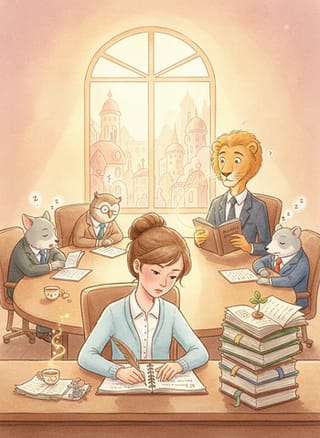
For nineteen days Maia has been stuck on a single line. It is not a long line: a character in the novel she is translating says three words to a bank clerk, and every reader of the original laughs. But the laugh depends on something her language does not contain. The three words are the opening of a children's radio programme that every child in that country heard at the same hour for forty years. The clerk, a stern woman, answers by humming the next phrase without noticing that she has done it.
Maia has tried the obvious things. A footnote explaining the programme kills the joke, which is rather like explaining an echo. A local equivalent, a jingle or a catchphrase or a nursery rhyme, feels false, because her readers' own childhoods would have to be moved into a foreign bank. She has tried leaving the line out, and the whole scene, which hangs from it, sags like a tent with one pole missing.
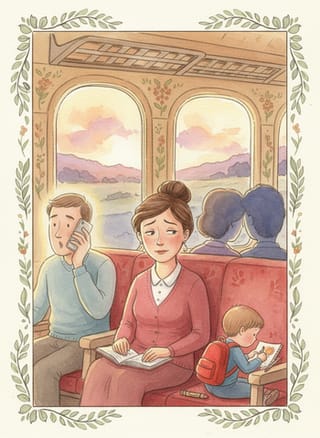
The obsession has begun to leak. She hums the theme tune, learned from a scratchy recording, in the supermarket queue, and watches the people around her with the odd hope that one of them will answer. On the bus she asks the driver whether any sentence makes him finish it automatically. After some thought he offers, "Please move down inside the vehicle," and looks startled by how quickly it came out. Rarely has a bus driver been thanked so warmly. Maia goes home to a page that has not changed.
Her editor, on the phone, is kind and no help at all.
"It's one joke, Maia. Readers will survive."
"I know they will," Maia says. "It's not the readers I'm worried about."
What finally moves her is, absurdly, the memory of the supermarket. Standing in the queue on the twentieth morning, she understands that what made the original funny was never the programme itself. It was the instant of recognition passing through a room, the sudden proof that these strangers had once been the same child. Her readers will never have that proof, but they can watch it happen to somebody else. Had she been less tired, she might have seen it on the second day.
So she leaves the three words exactly as they are, unexplained, and adds only what the room does next. The clerk hums. A man behind the speaker sets down his pen. A woman stops in the middle of a sentence, and for a moment the whole bank is perfectly silent, like a congregation that has been reminded of something. The English reader will not know why. The English reader will know only that a thing has passed between strangers that they were not invited to share. That, she suspects, is the joke's real mechanism; the laughing was only one way of showing it.
It takes forty minutes to type. Having lost nineteen days to the problem, she is faintly insulted that the solution takes less time than a kettle. She sends the page to her editor with a single line beneath it: "It is not as funny as the original. It is, I think, as accurate, and I'm beginning to suspect that comes to the same thing."