The Three Versions
Uma história gratuita em inglês de nível C1 para estudantes, para ler online em 4 idiomas, com opção de ouvir no app gratuito Storyteller.
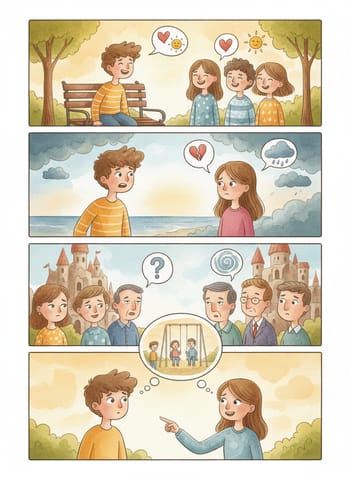
A teenager tells three increasingly different versions of the same breakup to three different audiences, until a friend who actually witnessed it leaves no room left to edit.
Essa foi a prévia! Ouça a história completa no app gratuito Storyteller. Baixar o app
O áudio não está disponível no momento.
By the time Larkin had told the story three times, it belonged less to what had actually happened than to whichever audience was currently listening.
No momento em que Larkin já tinha contado a história três vezes, ela pertencia menos ao que realmente tinha acontecido e mais a quem estivesse ouvindo naquele instante.
At the lunch table, the version was brisk and unbothered: Booker had been "kind of a lot," and Larkin had simply decided, calmly, to end things before junior year got busy. Nobody questioned it, because nobody had any particular reason to, and Larkin appreciated how easily boredom could pass for closure if it was delivered fast enough. Only in retelling it that way did Larkin notice how carefully every actual detail had been left out.
Na mesa do almoço, a versão era rápida e despreocupada: Booker tinha sido "meio demais", e Larkin simplesmente tinha decidido, com calma, terminar tudo antes de o segundo ano ficar corrido. Ninguém questionou, porque ninguém tinha motivo especial para isso, e Larkin gostava de como o tédio conseguia passar por superação, desde que contado rápido o suficiente. Só ao recontar daquele jeito Larkin percebeu como cada detalhe de verdade tinha sido cuidadosamente deixado de fora.
The second version came out that evening in the group chat, typed in fragments between other people's messages about homework. This one admitted a little more: Booker had stopped replying for four days before the breakup, not after it. Larkin had spent most of those four days checking a phone that never lit up. Framing it as Booker's failure rather than Larkin's own hurt made the story easier to type, even if it wasn't, strictly, the more accurate order of events.
A segunda versão saiu naquela noite no grupo, digitada aos pedaços entre mensagens de outras pessoas sobre lição de casa. Essa admitia um pouco mais: Booker tinha parado de responder por quatro dias antes do término, não depois. Larkin tinha passado a maior parte desses quatro dias olhando para um celular que nunca acendia. Contar como se fosse falha de Booker, e não mágoa própria de Larkin, tornava a história mais fácil de digitar, mesmo que não fosse, rigorosamente, a ordem mais fiel dos fatos.
The third version arrived almost by accident, late on a Thursday, to Yara, the one friend who had actually been there for the argument itself. She therefore couldn't be told a version that contradicted what she'd witnessed. Talking to her, Larkin ran out of edits to make. What came out instead was the plainer fact underneath both earlier tellings: that Larkin had ended it first, out of fear, the exact moment it seemed like Booker might end it first instead.
A terceira versão surgiu quase sem querer, numa quinta-feira tarde da noite, para Yara, a única amiga que realmente tinha estado presente na discussão em si. A ela, portanto, não dava para contar uma versão que contradissesse o que ela mesma tinha visto. Falando com ela, Larkin ficou sem mais edições para fazer. O que saiu, em vez disso, foi o fato mais simples por baixo das duas versões anteriores: que Larkin tinha terminado primeiro, por medo, no exato momento em que parecia que Booker é que ia terminar antes.
"You never said that part at lunch," Yara said, not unkindly.
"Você nunca contou essa parte no almoço", disse Yara, sem maldade.
"I know." Larkin turned a straw wrapper over on the table, not quite looking up. "Saying it out loud there would've made it a whole thing."
"Eu sei." Larkin virou o papel do canudo na mesa, sem erguer bem os olhos. "Falar isso em voz alta lá teria virado um assunto enorme."
"It is a whole thing. You've just been telling three different smaller ones."
"É um assunto enorme. Você só andou contando três versões menores dele."
Larkin didn't answer right away, turning the wrapper over again, aware of how strange it was that the truest version had needed the fewest words to say. Had anyone at the lunch table asked a single follow-up question, the fast, unbothered version might have held up for another week at least. Nobody had, which was either luck or a sign that everyone already sensed there was more to it than Larkin was offering.
Larkin não respondeu na hora, virando o papel de novo, percebendo como era estranho que a versão mais verdadeira tivesse precisado de menos palavras para ser dita. Se alguém na mesa do almoço tivesse feito uma única pergunta a mais, a versão rápida e despreocupada provavelmente teria se sustentado por mais uma semana, pelo menos. Ninguém fez, o que era sorte ou sinal de que todo mundo já sentia que havia mais por trás do que Larkin estava contando.
"Do you regret it?" Yara asked. "Ending it, I mean — not how you told it."
"Você se arrepende?" perguntou Yara. "De ter terminado, quero dizer — não de como você contou."
"Some days." Larkin shrugged, the kind of shrug that wasn't really an answer. "Mostly I regret how much easier the fake version was to say than the real one."
"Em alguns dias." Larkin deu de ombros, daquele jeito de ombros que não é bem uma resposta. "Na maior parte do tempo eu me arrependo de como a versão falsa era mais fácil de dizer do que a verdadeira."
Yara didn't push further, and the two of them sat there a while longer, the straw wrapper now folded into a small, tight square between Larkin's fingers. Somewhere across the cafeteria, a version of the story Larkin had told at lunch was probably still circulating, unbothered and brisk and almost entirely untrue, moving further from Thursday's version with every retelling it survived.
Yara não insistiu mais, e as duas ficaram ali sentadas por mais um tempo, o papel do canudo agora dobrado num quadradinho apertado entre os dedos de Larkin. Em algum lugar do refeitório, uma versão da história que Larkin tinha contado no almoço provavelmente ainda circulava, despreocupada e rápida e quase inteiramente falsa, se afastando cada vez mais da versão de quinta-feira a cada vez que sobrevivia a um novo recontar.