The Emperor's New Clothes
A free B1-level English story for language learners, readable online in 7 languages, with an option to listen via the free Storyteller app.
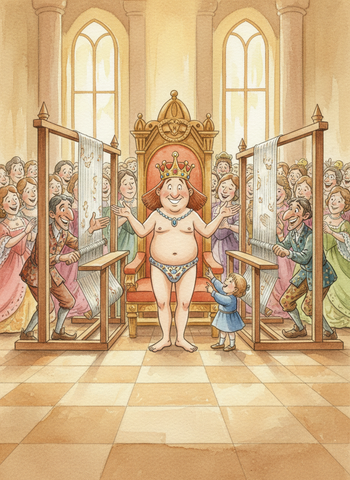
Two swindlers convince a vain Emperor they are weaving him magical cloth invisible to anyone unfit or foolish — and every courtier is too afraid to admit they see nothing at all.
Many years ago, there was an Emperor, who was so excessively fond of new clothes, that he spent all his money in dress. He did not trouble himself in the least about his soldiers; nor did he care to go either to the theatre or the chase, except for the opportunities then afforded him for displaying his new clothes. He had a different suit for each hour of the day; and as of any other king or emperor, one is accustomed to say, “he is sitting in council,” it was always said of him, “The Emperor is sitting in his wardrobe.”
Bertahun-tahun yang lalu, ada seorang Kaisar yang begitu gemar akan pakaian baru, sehingga ia menghabiskan seluruh uangnya untuk berdandan. Ia tidak peduli sama sekali tentang para prajuritnya; ia juga tidak tertarik pergi ke teater atau berburu, kecuali untuk kesempatan yang diberikan hal-hal itu kepadanya untuk memamerkan pakaian barunya. Ia memiliki setelan berbeda untuk setiap jam dalam sehari; dan jika terhadap raja atau kaisar lain orang biasa berkata, "beliau sedang bersidang," maka tentang dirinya selalu dikatakan, "Kaisar sedang berada di lemari pakaiannya."
Time passed merrily in the large town which was his capital; strangers arrived every day at the court. One day, two rogues, calling themselves weavers, made their appearance. They gave out that they knew how to weave stuffs of the most beautiful colors and elaborate patterns, the clothes manufactured from which should have the wonderful property of remaining invisible to everyone who was unfit for the office he held, or who was extraordinarily simple in character.
Waktu berlalu dengan riang di kota besar yang menjadi ibu kotanya; orang-orang asing datang setiap hari ke istana. Suatu hari, dua penipu, yang menyebut diri mereka penenun, muncul di sana. Mereka mengaku tahu cara menenun kain dengan warna-warna paling indah dan corak yang rumit, dan pakaian yang dibuat dari kain itu akan memiliki sifat ajaib yaitu tetap tidak terlihat oleh siapa pun yang tidak layak untuk jabatannya, atau yang sangat bodoh sifatnya.
“These must, indeed, be splendid clothes!” thought the Emperor. “Had I such a suit, I might at once find out what men in my realms are unfit for their office, and also be able to distinguish the wise from the foolish! This stuff must be woven for me immediately.” And he caused large sums of money to be given to both the weavers in order that they might begin their work directly.
"Pastilah ini pakaian yang luar biasa!" pikir Kaisar. "Seandainya aku punya setelan seperti itu, aku bisa segera mengetahui siapa saja di kerajaanku yang tidak layak untuk jabatan mereka, dan juga dapat membedakan yang bijak dari yang bodoh! Kain ini harus segera ditenun untukku." Maka ia memerintahkan agar sejumlah besar uang diberikan kepada kedua penenun itu agar mereka dapat segera memulai pekerjaan mereka.
So the two pretended weavers set up two looms, and affected to work very busily, though in reality they did nothing at all. They asked for the most delicate silk and the purest gold thread; put both into their own knapsacks; and then continued their pretended work at the empty looms until late at night.
Maka kedua penenun palsu itu memasang dua alat tenun, dan berpura-pura bekerja dengan sangat sibuk, meskipun sebenarnya mereka tidak mengerjakan apa pun. Mereka meminta sutra yang paling halus dan benang emas yang paling murni; memasukkan keduanya ke dalam ransel mereka sendiri; lalu melanjutkan kepura-puraan bekerja di alat tenun yang kosong hingga larut malam.
“I should like to know how the weavers are getting on with my cloth,” said the Emperor to himself, after some little time had elapsed; he was, however, rather embarrassed, when he remembered that a simpleton, or one unfit for his office, would be unable to see the manufacture. To be sure, he thought he had nothing to risk in his own person; but yet, he would prefer sending somebody else, to bring him intelligence about the weavers, and their work, before he troubled himself in the affair.
"Aku ingin tahu bagaimana kemajuan para penenun dengan kainku," kata Kaisar dalam hati, setelah beberapa waktu berlalu; namun ia sedikit khawatir, ketika teringat bahwa orang bodoh, atau orang yang tidak layak untuk jabatannya, tidak akan bisa melihat kain itu dibuat. Sesungguhnya, ia merasa tidak ada risiko apa pun bagi dirinya sendiri; namun demikian, ia lebih suka mengirim orang lain untuk membawakannya kabar tentang para penenun dan pekerjaan mereka, sebelum ia repot-repot memeriksanya sendiri.
All the people throughout the city had heard of the wonderful property the cloth was to possess; and all were anxious to learn how wise, or how ignorant, their neighbors might prove to be.
Seluruh rakyat di kota itu telah mendengar tentang sifat ajaib yang akan dimiliki kain itu; dan semua orang ingin tahu betapa bijak, atau betapa bodohnya, tetangga mereka nanti.
“I will send my faithful old minister to the weavers,” said the Emperor at last, after some deliberation, “he will be best able to see how the cloth looks; for he is a man of sense, and no one can be more suitable for his office than he is.”
"Aku akan mengirim menteri tua yang setia kepada para penenun," kata Kaisar akhirnya, setelah menimbang-nimbang, "dialah yang paling mampu melihat bagaimana kain itu terlihat; sebab ia orang yang berakal, dan tidak ada yang lebih pantas untuk jabatan itu selain dia."
So the faithful old minister went into the hall, where the knaves were working with all their might, at their empty looms. “What can be the meaning of this?” thought the old man, opening his eyes very wide. “I cannot discover the least bit of thread on the looms.” However, he did not express his thoughts aloud.
Maka menteri tua yang setia itu masuk ke aula, tempat para bajingan itu bekerja sekuat tenaga di alat tenun yang kosong. "Apa gerangan artinya ini?" pikir orang tua itu, membuka matanya lebar-lebar. "Aku tidak dapat menemukan sehelai benang pun di alat tenun itu." Namun, ia tidak mengucapkan pikirannya dengan lantang.
The impostors requested him very courteously to be so good as to come nearer their looms; and then asked him whether the design pleased him, and whether the colors were not very beautiful; at the same time pointing to the empty frames. The poor old minister looked and looked, he could not discover anything on the looms, for a very good reason, viz: there was nothing there.
Para penipu itu dengan sopan memintanya untuk mendekat ke alat tenun mereka; lalu bertanya apakah rancangannya berkenan di hatinya, dan apakah warna-warnanya tidak sangat indah; sambil menunjuk ke rangka yang kosong. Menteri tua yang malang itu memandang dan memandang, ia tidak dapat menemukan apa pun di alat tenun itu, dengan alasan yang sangat baik, yaitu: tidak ada apa pun di sana.
“What!” thought he again. “Is it possible that I am a simpleton? I have never thought so myself; and no one must know it now if I am so. Can it be, that I am unfit for my office? No, that must not be said either. I will never confess that I could not see the stuff.”
"Apa!" pikirnya lagi. "Mungkinkah aku ini orang bodoh? Aku tidak pernah menyangka begitu; dan tidak boleh ada yang tahu itu sekarang, sekalipun benar. Bisakah jadi, aku tidak layak untuk jabatanku? Tidak, itu tidak boleh dikatakan juga. Aku tidak akan pernah mengaku bahwa aku tidak bisa melihat kain itu."
“Well, Sir Minister!” said one of the knaves, still pretending to work. “You do not say whether the stuff pleases you.”
"Nah, Tuan Menteri!" kata salah satu bajingan itu, sambil tetap berpura-pura bekerja. "Anda belum mengatakan apakah kain ini berkenan di hati Anda."
“Oh, it is excellent!” replied the old minister, looking at the loom through his spectacles. “This pattern, and the colors, yes, I will tell the Emperor without delay, how very beautiful I think them.”
"Oh, ini sangat indah!" jawab menteri tua itu, memandang alat tenun melalui kacamatanya. "Corak ini, dan warna-warnanya, ya, aku akan segera memberitahu Kaisar betapa indahnya menurutku semua ini."
“We shall be much obliged to you,” said the impostors, and then they named the different colors and described the pattern of the pretended stuff. The old minister listened attentively to their words, in order that he might repeat them to the Emperor; and then the knaves asked for more silk and gold, saying that it was necessary to complete what they had begun. However, they put all that was given them into their knapsacks; and continued to work with as much apparent diligence as before at their empty looms.
"Kami sangat berterima kasih kepada Anda," kata para penipu itu, lalu mereka menyebutkan berbagai warna dan menggambarkan corak kain palsu itu. Menteri tua itu mendengarkan kata-kata mereka dengan saksama, agar ia dapat mengulanginya kepada Kaisar; kemudian para bajingan itu meminta lebih banyak sutra dan emas, dengan alasan itu perlu untuk menyelesaikan apa yang telah mereka mulai. Namun, mereka memasukkan semua yang diberikan kepada mereka ke dalam ransel mereka; dan terus bekerja dengan kesungguhan yang tampak seperti sebelumnya di alat tenun yang kosong.
The Emperor now sent another officer of his court to see how the men were getting on, and to ascertain whether the cloth would soon be ready. It was just the same with this gentleman as with the minister; he surveyed the looms on all sides, but could see nothing at all but the empty frames.
Kaisar kemudian mengutus pejabat istananya yang lain untuk melihat bagaimana kemajuan kedua orang itu, dan untuk memastikan apakah kain itu akan segera siap. Hal yang sama terjadi pada pejabat ini seperti pada menteri itu; ia mengamati alat tenun itu dari segala sisi, tetapi tidak dapat melihat apa pun selain rangka yang kosong.
“Does not the stuff appear as beautiful to you, as it did to my lord the minister?” asked the impostors of the Emperor's second ambassador; at the same time making the same gestures as before, and talking of the design and colors which were not there.
"Bukankah kain ini tampak seindah seperti yang dilihat tuanku menteri?" tanya para penipu itu kepada utusan kedua Kaisar; sambil membuat gerakan yang sama seperti sebelumnya, dan berbicara tentang rancangan dan warna yang sebenarnya tidak ada di sana.
“I certainly am not stupid!” thought the messenger. “It must be, that I am not fit for my good, profitable office! That is very odd; however, no one shall know anything about it.” And accordingly he praised the stuff he could not see, and declared that he was delighted with both colors and patterns. “Indeed, please your Imperial Majesty,” said he to his sovereign when he returned, “the cloth which the weavers are preparing is extraordinarily magnificent.”
"Aku pasti bukan orang bodoh!" pikir utusan itu. "Pastilah, aku tidak layak untuk jabatanku yang menguntungkan ini! Itu sangat aneh; namun, tidak ada yang boleh tahu apa pun tentang hal ini." Maka ia pun memuji kain yang tidak bisa dilihatnya itu, dan menyatakan bahwa ia sangat senang dengan warna dan corak itu. "Sungguh, Baginda Yang Mulia," katanya kepada rajanya ketika ia kembali, "kain yang sedang disiapkan para penenun itu sangat luar biasa indahnya."
The whole city was talking of the splendid cloth which the Emperor had ordered to be woven at his own expense.
Seluruh kota membicarakan kain indah yang telah diperintahkan Kaisar untuk ditenun dengan biayanya sendiri.
And now the Emperor himself wished to see the costly manufacture, while it was still in the loom. Accompanied by a select number of officers of the court, among whom were the two honest men who had already admired the cloth, he went to the crafty impostors, who, as soon as they were aware of the Emperor's approach, went on working more diligently than ever; although they still did not pass a single thread through the looms.
Dan sekarang Kaisar sendiri ingin melihat hasil karya yang mahal itu, ketika masih berada di alat tenun. Ditemani oleh sejumlah pejabat pilihan dari istananya, di antaranya kedua orang jujur yang telah mengagumi kain itu, ia pergi menemui para penipu licik itu, yang, begitu mereka sadar Kaisar akan datang, bekerja lebih giat lagi daripada sebelumnya; meskipun mereka tetap tidak melewatkan sehelai benang pun melalui alat tenun itu.
“Is not the work absolutely magnificent?” said the two officers of the crown, already mentioned. “If your Majesty will only be pleased to look at it! What a splendid design! What glorious colors!” and at the same time they pointed to the empty frames; for they imagined that everyone else could see this exquisite piece of workmanship.
"Bukankah hasil kerja ini benar-benar luar biasa?" kata kedua pejabat istana yang telah disebutkan tadi. "Sudilah Baginda melihatnya sendiri! Betapa indah rancangannya! Betapa cemerlang warnanya!" dan pada saat yang sama mereka menunjuk ke rangka yang kosong; sebab mereka mengira bahwa semua orang lain dapat melihat karya yang begitu indah ini.
“How is this?” said the Emperor to himself. “I can see nothing! This is indeed a terrible affair! Am I a simpleton, or am I unfit to be an Emperor? That would be the worst thing that could happen—Oh! the cloth is charming,” said he, aloud. “It has my complete approbation.” And he smiled most graciously, and looked closely at the empty looms; for on no account would he say that he could not see what two of the officers of his court had praised so much.
"Bagaimana ini?" kata Kaisar dalam hati. "Aku tidak bisa melihat apa pun! Ini sungguh perkara yang mengerikan! Apakah aku orang bodoh, atau apakah aku tidak layak menjadi Kaisar? Itu akan menjadi hal terburuk yang bisa terjadi—Oh! kain ini memesona," katanya, dengan lantang. "Aku sangat menyetujuinya." Dan ia tersenyum dengan penuh keanggunan, dan memandang lekat-lekat ke alat tenun yang kosong; sebab tidak mau sama sekali ia mengatakan bahwa ia tidak dapat melihat apa yang telah dipuji begitu tinggi oleh kedua pejabat istananya.
All his retinue now strained their eyes, hoping to discover something on the looms, but they could see no more than the others; nevertheless, they all exclaimed, “Oh, how beautiful!” and advised his majesty to have some new clothes made from this splendid material, for the approaching procession. “Magnificent! Charming! Excellent!” resounded on all sides; and everyone was uncommonly gay. The Emperor shared in the general satisfaction; and presented the impostors with the riband of an order of knighthood, to be worn in their button-holes, and the title of “Gentlemen Weavers.”
Seluruh rombongannya kini menajamkan mata mereka, berharap dapat menemukan sesuatu di alat tenun itu, tetapi mereka tidak dapat melihat lebih banyak daripada yang lain; namun demikian, mereka semua berseru, "Oh, betapa indahnya!" dan menasihati Baginda untuk membuat pakaian baru dari bahan yang megah ini, untuk perarakan yang akan datang. "Luar biasa! Memesona! Sempurna!" bergema di mana-mana; dan semua orang menjadi sangat riang. Kaisar turut merasakan kepuasan umum itu; dan menghadiahi para penipu itu dengan pita tanda kehormatan bangsawan, untuk dikenakan di lubang kancing mereka, dan gelar "Tuan-Tuan Penenun."
The rogues sat up the whole of the night before the day on which the procession was to take place, and had sixteen lights burning, so that everyone might see how anxious they were to finish the Emperor's new suit. They pretended to roll the cloth off the looms; cut the air with their scissors; and sewed with needles without any thread in them. “See!” cried they, at last. “The Emperor's new clothes are ready!”
Para bajingan itu begadang semalaman sebelum hari perarakan itu akan berlangsung, dan menyalakan enam belas lampu, agar semua orang dapat melihat betapa mereka bersungguh-sungguh untuk menyelesaikan setelan baru Kaisar. Mereka berpura-pura menggulung kain dari alat tenun; menggunting udara dengan gunting mereka; dan menjahit dengan jarum tanpa benang sama sekali. "Lihat!" seru mereka, akhirnya. "Pakaian baru Kaisar sudah siap!"
And now the Emperor, with all the grandees of his court, came to the weavers; and the rogues raised their arms, as if in the act of holding something up, saying, “Here are your Majesty's trousers! Here is the scarf! Here is the mantle! The whole suit is as light as a cobweb; one might fancy one has nothing at all on, when dressed in it; that, however, is the great virtue of this delicate cloth.”
Dan sekarang Kaisar, bersama seluruh bangsawan istananya, datang kepada para penenun itu; dan para bajingan itu mengangkat lengan mereka, seolah-olah sedang memegang sesuatu, sambil berkata, "Ini celana Baginda! Ini selendangnya! Ini jubahnya! Seluruh setelan ini seringan sarang laba-laba; orang mungkin merasa tidak mengenakan apa pun sama sekali, ketika mengenakannya; itulah, namun, keutamaan besar dari kain yang halus ini."
“Yes indeed!” said all the courtiers, although not one of them could see anything of this exquisite manufacture.
"Benar sekali!" kata semua para punggawa, meskipun tidak seorang pun dari mereka dapat melihat apa pun dari karya yang luar biasa ini.
“If your Imperial Majesty will be graciously pleased to take off your clothes, we will fit on the new suit, in front of the looking glass.”
"Sudilah Baginda Yang Mulia menanggalkan pakaian Anda, kami akan memasangkan setelan baru ini, di depan cermin."
The Emperor was accordingly undressed, and the rogues pretended to array him in his new suit; the Emperor turning round, from side to side, before the looking glass.
Maka Kaisar pun ditanggalkan pakaiannya, dan para bajingan itu berpura-pura mengenakan setelan barunya; Kaisar berputar dari satu sisi ke sisi lain, di depan cermin.
“How splendid his Majesty looks in his new clothes, and how well they fit!” everyone cried out. “What a design! What colors! These are indeed royal robes!”
"Betapa gagahnya Baginda dengan pakaian barunya, dan betapa pasnya setelan itu!" seru semua orang. "Rancangan yang luar biasa! Warna yang indah! Ini sungguh jubah kebesaran!"
“The canopy which is to be borne over your Majesty, in the procession, is waiting,” announced the chief master of the ceremonies.
"Kanopi yang akan dibawa di atas Baginda, dalam perarakan itu, sudah menunggu," umum kepala upacara istana.
“I am quite ready,” answered the Emperor. “Do my new clothes fit well?” asked he, turning himself round again before the looking glass, in order that he might appear to be examining his handsome suit.
"Aku sudah siap," jawab Kaisar. "Apakah pakaian baruku pas benar?" tanyanya, sambil kembali berputar di depan cermin, agar ia tampak sedang memeriksa setelannya yang indah.
The lords of the bedchamber, who were to carry his Majesty's train felt about on the ground, as if they were lifting up the ends of the mantle; and pretended to be carrying something; for they would by no means betray anything like simplicity, or unfitness for their office.
Para bangsawan kamar tidur, yang bertugas membawa ekor jubah Baginda, meraba-raba di tanah, seolah-olah sedang mengangkat ujung jubah itu; dan berpura-pura sedang membawa sesuatu; sebab mereka sama sekali tidak mau menunjukkan kesan kebodohan, atau ketidaklayakan untuk jabatan mereka.
So now the Emperor walked under his high canopy in the midst of the procession, through the streets of his capital; and all the people standing by, and those at the windows, cried out, “Oh! How beautiful are our Emperor's new clothes! What a magnificent train there is to the mantle; and how gracefully the scarf hangs!” in short, no one would allow that he could not see these much-admired clothes; because, in doing so, he would have declared himself either a simpleton or unfit for his office. Certainly, none of the Emperor's various suits, had ever made so great an impression, as these invisible ones.
Maka sekarang Kaisar berjalan di bawah kanopi tingginya di tengah perarakan, melewati jalan-jalan ibu kotanya; dan semua rakyat yang berdiri di pinggir jalan, serta mereka yang berada di jendela-jendela, berseru, "Oh! Betapa indahnya pakaian baru Kaisar kita! Betapa megah ekor jubah itu; dan betapa anggunnya selendang itu bergantung!" singkatnya, tidak seorang pun mau mengakui bahwa ia tidak dapat melihat pakaian yang sangat dikagumi ini; sebab, dengan berbuat begitu, ia akan menyatakan dirinya sendiri sebagai orang bodoh atau tidak layak untuk jabatannya. Sungguh, belum pernah ada setelan Kaisar yang lain yang memberikan kesan sebesar ini, seperti pakaian yang tidak terlihat ini.
“But the Emperor has nothing at all on!” said a little child.
"Tapi Kaisar tidak memakai apa pun!" kata seorang anak kecil.
“Listen to the voice of innocence!” exclaimed his father; and what the child had said was whispered from one to another.
"Dengarlah suara kepolosan!" seru ayahnya; dan apa yang dikatakan anak itu pun dibisikkan dari satu orang ke orang lain.
“But he has nothing at all on!” at last cried out all the people. The Emperor was vexed, for he knew that the people were right; but he thought the procession must go on now! And the lords of the bedchamber took greater pains than ever, to appear holding up a train, although, in reality, there was no train to hold.
"Tapi ia tidak memakai apa pun!" akhirnya semua orang berseru bersama-sama. Kaisar merasa jengkel, sebab ia tahu bahwa rakyatnya benar; namun ia berpikir perarakan itu harus tetap berlanjut sekarang! Dan para bangsawan kamar tidur berusaha lebih keras lagi, untuk tampak seolah-olah sedang mengangkat ekor jubah, padahal, sebenarnya, tidak ada ekor jubah yang perlu diangkat. </content>
