The Tailor of Gloucester
A free B2-level English story for language learners, readable online in 7 languages, with an option to listen via the free Storyteller app.
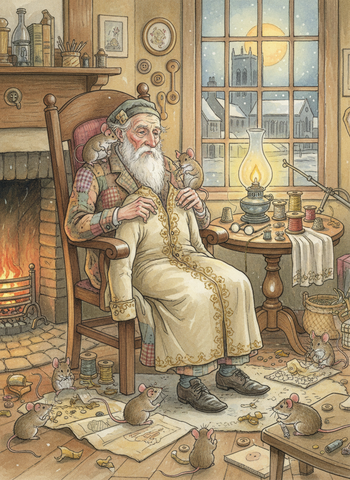
A poor, ailing tailor in Gloucester falls ill with just one Christmas wedding coat left to finish — but the little mice he once set free have not forgotten his kindness.
In the time of swords and periwigs and full-skirted coats with flowered lappets—when gentlemen wore ruffles, and gold-laced waistcoats of paduasoy and taffeta—there lived a tailor in Gloucester.
En los tiempos de las espadas y las pelucas empolvadas y los abrigos de faldón amplio con solapas floreadas —cuando los caballeros llevaban chorreras y chalecos con ribetes dorados de paduasoy y tafetán— vivía un sastre en Gloucester.
He sat in the window of a little shop in Westgate Street, cross-legged on a table, from morning till dark.
Se sentaba en el escaparate de una pequeña tienda en Westgate Street, con las piernas cruzadas sobre una mesa, desde la mañana hasta el anochecer.
All day long while the light lasted he sewed and snippeted, piecing out his satin and pompadour, and lutestring; stuffs had strange names, and were very expensive in the days of the Tailor of Gloucester.
Todo el día, mientras hubiera luz, cosía y recortaba, uniendo retazos de raso, popelín y seda relucientes; las telas tenían nombres extraños y eran muy caras en los tiempos del Sastre de Gloucester.
But although he sewed fine silk for his neighbours, he himself was very, very poor—a little old man in spectacles, with a pinched face, old crooked fingers, and a suit of thread-bare clothes.
Pero aunque cosía sedas finas para sus vecinos, él mismo era muy, muy pobre: un ancianito con anteojos, de rostro chupado, dedos viejos y torcidos, y un traje raído.
He cut his coats without waste, according to his embroidered cloth; they were very small ends and snippets that lay about upon the table—"Too narrow breadths for nought—except waistcoats for mice," said the tailor.
Cortaba sus abrigos sin desperdiciar nada de su tela bordada; quedaban sobre la mesa retazos y recortes muy pequeños. «Anchos demasiado estrechos para nada, salvo para hacer chalecos de ratón», decía el sastre.
One bitter cold day near Christmastime the tailor began to make a coat—a coat of cherry-coloured corded silk embroidered with pansies and roses, and a cream coloured satin waistcoat—trimmed with gauze and green worsted chenille—for the Mayor of Gloucester.
Un día de frío intenso, cerca de la Navidad, el sastre se puso a hacer un abrigo —un abrigo de seda acordonada color cereza bordado con pensamientos y rosas, y un chaleco de raso color crema, adornado con gasa y felpilla de estambre verde— para el Alcalde de Gloucester.
The tailor worked and worked, and he talked to himself. He measured the silk, and turned it round and round, and trimmed it into shape with his shears; the table was all littered with cherry-coloured snippets.
El sastre trabajaba y trabajaba, y hablaba solo. Medía la seda, la giraba una y otra vez, y la recortaba con sus tijeras; la mesa quedó cubierta de retazos color cereza.
"No breadth at all, and cut on the cross; it is no breadth at all; tippets for mice and ribbons for mobs! for mice!" said the Tailor of Gloucester.
«Ni un ancho entero, y cortado al bies; no queda ni un ancho entero; capas para ratones y cintas para gorros, ¡para ratones!», decía el Sastre de Gloucester.
When the snow-flakes came down against the small leaded window-panes and shut out the light, the tailor had done his day's work; all the silk and satin lay cut out upon the table.
Cuando los copos de nieve empezaron a caer contra los pequeños vidrios emplomados de la ventana y apagaron la luz, el sastre había terminado su trabajo del día; toda la seda y el raso yacían cortados sobre la mesa.
There were twelve pieces for the coat and four pieces for the waistcoat; and there were pocket flaps and cuffs, and buttons all in order. For the lining of the coat there was fine yellow taffeta; and for the button-holes of the waistcoat, there was cherry-coloured twist. And everything was ready to sew together in the morning, all measured and sufficient—except that there was wanting just one single skein of cherry-coloured twisted silk.
Había doce piezas para el abrigo y cuatro para el chaleco; y había carteras de bolsillo y puños, y botones, todo en orden. Para el forro del abrigo había un fino tafetán amarillo; y para los ojales del chaleco, había torzal color cereza. Y todo estaba listo para coserse a la mañana siguiente, todo medido y suficiente, salvo que faltaba una sola madeja de seda torcida color cereza.
The tailor came out of his shop at dark, for he did not sleep there at nights; he fastened the window and locked the door, and took away the key. No one lived there at night but little brown mice, and they run in and out without any keys!
El sastre salió de su tienda al caer la noche, pues no dormía allí; aseguró la ventana, cerró la puerta con llave y se llevó la llave consigo. Allí no vivía nadie de noche, solo unos ratoncitos pardos, ¡y ellos entraban y salían sin necesidad de llaves!
For behind the wooden wainscots of all the old houses in Gloucester, there are little mouse staircases and secret trap-doors; and the mice run from house to house through those long narrow passages; they can run all over the town without going into the streets.
Pues detrás de los revestimientos de madera de todas las casas viejas de Gloucester hay pequeñas escaleras de ratones y trampillas secretas; y los ratones corren de casa en casa por esos pasajes largos y angostos; pueden recorrer toda la ciudad sin salir jamás a las calles.
But the tailor came out of his shop, and shuffled home through the snow. He lived quite near by in College Court, next the doorway to College Green; and although it was not a big house, the tailor was so poor he only rented the kitchen.
Pero el sastre salió de su tienda y anduvo arrastrando los pies por la nieve hasta su casa. Vivía muy cerca, en College Court, junto a la entrada de College Green; y aunque no era una casa grande, el sastre era tan pobre que solo alquilaba la cocina.
He lived alone with his cat; it was called Simpkin.
Vivía solo con su gato; se llamaba Simpkin.
Now all day long while the tailor was out at work, Simpkin kept house by himself; and he also was fond of the mice, though he gave them no satin for coats!
Ahora bien, todo el día, mientras el sastre estaba fuera trabajando, Simpkin cuidaba la casa por su cuenta; y también él sentía cariño por los ratones, ¡aunque no les daba raso para hacerles abrigos!
"Miaw?" said the cat when the tailor opened the door. "Miaw?"
«¿Miau?», dijo el gato cuando el sastre abrió la puerta. «¿Miau?»
The tailor replied—"Simpkin, we shall make our fortune, but I am worn to a ravelling. Take this groat (which is our last fourpence) and Simpkin, take a china pipkin; buy a penn'orth of bread, a penn'orth of milk and a penn'orth of sausages. And oh, Simpkin, with the last penny of our fourpence buy me one penn'orth of cherry-coloured silk. But do not lose the last penny of the fourpence, Simpkin, or I am undone and worn to a thread-paper, for I have NO MORE TWIST."
El sastre respondió: «Simpkin, vamos a hacer nuestra fortuna, pero estoy hecho jirones. Toma este groat (que es nuestro último cuartillo) y, Simpkin, toma también una jarrita de loza; compra un penique de pan, un penique de leche y un penique de salchichas. Y ay, Simpkin, con el último penique de nuestros cuatro peniques cómprame un penique de seda color cereza. Pero no vayas a perder ese último penique, Simpkin, o estaré perdido y hecho un hilacho, pues NO ME QUEDA MÁS TORZAL».
Then Simpkin again said, "Miaw?" and took the groat and the pipkin, and went out into the dark.
Entonces Simpkin volvió a decir «¿Miau?», y tomó el groat y la jarrita, y salió hacia la oscuridad.
The tailor was very tired and beginning to be ill. He sat down by the hearth and talked to himself about that wonderful coat.
El sastre estaba muy cansado y empezaba a sentirse enfermo. Se sentó junto al hogar y se puso a hablar solo sobre aquel maravilloso abrigo.
"I shall make my fortune—to be cut bias—the Mayor of Gloucester is to be married on Christmas Day in the morning, and he hath ordered a coat and an embroidered waistcoat—to be lined with yellow taffeta—and the taffeta sufficeth; there is no more left over in snippets than will serve to make tippets for mice——"
«Voy a hacer mi fortuna —cortado al bies—; el Alcalde de Gloucester se casará el día de Navidad por la mañana, y me ha encargado un abrigo y un chaleco bordado —forrado de tafetán amarillo— y el tafetán alcanza; no queda de sobra en los recortes más que lo justo para hacer capitas de ratón…»
Then the tailor started; for suddenly, interrupting him, from the dresser at the other side of the kitchen came a number of little noises—
Entonces el sastre se sobresaltó; pues de pronto, interrumpiéndolo, desde el aparador al otro lado de la cocina llegó una serie de ruiditos.
Tip tap, tip tap, tip tap tip!
¡Tic tac, tic tac, tic tac tic!
"Now what can that be?" said the Tailor of Gloucester, jumping up from his chair. The dresser was covered with crockery and pipkins, willow pattern plates, and tea-cups and mugs.
«¿Y ahora qué puede ser eso?», dijo el Sastre de Gloucester, levantándose de un salto de su silla. El aparador estaba cubierto de loza y jarritas, platos de estampado de sauce, y tazas y jarras de té.
The tailor crossed the kitchen, and stood quite still beside the dresser, listening, and peering through his spectacles. Again from under a tea-cup, came those funny little noises—
El sastre cruzó la cocina y se quedó muy quieto junto al aparador, escuchando y mirando por encima de sus anteojos. De nuevo, bajo una taza de té, llegaron aquellos graciosos ruiditos.
Tip tap, tip tap, Tip tap tip!
¡Tic tac, tic tac, tic tac tic!
"This is very peculiar," said the Tailor of Gloucester; and he lifted up the tea-cup which was upside down.
«Esto es muy peculiar», dijo el Sastre de Gloucester; y levantó la taza de té que estaba boca abajo.
Out stepped a little live lady mouse, and made a curtsey to the tailor! Then she hopped away down off the dresser, and under the wainscot.
¡Salió una ratoncita viva y le hizo una reverencia al sastre! Luego se alejó saltando del aparador y se metió bajo el revestimiento de madera.
The tailor sat down again by the fire, warming his poor cold hands, and mumbling to himself——
El sastre se sentó de nuevo junto al fuego, calentándose las pobres manos frías, y murmurando para sí.
"The waistcoat is cut out from peach-coloured satin—tambour stitch and rose-buds in beautiful floss silk. Was I wise to entrust my last fourpence to Simpkin? One-and-twenty button-holes of cherry-coloured twist!"
«El chaleco está cortado de raso color melocotón —punto de tambor y capullos de rosa en hermosa seda floja. ¿Habré hecho bien en confiar mi último cuartillo a Simpkin? ¡Veintiún ojales de torzal color cereza!»
But all at once, from the dresser, there came other little noises:
Pero de pronto, desde el aparador, llegaron otros ruiditos:
Tip tap, tip tap, tip tap tip!
¡Tic tac, tic tac, tic tac tic!
"This is passing extraordinary!" said the Tailor of Gloucester, and turned over another tea-cup, which was upside down.
«¡Esto es sencillamente extraordinario!», dijo el Sastre de Gloucester, y volteó otra taza de té que estaba boca abajo.
Out stepped a little gentleman mouse, and made a bow to the tailor!
¡Salió un ratoncito caballero y le hizo una reverencia al sastre!
And then from all over the dresser came a chorus of little tappings, all sounding together, and answering one another, like watch-beetles in an old worm-eaten window-shutter—
Y entonces, por todo el aparador, llegó un coro de golpecitos, todos sonando juntos y respondiéndose unos a otros, como escarabajos de reloj en un viejo postigo carcomido.
Tip tap, tip tap, tip tap tip!
¡Tic tac, tic tac, tic tac tic!
And out from under tea-cups and from under bowls and basins, stepped other and more little mice who hopped away down off the dresser and under the wainscot.
Y de debajo de las tazas de té y de los cuencos y las palanganas salieron otros ratoncitos más, que se alejaron saltando del aparador y se metieron bajo el revestimiento de madera.
The tailor sat down, close over the fire, lamenting—"One-and-twenty button-holes of cherry-coloured silk! To be finished by noon of Saturday: and this is Tuesday evening. Was it right to let loose those mice, undoubtedly the property of Simpkin? Alack, I am undone, for I have no more twist!"
El sastre se sentó, muy pegado al fuego, lamentándose: «¡Veintiún ojales de seda color cereza! Debe estar terminado para el mediodía del sábado, y esto es la tarde del martes. ¿Habré hecho bien en soltar a esos ratones, que sin duda son propiedad de Simpkin? Ay, estoy perdido, pues ¡no me queda más torzal!»
The little mice came out again, and listened to the tailor; they took notice of the pattern of that wonderful coat. They whispered to one another about the taffeta lining, and about little mouse tippets.
Los ratoncitos volvieron a salir y escucharon al sastre; se fijaron en el patrón de aquel maravilloso abrigo. Se susurraron unos a otros sobre el forro de tafetán y sobre pequeñas capitas de ratón.
And then all at once they all ran away together down the passage behind the wainscot, squeaking and calling to one another, as they ran from house to house; and not one mouse was left in the tailor's kitchen when Simpkin came back with the pipkin of milk!
Y entonces, de repente, todos se marcharon juntos corriendo por el pasadizo detrás del revestimiento, chillando y llamándose unos a otros mientras corrían de casa en casa; ¡y no quedó ni un solo ratón en la cocina del sastre cuando Simpkin volvió con la jarrita de leche!
Simpkin opened the door and bounced in, with an angry "G-r-r-miaw!" like a cat that is vexed: for he hated the snow, and there was snow in his ears, and snow in his collar at the back of his neck. He put down the loaf and the sausages upon the dresser, and sniffed.
Simpkin abrió la puerta y entró de un brinco, con un enojado «¡Grr-miau!», como un gato fastidiado: pues odiaba la nieve, y tenía nieve en las orejas y nieve en el cuello por detrás. Dejó el pan y las salchichas sobre el aparador, y olfateó.
"Simpkin," said the tailor, "where is my twist?"
«Simpkin», dijo el sastre, «¿dónde está mi torzal?»
But Simpkin set down the pipkin of milk upon the dresser, and looked suspiciously at the tea-cups. He wanted his supper of little fat mouse!
Pero Simpkin dejó la jarrita de leche sobre el aparador y miró con recelo las tazas de té. ¡Quería su cena de ratoncito gordo!
"Simpkin," said the tailor, "where is my TWIST?"
«Simpkin», dijo el sastre, «¿DÓNDE está mi TORZAL?»
But Simpkin hid a little parcel privately in the tea-pot, and spit and growled at the tailor; and if Simpkin had been able to talk, he would have asked: "Where is my MOUSE?"
Pero Simpkin escondió a escondidas un paquetito en la tetera, y bufó y gruñó al sastre; y si Simpkin hubiera podido hablar, habría preguntado: «¿Dónde está mi RATÓN?»
"Alack, I am undone!" said the Tailor of Gloucester, and went sadly to bed.
«¡Ay, estoy perdido!», dijo el Sastre de Gloucester, y se fue tristemente a la cama.
All that night long Simpkin hunted and searched through the kitchen, peeping into cupboards and under the wainscot, and into the tea-pot where he had hidden that twist; but still he found never a mouse!
Toda esa noche Simpkin buscó y rebuscó por toda la cocina, husmeando en los armarios y bajo el revestimiento de madera, y dentro de la tetera donde había escondido aquel torzal; ¡pero no encontró ni un solo ratón!
Whenever the tailor muttered and talked in his sleep, Simpkin said "Miaw-ger-r-w-s-s-ch!" and made strange horrid noises, as cats do at night.
Cada vez que el sastre murmuraba y hablaba en sueños, Simpkin decía «¡Miau-grr-uau-ss-ch!» y hacía ruidos raros y horribles, como hacen los gatos de noche.
For the poor old tailor was very ill with a fever, tossing and turning in his four-post bed; and still in his dreams he mumbled—"No more twist! no more twist!"
Pues el pobre y anciano sastre estaba muy enfermo, con fiebre, revolviéndose en su cama de cuatro postes; y aún en sueños murmuraba: «¡No me queda más torzal! ¡No me queda más torzal!»
All that day he was ill, and the next day, and the next; and what should become of the cherry-coloured coat? In the tailor's shop in Westgate Street the embroidered silk and satin lay cut out upon the table—one-and-twenty button-holes—and who should come to sew them, when the window was barred, and the door was fast locked?
Todo ese día estuvo enfermo, y al día siguiente, y al otro; y ¿qué sería del abrigo color cereza? En la tienda del sastre, en Westgate Street, la seda y el raso bordados yacían cortados sobre la mesa —veintiún ojales— y ¿quién vendría a coserlos, con la ventana atrancada y la puerta bien cerrada con llave?
But that does not hinder the little brown mice; they run in and out without any keys through all the old houses in Gloucester!
Pero eso no detiene a los ratoncitos pardos; ¡ellos entran y salen sin necesidad de llaves por todas las casas viejas de Gloucester!
Out of doors the market folks went trudging through the snow to buy their geese and turkeys, and to bake their Christmas pies; but there would be no Christmas dinner for Simpkin and the poor old Tailor of Gloucester.
Afuera, la gente del mercado iba caminando con esfuerzo por la nieve para comprar sus gansos y pavos, y hornear sus pasteles de Navidad; pero no habría cena de Navidad para Simpkin ni para el pobre y anciano Sastre de Gloucester.
The tailor lay ill for three days and nights; and then it was Christmas Eve, and very late at night. The moon climbed up over the roofs and chimneys, and looked down over the gateway into College Court. There were no lights in the windows, nor any sound in the houses; all the city of Gloucester was fast asleep under the snow.
El sastre estuvo enfermo tres días y tres noches; y luego llegó la víspera de Navidad, muy entrada la noche. La luna se alzó sobre los tejados y las chimeneas, y miró hacia abajo por encima de la entrada de College Court. No había luces en las ventanas, ni ningún sonido en las casas; toda la ciudad de Gloucester dormía profundamente bajo la nieve.
And still Simpkin wanted his mice, and he mewed as he stood beside the four-post bed.
Y Simpkin seguía queriendo sus ratones, y maullaba de pie junto a la cama de cuatro postes.
But it is in the old story that all the beasts can talk, in the night between Christmas Eve and Christmas Day in the morning (though there are very few folk that can hear them, or know what it is that they say).
Pero cuenta la vieja historia que todos los animales pueden hablar, en la noche entre la Nochebuena y la mañana de Navidad (aunque muy poca gente puede oírlos, o sabe lo que dicen).
When the Cathedral clock struck twelve there was an answer—like an echo of the chimes—and Simpkin heard it, and came out of the tailor's door, and wandered about in the snow.
Cuando el reloj de la Catedral dio las doce, hubo una respuesta —como un eco de las campanadas— y Simpkin la oyó, y salió por la puerta del sastre, y anduvo vagando por la nieve.
From all the roofs and gables and old wooden houses in Gloucester came a thousand merry voices singing the old Christmas rhymes—all the old songs that ever I heard of, and some that I don't know, like Whittington's bells.
De todos los tejados y frontones y viejas casas de madera de Gloucester llegó un millar de voces alegres cantando los viejos villancicos de Navidad —todas las viejas canciones que jamás he oído, y algunas que ni siquiera conozco, como las campanas de Whittington.
First and loudest the cocks cried out: "Dame, get up, and bake your pies!"
Primero y más fuerte, los gallos cantaron: «¡Ama, levántate y hornea tus pasteles!»
"Oh, dilly, dilly, dilly!" sighed Simpkin.
«¡Ay, dilly, dilly, dilly!», suspiró Simpkin.
And now in a garret there were lights and sounds of dancing, and cats came from over the way.
Y ahora, en una buhardilla, había luces y sonidos de baile, y venían gatos de todas partes.
"Hey, diddle, diddle, the cat and the fiddle! All the cats in Gloucester—except me," said Simpkin.
«¡Hey, diddle, diddle, el gato y el violín! Todos los gatos de Gloucester… menos yo», dijo Simpkin.
Under the wooden eaves the starlings and sparrows sang of Christmas pies; the jack-daws woke up in the Cathedral tower; and although it was the middle of the night the throstles and robins sang; the air was quite full of little twittering tunes.
Bajo los aleros de madera, los estorninos y gorriones cantaban sobre los pasteles de Navidad; las grajillas despertaron en la torre de la Catedral; y aunque era plena noche, los zorzales y petirrojos cantaban; el aire estaba lleno de pequeñas melodías gorjeantes.
But it was all rather provoking to poor hungry Simpkin!
¡Pero todo aquello resultaba bastante irritante para el pobre y hambriento Simpkin!
Particularly he was vexed with some little shrill voices from behind a wooden lattice. I think that they were bats, because they always have very small voices—especially in a black frost, when they talk in their sleep, like the Tailor of Gloucester.
En particular, lo fastidiaban unas vocecitas agudas que venían de detrás de una celosía de madera. Creo que eran murciélagos, porque siempre tienen voces muy pequeñas, sobre todo en una helada intensa, cuando hablan en sueños, igual que el Sastre de Gloucester.
They said something mysterious that sounded like—
Decían algo misterioso que sonaba así:
"Buz, quoth the blue fly, hum, quoth the bee, Buz and hum they cry, and so do we!"
«Zumba, dice la mosca azul; hum, dice la abeja; zumban y hacen hum, y nosotros también lo hacemos así».
and Simpkin went away shaking his ears as if he had a bee in his bonnet.
Y Simpkin se alejó sacudiendo las orejas, como si tuviera una abeja en el sombrero.
From the tailor's shop in Westgate came a glow of light; and when Simpkin crept up to peep in at the window it was full of candles. There was a snippeting of scissors, and snappeting of thread; and little mouse voices sang loudly and gaily—
De la tienda del sastre en Westgate salía un resplandor de luz; y cuando Simpkin se acercó sigilosamente a espiar por la ventana, la vio llena de velas. Se oía el recorte de las tijeras y el chasquido del hilo; y unas vocecitas de ratón cantaban fuerte y alegremente.
"Four-and-twenty tailors Went to catch a snail, The best man amongst them Durst not touch her tail, She put out her horns Like a little kyloe cow, Run, tailors, run! or she'll have you all e'en now!"
«Veinticuatro sastres se fueron a cazar un caracol; el más valiente de todos no se atrevió a tocarle la cola; ella sacó sus cuernos como una vaquita de las Highlands. ¡Corran, sastres, corran, o los atrapará a todos ahora mismo!»
Then without a pause the little mouse voices went on again—
Y sin pausa, las vocecitas de ratón siguieron cantando de nuevo:
"Sieve my lady's oatmeal, Grind my lady's flour, Put it in a chestnut, Let it stand an hour——"
«Cierne la avena de mi señora, muele la harina de mi señora, mételo en una castaña y déjalo reposar una hora…»
"Mew! Mew!" interrupted Simpkin, and he scratched at the door. But the key was under the tailor's pillow, he could not get in.
«¡Miau! ¡Miau!», interrumpió Simpkin, y arañó la puerta. Pero la llave estaba bajo la almohada del sastre, y no pudo entrar.
The little mice only laughed, and tried another tune—
Los ratoncitos solo se rieron, y probaron otra tonada:
"Three little mice sat down to spin, Pussy passed by and she peeped in. What are you at, my fine little men? Making coats for gentlemen. Shall I come in and cut off your threads? Oh, no, Miss Pussy, you'd bite off our heads!"
«Tres ratoncitos se sentaron a hilar; la gatita pasó y se asomó a mirar. ¿Qué hacéis, mis buenos hombrecillos? Hacemos abrigos para caballeros. ¿Puedo entrar y cortaros los hilos? ¡Ay no, señorita Gatita, nos morderías la cabeza!»
"Mew! Mew!" cried Simpkin. "Hey diddle dinketty?" answered the little mice—
«¡Miau! ¡Miau!», gritó Simpkin. «¿Hey diddle dinketty?», respondieron los ratoncitos.
"Hey diddle dinketty, poppetty pet! The merchants of London they wear scarlet; Silk in the collar, and gold in the hem, So merrily march the merchantmen!"
«¡Hey diddle dinketty, poppetty pet! Los mercaderes de Londres visten de escarlata; seda en el cuello y oro en el ribete, ¡así marchan alegremente los mercaderes!»
They clicked their thimbles to mark the time, but none of the songs pleased Simpkin; he sniffed and mewed at the door of the shop.
Chasquearon sus dedales para marcar el compás, pero ninguna de las canciones agradó a Simpkin; olfateó y maulló a la puerta de la tienda.
"And then I bought A pipkin and a popkin, A slipkin and a slopkin, All for one farthing——
«Y luego compré una jarrita y una cosita, una botita y otra cosita, todo por un cuarto de penique…»
and upon the kitchen dresser!" added the rude little mice.
«¡Y sobre el aparador de la cocina!», añadieron los ratoncitos traviesos.
"Mew! scratch! scratch!" scuffled Simpkin on the window-sill; while the little mice inside sprang to their feet, and all began to shout at once in little twittering voices: "No more twist! No more twist!" And they barred up the window shutters and shut out Simpkin.
«¡Miau! ¡Araña, araña!», forcejeó Simpkin en el alféizar de la ventana; mientras los ratoncitos de adentro se ponían de pie de un salto, y todos empezaron a gritar a la vez con vocecitas gorjeantes: «¡No queda más torzal! ¡No queda más torzal!» Y cerraron los postigos de la ventana y dejaron fuera a Simpkin.
But still through the nicks in the shutters he could hear the click of thimbles, and little mouse voices singing—
Pero aún a través de las rendijas de los postigos podía oír el chasquido de los dedales, y las vocecitas de ratón cantando:
"No more twist! No more twist!"
«¡No queda más torzal! ¡No queda más torzal!»
Simpkin came away from the shop and went home, considering in his mind. He found the poor old tailor without fever, sleeping peacefully.
Simpkin se alejó de la tienda y se fue a casa, pensativo. Encontró al pobre anciano sastre sin fiebre, durmiendo apaciblemente.
Then Simpkin went on tip-toe and took a little parcel of silk out of the tea-pot, and looked at it in the moonlight; and he felt quite ashamed of his badness compared with those good little mice!
Entonces Simpkin fue de puntillas y sacó un paquetito de seda de la tetera, y lo miró a la luz de la luna; ¡y sintió mucha vergüenza de su maldad, comparada con la de aquellos buenos ratoncitos!
When the tailor awoke in the morning, the first thing which he saw upon the patchwork quilt, was a skein of cherry-coloured twisted silk, and beside his bed stood the repentant Simpkin!
Cuando el sastre despertó por la mañana, lo primero que vio sobre la colcha de retazos fue una madeja de seda torcida color cereza, y junto a su cama estaba el arrepentido Simpkin.
"Alack, I am worn to a ravelling," said the Tailor of Gloucester, "but I have my twist!"
«Ay, estoy hecho jirones», dijo el Sastre de Gloucester, «¡pero tengo mi torzal!»
The sun was shining on the snow when the tailor got up and dressed, and came out into the street with Simpkin running before him.
El sol brillaba sobre la nieve cuando el sastre se levantó y se vistió, y salió a la calle con Simpkin corriendo delante de él.
The starlings whistled on the chimney stacks, and the throstles and robins sang—but they sang their own little noises, not the words they had sung in the night.
Los estorninos silbaban en las chimeneas, y los zorzales y petirrojos cantaban, pero cantaban sus propios ruiditos, no las palabras que habían cantado por la noche.
"Alack," said the tailor, "I have my twist; but no more strength—nor time—than will serve to make me one single button-hole; for this is Christmas Day in the Morning! The Mayor of Gloucester shall be married by noon—and where is his cherry-coloured coat?"
«Ay», dijo el sastre, «tengo mi torzal, pero no me queda más fuerza —ni tiempo— que la justa para hacer un solo ojal; ¡pues esta es la mañana de Navidad! El Alcalde de Gloucester se casará al mediodía, ¿y dónde está su abrigo color cereza?»
He unlocked the door of the little shop in Westgate Street, and Simpkin ran in, like a cat that expects something.
Abrió la puerta de la pequeña tienda en Westgate Street, y Simpkin entró corriendo, como un gato que espera algo.
But there was no one there! Not even one little brown mouse!
¡Pero allí no había nadie! ¡Ni siquiera un solo ratoncito pardo!
The boards were swept clean; the little ends of thread and the little silk snippets were all tidied away, and gone from off the floor.
El suelo estaba barrido y limpio; los cabitos de hilo y los pequeños retazos de seda habían sido recogidos y ya no estaban en el suelo.
But upon the table—oh joy! the tailor gave a shout—there, where he had left plain cuttings of silk—there lay the most beautifullest coat and embroidered satin waistcoat that ever were worn by a Mayor of Gloucester.
Pero sobre la mesa —¡oh, alegría!— el sastre lanzó un grito—: allí, donde había dejado simples recortes de seda, había ahora el abrigo más hermoso y el chaleco de raso bordado más bello que jamás hubiera llevado un Alcalde de Gloucester.
There were roses and pansies upon the facings of the coat; and the waistcoat was worked with poppies and corn-flowers.
Había rosas y pensamientos en las solapas del abrigo; y el chaleco estaba bordado con amapolas y acianos.
Everything was finished except just one single cherry-coloured button-hole, and where that button-hole was wanting there was pinned a scrap of paper with these words—in little teeny weeny writing—
Todo estaba terminado, salvo un solo ojal color cereza, y donde faltaba ese ojal había prendido un trocito de papel con estas palabras, en una letra diminuta:
NO MORE TWIST
NO QUEDA MÁS TORZAL
And from then began the luck of the Tailor of Gloucester; he grew quite stout, and he grew quite rich.
Y desde entonces comenzó la buena suerte del Sastre de Gloucester; engordó bastante y se hizo bastante rico.
He made the most wonderful waistcoats for all the rich merchants of Gloucester, and for all the fine gentlemen of the country round.
Hizo los chalecos más maravillosos para todos los ricos mercaderes de Gloucester, y para todos los distinguidos caballeros de los alrededores.
Never were seen such ruffles, or such embroidered cuffs and lappets! But his button-holes were the greatest triumph of it all.
¡Nunca se vieron chorreras, ni puños ni solapas bordadas semejantes! Pero sus ojales fueron el mayor triunfo de todos.
The stitches of those button-holes were so neat—so neat—I wonder how they could be stitched by an old man in spectacles, with crooked old fingers, and a tailor's thimble.
Las puntadas de aquellos ojales eran tan pulcras —tan pulcras— que me pregunto cómo pudo hacerlas un anciano con anteojos, con dedos viejos y torcidos, y un dedal de sastre.
The stitches of those button-holes were so small—so small—they looked as if they had been made by little mice!
Las puntadas de aquellos ojales eran tan diminutas —tan diminutas— que parecían hechas por ratoncitos.
