The Master-Smith
A free B2-level English story for language learners, readable online in 7 languages, with an option to listen via the free Storyteller app.
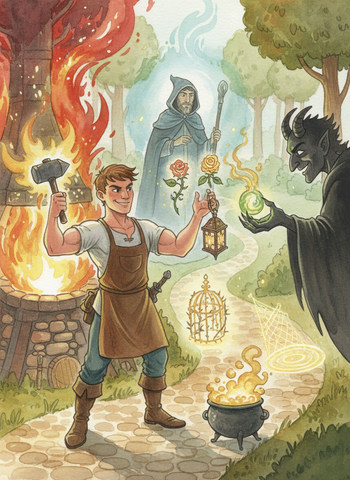
A cocky blacksmith trades his soul to the Devil, then wins three strange wishes from a mysterious traveller — and turns them into traps for anyone who comes to collect what's owed.
Once on a time, in the days when our Lord and St Peter used to wander on earth, they came to a smith’s house. He had made a bargain with the Devil, that the fiend should have him after seven years, but during that time he was to be the master of all masters in his trade, and to this bargain both he and the Devil had signed their names. So he had stuck up in great letters over the door of his forge: _“Here dwells the Master over all Masters.”_
Érase una vez, en los días en que Nuestro Señor y San Pedro solían andar por la tierra, llegaron a la casa de un herrero. Este había hecho un trato con el Diablo, que el maligno lo tendría al cabo de siete años, pero durante ese tiempo él sería el maestro de todos los maestros en su oficio, y a este trato tanto él como el Diablo habían firmado con sus nombres. Así que había colgado en grandes letras sobre la puerta de su fragua: _“Aquí vive el Maestro sobre todos los Maestros.”_
Now when our Lord passed by and saw that, he went in.
Ahora bien, cuando Nuestro Señor pasó y vio eso, entró.
“Who are you?” he said to the Smith.
“¿Quién eres tú?” le dijo al herrero.
“Read what’s written over the door”, said the Smith; “but maybe you can’t read writing. If so, you must wait till some one comes to help you.”
“Lee lo que está escrito sobre la puerta”, dijo el herrero; “pero quizás no sepas leer. Si es así, tendrás que esperar hasta que alguien venga a ayudarte.”
Before our Lord had time to answer him, a man came with his horse, which he begged the Smith to shoe.
Antes de que Nuestro Señor tuviera tiempo de responderle, llegó un hombre con su caballo, al que le pidió al herrero que herrara.
“Might I have leave to shoe it?” asked our Lord.
“¿Me daría permiso de herrarlo?” preguntó Nuestro Señor.
“You may try, if you like”, said the Smith; “you can’t do it so badly that I shall not be able to make it right again.”
“Puede intentarlo, si quiere”, dijo el herrero; “no puede hacerlo tan mal que yo no pueda arreglarlo después.”
So our Lord went out and took one leg off the horse, and laid it in the furnace, and made the shoe red-hot; after that, he turned up the ends of the shoe, and filed down the heads of the nails, and clenched the points; and then he put back the leg safe and sound on the horse again.
Así que Nuestro Señor salió y le quitó una pata al caballo, y la puso en el horno, y calentó la herradura hasta ponerla al rojo vivo; después de eso, dobló los extremos de la herradura, y limó las cabezas de los clavos, y remachó las puntas; y luego volvió a poner la pata sana y salva en el caballo.
And when he was done with that leg, he took the other fore-leg and did the same with it; and when he was done with that, he took the hind-legs—first, the off, and then the near leg, and laid them in the furnace, making the shoes red-hot, turning up the ends; filing the heads of the nails, and clenching the points; and after all was done, putting the legs on the horse again. All the while, the Smith stood by and looked on.
Y cuando terminó con esa pata, tomó la otra pata delantera e hizo lo mismo con ella; y cuando terminó con esa, tomó las patas traseras—primero la derecha, y luego la izquierda—y las puso en el horno, calentando las herraduras al rojo vivo, doblando los extremos; limando las cabezas de los clavos, y remachando las puntas; y cuando todo estuvo hecho, volvió a poner las patas en el caballo. Durante todo ese tiempo, el herrero se quedó mirando.
“You’re not so bad a smith after all”, said he.
“No eres tan mal herrero después de todo”, dijo.
“Oh, you think so, do you?” said our Lord.
“Ah, ¿eso crees?” dijo Nuestro Señor.
A little while after came the Smith’s mother to the forge, and called him to come home and eat his dinner; she was an old, old woman with an ugly crook on her back, and wrinkles in her face, and it was as much as she could do to crawl along.
Un rato después llegó a la fragua la madre del herrero, y lo llamó para que fuera a comer; era una anciana, muy anciana, con una horrible joroba en la espalda, y arrugas en el rostro, y ya era bastante lo que podía hacer con arrastrarse.
“Mark now, what you see”, said our Lord.
“Fíjate bien en lo que verás”, dijo Nuestro Señor.
Then he took the woman and laid her in the furnace, and smithied a lovely young maiden out of her.
Entonces tomó a la mujer y la puso en el horno, y forjó de ella una hermosa doncella joven.
“Well”, said the Smith, “I say now, as I said before, you are not such a bad smith after all. There it stands over my door. _Here dwells the Master over all Masters_ ; but for all that, I say right out, one learns as long as one lives”; and with that he walked off to his house and ate his dinner.
“Bueno”, dijo el herrero, “ahora digo, como dije antes, que no eres tan mal herrero después de todo. Ahí está escrito sobre mi puerta: _Aquí vive el Maestro sobre todos los Maestros_; pero aun así, lo digo bien claro, uno aprende mientras vive”; y con eso se fue a su casa y comió.
So after dinner, just after he had got back to his forge, a man came riding up to have his horse shod.
Así que después de comer, apenas había vuelto a su fragua, un hombre llegó cabalgando para que le herraran el caballo.
“It shall be done in the twinkling of an eye”, said the Smith, “for I have just learnt a new way to shoe; and a very good way it is when the days are short.”
“Se hará en un abrir y cerrar de ojos”, dijo el herrero, “pues acabo de aprender una nueva manera de herrar; y es muy buena manera cuando los días son cortos.”
So he began to cut and hack till he had got all the horse’s legs off, for he said, I don’t know why one should go pottering backwards and forwards—first, with one leg, and then with another.
Así que se puso a cortar y a hachear hasta que le hubo quitado todas las patas al caballo, pues dijo: no sé por qué uno tiene que andar dando vueltas de un lado a otro—primero con una pata, y luego con otra.
Then he laid the legs in the furnace, just as he had seen our Lord lay them, and threw on a great heap of coal, and made his mates work the bellows bravely; but it went as one might suppose it would go. The legs were burnt to ashes, and the Smith had to pay for the horse.
Entonces puso las patas en el horno, tal como había visto hacer a Nuestro Señor con ellas, y echó un gran montón de carbón, y puso a sus ayudantes a trabajar el fuelle con brío; pero salió como cabría suponer que saldría. Las patas se quemaron hasta hacerse cenizas, y el herrero tuvo que pagar por el caballo.
Well, he didn’t care much about that, but just then an old beggar-woman came along the road, and he thought to himself, “better luck next time”; so he took the old dame and laid her in the furnace, and though she begged and prayed hard for her life, it was no good.
Bueno, eso no le importó mucho, pero justo entonces una vieja mendiga pasó por el camino, y pensó para sí: “mejor suerte la próxima vez”; así que tomó a la anciana y la puso en el horno, y aunque ella suplicó y rogó con fuerza por su vida, de nada sirvió.
“You’re so old, you don’t know what is good for you”, said the Smith; “now you shall be a lovely young maiden in half no time, and for all that, I’ll not charge you a penny for the job.”
“Eres tan vieja que no sabes qué es bueno para ti”, dijo el herrero; “ahora serás una hermosa doncella joven en un santiamén, y con todo eso, no te cobraré ni un centavo por el trabajo.”
But it went no better with the poor old woman than with the horse’s legs.
Pero no le fue mejor a la pobre anciana que a las patas del caballo.
“That was ill done, and I say it”, said our Lord.
“Eso estuvo mal hecho, y lo digo yo”, dijo Nuestro Señor.
“Oh! for that matter”, said the Smith, “there’s not many who’ll ask after her, I’ll be bound; but it’s a shame of the Devil, if this is the way he holds to what is written up over the door.”
“¡Ah! por lo que a eso toca”, dijo el herrero, “no muchos preguntarán por ella, seguro; pero es una vergüenza del Diablo, si esta es la manera en que cumple lo que está escrito sobre la puerta.”
“If you might have three wishes from me”, said our Lord, “what would you wish for?”
“Si pudieras pedirme tres deseos”, dijo Nuestro Señor, “¿qué pedirías?”
“Only try me”, said the Smith, “and you’ll soon know.”
“Solo pruébame”, dijo el herrero, “y pronto lo sabrás.”
So our Lord gave him three wishes.
Así que Nuestro Señor le concedió tres deseos.
“Well”, said the Smith, “first and foremost, I wish that any one whom I ask to climb up into the pear-tree that stands outside by the wall of my forge, may stay sitting there till I ask him to come down again. The second wish I wish is, that any one whom I ask to sit down in my easy chair which stands inside the workshop yonder, may stay sitting there till I ask him to get up. Last of all, I wish that any one whom I ask to creep into the steel purse which I have in my pocket, may stay in it till I give him leave to creep out again.”
“Bueno”, dijo el herrero, “primero y ante todo, deseo que cualquiera a quien le pida que suba al peral que está afuera junto a la pared de mi fragua, se quede sentado allí hasta que yo le pida que baje de nuevo. El segundo deseo que pido es que cualquiera a quien le pida que se siente en mi sillón cómodo que está dentro del taller, se quede sentado allí hasta que yo le pida que se levante. Por último, deseo que cualquiera a quien le pida que se meta en la bolsa de acero que llevo en el bolsillo, se quede en ella hasta que yo le dé permiso para salir de nuevo.”
“You have wished as a wicked man”, said St Peter; “first and foremost, you should have wished for God’s grace and goodwill.”
“Has deseado como un hombre malvado”, dijo San Pedro; “primero y ante todo, deberías haber deseado la gracia y la buena voluntad de Dios.”
“I durstn’t look so high as that”, said the Smith; and after that our Lord and St Peter bade him “good-bye”, and went on their way.
“No me atrevería a mirar tan alto”, dijo el herrero; y después de eso Nuestro Señor y San Pedro le dijeron “adiós”, y siguieron su camino.
Well, the years went on and on, and when the time was up, the Devil came to fetch the Smith, as it was written in their bargain.
Bueno, pasaron los años, y cuando se cumplió el plazo, el Diablo vino a buscar al herrero, tal como estaba escrito en su trato.
“Are you ready?” he said, as he stuck his nose in at the door of the forge.
“¿Estás listo?” dijo, mientras asomaba la nariz por la puerta de la fragua.
“Oh”, said the Smith, “I must just hammer the head of this tenpenny nail first; meantime, you can just climb up into the pear-tree, and pluck yourself a pear to gnaw at; you must be, both hungry and thirsty after your journey.”
“Ah”, dijo el herrero, “antes debo martillar la cabeza de este clavo de diez peniques; mientras tanto, puedes subirte al peral, y arrancarte una pera para roer; debes de estar hambriento y sediento después de tu viaje.”
So the Devil thanked him for his kind offer, and climbed up into the pear-tree.
Así que el Diablo le agradeció su gentil oferta, y se subió al peral.
“Very good”, said the Smith; “but now, on thinking the matter over, I find I shall never be able to have done hammering the head of this nail till four years are out at least, this iron is so plaguey hard; down you can’t come in all that time, but may sit up there and rest your bones.”
“Muy bien”, dijo el herrero; “pero ahora, pensándolo mejor, veo que no podré terminar de martillar la cabeza de este clavo hasta dentro de al menos cuatro años, este hierro es tan endiabladamente duro; no podrás bajar en todo ese tiempo, pero puedes quedarte sentado ahí y descansar los huesos.”
When the Devil heard this, he begged and prayed till his voice was as thin as a silver penny that he might have leave to come down; but there was no help for it. There he was, and there he must stay. At last he had to give his word of honour not to come again till the four years were out, which the Smith had spoken of, and then the Smith said, “Very well, now you may come down.”
Cuando el Diablo oyó esto, suplicó y rogó hasta que su voz se hizo tan delgada como una moneda de plata, para que le dejaran bajar; pero no había remedio. Allí estaba, y allí tenía que quedarse. Al fin tuvo que dar su palabra de honor de no volver hasta que se cumplieran los cuatro años de los que había hablado el herrero, y entonces el herrero dijo: “Muy bien, ahora puedes bajar.”
So when the time was up, the Devil came again to fetch the Smith.
Así que cuando se cumplió el plazo, el Diablo volvió a buscar al herrero.
“You’re ready now, of course”, said he; “you’ve had time enough to hammer the head of that nail, I should think.”
“Ya estás listo, por supuesto”, dijo; “ya has tenido tiempo de sobra para martillar la cabeza de ese clavo, creería yo.”
“Yes, the head is right enough now”, said the Smith; “but still you have come a little tiny bit too soon, for I haven’t quite done sharpening the point; such plaguey hard iron I never hammered in all my born days. So while I work at the point, you may just as well sit down in my easy chair and rest yourself; I’ll be bound you’re weary after coming so far.”
“Sí, la cabeza ya está bastante bien”, dijo el herrero; “pero aun así llegas un poquitito demasiado pronto, pues no he terminado del todo de afilar la punta; nunca en toda mi vida martillé un hierro tan endiabladamente duro. Así que mientras trabajo en la punta, bien puedes sentarte en mi sillón cómodo y descansar; seguro que estás cansado tras venir de tan lejos.”
“Thank you kindly”, said the Devil, and down he plumped into the easy chair; but just as he had made himself comfortable, the Smith said, on second thoughts, he found he couldn’t get the point sharp till four years were out. First of all, the Devil begged so prettily to be let out of the chair, and afterwards, waxing wroth, he began to threaten and scold; but the Smith kept on, all the while excusing himself, and saying it was all the iron’s fault, it was so plaguy hard, and telling the Devil he was not so badly off to have to sit quietly in an easy chair, and that he would let him out to the minute when the four years were over.
“Se lo agradezco cordialmente”, dijo el Diablo, y se dejó caer en el sillón cómodo; pero justo cuando ya se había puesto cómodo, el herrero dijo, pensándolo mejor, que no podría afilar bien la punta hasta dentro de cuatro años. Primero el Diablo suplicó con buenas maneras que lo dejaran salir del sillón, y después, encolerizándose, comenzó a amenazar y a regañar; pero el herrero siguió, todo el tiempo excusándose, y diciendo que era culpa del hierro, que era tan endiabladamente duro, y le decía al Diablo que no estaba tan mal sentado tranquilamente en un sillón cómodo, y que lo dejaría salir al minuto exacto en que los cuatro años terminaran.
Well, at last there was no help for it, and the Devil had to give his word of honour not to fetch the Smith till the four years were out; and then the Smith said:
Bueno, al fin no hubo remedio, y el Diablo tuvo que dar su palabra de honor de no volver a buscar al herrero hasta que se cumplieran los cuatro años; y entonces el herrero dijo:
“Well now, you may get up and be off about your business”, and away went the Devil as fast as he could lay legs to the ground.
“Bueno, ahora puedes levantarte e ir a ocuparte de tus asuntos”, y allá se fue el Diablo tan rápido como pudo llevar las piernas.
When the four years were over, the Devil came again to fetch the Smith, and he called out, as he stuck his nose in at the door of the forge:
Cuando pasaron los cuatro años, el Diablo volvió a buscar al herrero, y llamó, mientras asomaba la nariz por la puerta de la fragua:
“Now, I know you must be ready.”
“Ahora sí, sé que debes estar listo.”
“Ready, aye, ready”, answered the Smith; “we can go now as soon as you please; but hark ye, there is one thing I have stood here and thought, and thought, I would ask you to tell me. Is it true what people say, that the Devil can make himself as small as he pleases?”
“Listo, sí, listo”, respondió el herrero; “podemos irnos ya en cuanto gustes; pero escucha, hay una cosa en la que he estado pensando y pensando aquí parado, y quisiera que me la dijeras. ¿Es verdad lo que dice la gente, que el Diablo puede hacerse tan pequeño como quiera?”
“God knows, it is the very truth”, said the Devil.
“Dios sabe que es la pura verdad”, dijo el Diablo.
“Oh!” said the Smith; “it is true, is it? then I wish you would just be so good as to creep into this steel purse of mine, and see whether it is sound at the bottom, for to tell you the truth, I’m afraid my travelling money will drop out.”
“¡Ah!” dijo el herrero; “¿así que es verdad? entonces desearía que fueras tan bueno de meterte en esta bolsa de acero mía, y ver si está firme por el fondo, pues a decir verdad, temo que mi dinero de viaje se me vaya a caer.”
“With all my heart”, said the Devil, who made himself small in a trice, and crept into the purse; but he was scarce in when the Smith snapped to the clasp.
“Con mucho gusto”, dijo el Diablo, que se hizo pequeño en un instante, y se metió en la bolsa; pero apenas había entrado cuando el herrero cerró de golpe el broche.
“Yes”, called out the Devil inside the purse; “it’s right and tight everywhere.”
“Sí”, gritó el Diablo desde dentro de la bolsa; “está firme y apretada por todas partes.”
“Very good”, said the Smith; “I’m glad to hear you say so, but ‘more haste the worse speed’, says the old saw, and ‘forewarned is forearmed’, says another; so I’ll just weld these links a little together, just for safety’s sake”; and with that he laid the purse in the furnace, and made it red-hot.
“Muy bien”, dijo el herrero; “me alegra oírte decir eso, pero ‘prisa, mala guía’, dice el viejo refrán, y ‘hombre prevenido vale por dos’, dice otro; así que voy a soldar estos eslabones un poco más, solo para mayor seguridad”; y con eso puso la bolsa en el horno, y la puso al rojo vivo.
“AU! AU!” screamed the Devil, “are you mad? don’t you know I’m inside the purse?”
“¡AY! ¡AY!” gritó el Diablo, “¿estás loco? ¿no sabes que estoy dentro de la bolsa?”
“Yes, I do!” said the Smith; “but I can’t help you, for another old saw says, ‘one must strike while the iron is hot’”; and as he said this, he took up his sledge-hammer, laid the purse on the anvil, and let fly at it as hard as he could.
“¡Sí, lo sé!” dijo el herrero; “pero no puedo evitarlo, pues otro viejo refrán dice: ‘hay que golpear mientras el hierro está caliente’”; y al decir esto, tomó su mazo, puso la bolsa sobre el yunque, y la golpeó con toda la fuerza que pudo.
“AU! AU! AU!” bellowed the Devil, inside the purse. “Dear friend, do let me out, and I’ll never come near you again.”
“¡AY! ¡AY! ¡AY!” bramó el Diablo, dentro de la bolsa. “Querido amigo, por favor déjame salir, y jamás volveré a acercarme a ti.”
“Very well!” said the Smith; “now, I think, the links are pretty well welded, and you may come out”; so he unclasped the purse, and away went the Devil in such a hurry that he didn’t once look behind him.
“¡Muy bien!” dijo el herrero; “ahora, creo, los eslabones están bastante bien soldados, y puedes salir”; así que abrió el broche de la bolsa, y se fue el Diablo con tanta prisa que ni una sola vez miró hacia atrás.
Now, some time after, it came across the Smith’s mind that he had done a silly thing in making the Devil his enemy, for, he said to himself:
Ahora bien, algún tiempo después, se le ocurrió al herrero que había hecho una tontería al ganarse la enemistad del Diablo, pues se dijo a sí mismo:
“If, as is like enough, they won’t have me in the kingdom of Heaven, I shall be in danger of being houseless, since I’ve fallen out with him who rules over Hell.”
“Si, como es bastante probable, no me quieren en el reino del Cielo, correré el peligro de quedarme sin techo, ya que me he enemistado con quien gobierna el Infierno.”
So he made up his mind it would be best to try to get either into Hell or Heaven, and to try at once, rather than to put it off any longer, so that he might know how things really stood. Then he threw his sledge-hammer over his shoulder and set off; and when he had gone a good bit of the way, he came to a place where two roads met, and where the path to the kingdom of Heaven parts from the path that leads to Hell, and here he overtook a tailor, who was pelting along with his goose in his hand.
Así que decidió que sería mejor intentar entrar ya fuera en el Infierno o en el Cielo, y probar de inmediato, en lugar de posponerlo por más tiempo, para saber cómo estaban realmente las cosas. Entonces se echó su mazo al hombro y se puso en marcha; y cuando ya había andado un buen trecho del camino, llegó a un lugar donde se cruzaban dos caminos, y donde el sendero hacia el reino del Cielo se separaba del sendero que lleva al Infierno, y aquí alcanzó a un sastre, que iba corriendo a toda prisa con su plancha en la mano.
“Good day”, said the Smith; “whither are you off to?”
“Buen día”, dijo el herrero; “¿adónde vas?”
“To the kingdom of Heaven”, said the Tailor, “if I can only get into it”—“but whither are you going yourself?”
“Al reino del Cielo”, dijo el sastre, “si tan solo logro entrar en él—¿pero adónde vas tú?”
“Oh, our ways don’t run together”, said the Smith; “for I have made up my mind to try first in Hell, as the Devil and I know something of one another, from old times.”
“Ah, nuestros caminos no van juntos”, dijo el herrero; “pues he decidido probar primero en el Infierno, ya que el Diablo y yo nos conocemos algo el uno al otro, desde hace tiempo.”
So they bade one another “Good-bye”, and each went his way; but the Smith was a stout, strong man, and got over the ground far faster than the tailor, and so it wasn’t long before he stood at the gates of Hell. Then he called the watch, and bade him go and tell the Devil there was some one outside who wished to speak a word with him.
Así que se dijeron “adiós” el uno al otro, y cada uno siguió su camino; pero el herrero era un hombre robusto y fuerte, y avanzaba por el terreno mucho más rápido que el sastre, así que no pasó mucho tiempo antes de que estuviera de pie ante las puertas del Infierno. Entonces llamó al guardia, y le pidió que fuera a decirle al Diablo que había alguien afuera que deseaba hablar unas palabras con él.
“Go out”, said the Devil to the watch, “and ask him who he is?” So that when the watch came and told him that, the Smith answered:
“Sal”, le dijo el Diablo al guardia, “y pregúntale quién es.” Así que cuando el guardia volvió y se lo contó, el herrero respondió:
“Go and greet the Devil in my name, and say it is the Smith who owns the purse he wots of; and beg him prettily to let me in at once, for I worked at my forge till noon, and I have had a long walk since.”
“Ve y saluda al Diablo en mi nombre, y dile que es el herrero, dueño de la bolsa que él bien conoce; y pídele con buenas maneras que me deje entrar de inmediato, pues trabajé en mi fragua hasta el mediodía, y he tenido un largo camino desde entonces.”
But when the Devil heard who it was, he charged the watch to go back and lock up all the nine locks on the gates of Hell.
Pero cuando el Diablo oyó de quién se trataba, le ordenó al guardia que volviera y cerrara con llave las nueve cerraduras de las puertas del Infierno.
“And, besides”, he said, “you may as well put on a padlock, for if he only once gets in, he’ll turn Hell topsy-turvy!”
“Y, además”, dijo, “bien puedes ponerle también un candado, pues si él logra entrar una sola vez, ¡pondrá el Infierno patas arriba!”
“Well!” said the Smith to himself, when he saw them busy bolting up the gates, “there’s no lodging to be got here, that’s plain; so I may as well try my luck in the kingdom of Heaven”; and with that he turned round and went back till he reached the cross-roads, and then he went along the path the tailor had taken. And now, as he was cross at having gone backwards and forwards so far for no good, he strode along with all his might, and reached the gate of Heaven just as St Peter was opening it a very little, just enough to let the half-starved tailor slip in. The Smith was still six or seven strides off the gate, so he thought to himself, “Now there’s no time to be lost”; and, grasping his sledge-hammer, he hurled it into the opening of the door just as the tailor slunk in; and if the Smith didn’t get in then, when the door was ajar, why I don’t know what has become of him.
“¡Bueno!” se dijo el herrero a sí mismo, cuando los vio muy ocupados atrancando las puertas, “aquí no hay alojamiento que conseguir, eso está claro; así que bien puedo probar suerte en el reino del Cielo”; y con eso dio media vuelta y regresó hasta llegar a la encrucijada, y entonces tomó el sendero que había tomado el sastre. Y ahora, como estaba molesto por haber ido y venido tanto para nada, marchó con todas sus fuerzas, y llegó a la puerta del Cielo justo cuando San Pedro la abría apenas un poquito, lo justo para dejar que el sastre medio muerto de hambre se colara. El herrero todavía estaba a seis o siete zancadas de la puerta, así que pensó para sí: “Ahora no hay tiempo que perder”; y, agarrando su mazo, lo arrojó hacia la abertura de la puerta justo cuando el sastre se colaba dentro; y si el herrero no logró entrar entonces, cuando la puerta estaba entreabierta, pues no sé qué habrá sido de él.
