The Steadfast Tin-Soldier
A free B2-level English story for language learners, readable online in 7 languages, with an option to listen via the free Storyteller app.
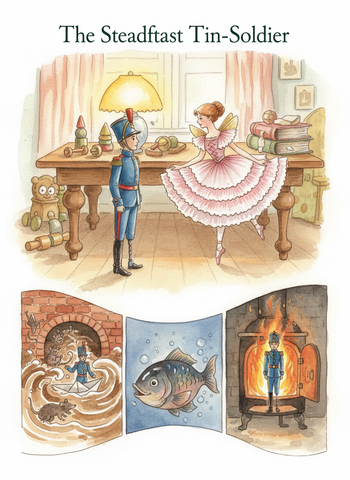
A one-legged tin soldier falls for a paper dancer across the nursery table, then endures a sewer flood, a fish's belly, and a stove's fire without ever breaking rank.
There were once upon a time five-and twenty tin-soldiers—all brothers, as they were made out of the same old tin spoon. Their uniform was red and blue, and they shouldered their guns and looked straight in front of them. The first words that they heard in this world, when the lid of the box in which they lay was taken off, were: ‘Hurrah, tin-soldiers!’ This was exclaimed by a little boy, clapping his hands; they had been given to him because it was his birthday, and now he began setting them out on the table.
Había una vez veinticinco soldaditos de plomo, todos hermanos, pues estaban hechos de la misma vieja cuchara de estaño. Su uniforme era rojo y azul, y llevaban el fusil al hombro y miraban al frente. Las primeras palabras que oyeron en este mundo, cuando quitaron la tapa de la caja donde yacían, fueron: «¡Hurra, soldaditos de plomo!» Esto lo exclamó un niño pequeño, dando palmas; se los habían regalado porque era su cumpleaños, y ahora empezaba a colocarlos sobre la mesa.
Each soldier was exactly like the other in shape, except just one, who had been made last when the tin had run short; but there he stood as firmly on his one leg as the others did on two, and he is the one that became famous.
Cada soldado era exactamente igual a los demás en forma, salvo uno solo, que había sido hecho al final, cuando ya escaseaba el estaño; pero se mantenía tan firme sobre su única pierna como los otros sobre dos, y es él quien llegó a hacerse famoso.
There were many other playthings on the table on which they were being set out, but the nicest of all was a pretty little castle made of cardboard, with windows through which you could see into the rooms. In front of the castle stood some little trees surrounding a tiny mirror which looked like a lake. Wax swans were floating about and reflecting themselves in it. That was all very pretty; but the most beautiful thing was a little lady, who stood in the open doorway.
Había muchos otros juguetes sobre la mesa donde los colocaban, pero el más bonito de todos era un precioso castillito de cartón, con ventanas por las que se podía ver el interior de las habitaciones. Delante del castillo había unos arbolitos rodeando un espejito diminuto que parecía un lago. Unos cisnes de cera flotaban en él, reflejándose en su superficie. Todo aquello era muy bonito; pero lo más hermoso era una damita que estaba de pie en la puerta abierta.
She was cut out of paper, but she had on a dress of the finest muslin, with a scarf of narrow blue ribbon round her shoulders, fastened in the middle with a glittering rose made of gold paper, which was as large as her head. The little lady was stretching out both her arms, for she was a Dancer, and was lifting up one leg so high in the air that the Tin-soldier couldn’t find it anywhere, and thought that she, too, had only one leg.
Estaba recortada en papel, pero llevaba puesto un vestido de la más fina muselina, con una bufanda de estrecha cinta azul alrededor de los hombros, sujeta en el centro con una reluciente rosa de papel dorado, tan grande como su cabeza. La damita tenía ambos brazos extendidos, pues era una Bailarina, y levantaba una pierna tan alto en el aire que el Soldadito de Plomo no lograba encontrarla por ninguna parte, y pensó que ella también tenía una sola pierna.
‘That’s the wife for me!’ he thought; ‘but she is so grand, and lives in a castle, whilst I have only a box with four-and-twenty others. This is no place for her! But I must make her acquaintance.’ Then he stretched himself out behind a snuff-box that lay on the table; from thence he could watch the dainty little lady, who continued to stand on one leg without losing her balance.
«¡Esa es la esposa para mí!», pensó; «pero es demasiado distinguida, y vive en un castillo, mientras que yo solo tengo una caja con otros veinticuatro. ¡Este no es lugar para ella! Pero debo conocerla.» Entonces se tendió detrás de una tabaquera que había sobre la mesa; desde allí podía observar a la delicada damita, que seguía de pie sobre una sola pierna sin perder el equilibrio.
When the night came all the other tin-soldiers went into their box, and the people of the house went to bed. Then the toys began to play at visiting, dancing, and fighting. The tin-soldiers rattled in their box, for they wanted to be out too, but they could not raise the lid. The nut-crackers played at leap-frog, and the slate-pencil ran about the slate; there was such a noise that the canary woke up and began to talk to them, in poetry too!
Cuando llegó la noche, todos los demás soldaditos de plomo entraron en su caja, y la gente de la casa se fue a dormir. Entonces los juguetes se pusieron a jugar a visitarse, a bailar y a pelear. Los soldaditos de plomo repiqueteaban dentro de su caja, pues también querían salir, pero no podían levantar la tapa. Los cascanueces jugaban a saltar la rana, y el pizarrín corría por la pizarra; había tanto ruido que el canario se despertó y se puso a hablarles, ¡y en verso, además!
The only two who did not stir from their places were the Tin-soldier and the little Dancer. She remained on tip-toe, with both arms outstretched; he stood steadfastly on his one leg, never moving his eyes from her face.
Los únicos dos que no se movieron de su sitio fueron el Soldadito de Plomo y la pequeña Bailarina. Ella permaneció de puntillas, con ambos brazos extendidos; él se mantuvo firme sobre su única pierna, sin apartar jamás los ojos de su rostro.
The clock struck twelve, and crack! off flew the lid of the snuff-box; but there was no snuff inside, only a little black imp—that was the beauty of it.
El reloj dio las doce, y ¡crac!, saltó la tapa de la tabaquera; pero dentro no había rapé, sino un duendecillo negro; eso era lo mejor de todo.
‘Hullo, Tin-soldier!’ said the imp. ‘Don’t look at things that aren’t intended for the likes of you!’
«¡Eh, Soldadito de Plomo!», dijo el duende. «¡No mires cosas que no están hechas para alguien como tú!»
But the Tin-soldier took no notice, and seemed not to hear.
Pero el Soldadito de Plomo no le hizo caso, y pareció no oírlo.
‘Very well, wait till to-morrow!’ said the imp.
«¡Muy bien, espera a mañana!», dijo el duende.
When it was morning, and the children had got up, the Tin-soldier was put in the window; and whether it was the wind or the little black imp, I don’t know, but all at once the window flew open and out fell the little Tin-soldier, head over heels, from the third-storey window! That was a terrible fall, I can tell you! He landed on his head with his leg in the air, his gun being wedged between two paving-stones.
Cuando llegó la mañana, y los niños se levantaron, pusieron al Soldadito de Plomo en la ventana; y no sé si fue el viento o el duendecillo negro, pero de pronto la ventana se abrió de golpe y el Soldadito de Plomo cayó, dando tumbos, ¡desde la ventana del tercer piso! Aquella fue una caída terrible, se lo aseguro. Cayó de cabeza, con la pierna al aire, y el fusil quedó encajado entre dos adoquines.
The nursery-maid and the little boy came down at once to look for him, but, though they were so near him that they almost trod on him, they did not notice him. If the Tin-soldier had only called out ‘Here I am!’ they must have found him; but he did not think it fitting for him to cry out, because he had on his uniform.
La niñera y el niño pequeño bajaron enseguida a buscarlo, pero, aunque estaban tan cerca de él que casi lo pisaron, no lo vieron. Si el Soldadito de Plomo hubiera gritado «¡Aquí estoy!», sin duda lo habrían encontrado; pero no le pareció digno gritar, pues llevaba puesto su uniforme.
Soon it began to drizzle; then the drops came faster, and there was a regular down-pour. When it was over, two little street boys came along.
Pronto empezó a lloviznar; luego las gotas se hicieron más rápidas, y cayó un verdadero aguacero. Cuando pasó, llegaron dos muchachitos de la calle.
‘Just look!’ cried one. ‘Here is a Tin-soldier! He shall sail up and down in a boat!’
«¡Mirad!», gritó uno. «¡Aquí hay un Soldadito de Plomo! ¡Navegará en un barco, arriba y abajo!»
So they made a little boat out of newspaper, put the Tin-soldier in it, and made him sail up and down the gutter; both the boys ran along beside him, clapping their hands. What great waves there were in the gutter, and what a swift current! The paper-boat tossed up and down, and in the middle of the stream it went so quick that the Tin-soldier trembled; but he remained steadfast, showed no emotion, looked straight in front of him, shouldering his gun. All at once the boat passed under a long tunnel that was as dark as his box had been.
Así que hicieron un barquito de papel de periódico, pusieron dentro al Soldadito de Plomo, y lo hicieron navegar arriba y abajo por la alcantarilla; los dos muchachos corrían a su lado, dando palmas. ¡Qué olas tan grandes había en la alcantarilla, y qué corriente tan veloz! El barco de papel se zarandeaba de un lado a otro, y en medio de la corriente iba tan rápido que el Soldadito de Plomo temblaba; pero se mantuvo firme, sin mostrar emoción alguna, mirando al frente, con el fusil al hombro. De pronto el barco pasó bajo un largo túnel, tan oscuro como había sido su caja.
‘Where can I be coming now?’ he wondered. ‘Oh, dear! This is the black imp’s fault! Ah, if only the little lady were sitting beside me in the boat, it might be twice as dark for all I should care!’
«¿Adónde iré a parar ahora?», se preguntó. «¡Ay, es culpa de aquel duende negro! Ah, si al menos la damita estuviera sentada a mi lado en el barco, ¡por mí podría estar el doble de oscuro!»
Suddenly there came along a great water-rat that lived in the tunnel.
De pronto apareció una gran rata de agua que vivía en el túnel.
‘Have you a passport?’ asked the rat. ‘Out with your passport!’
«¿Tienes pasaporte?», preguntó la rata. «¡Muestra tu pasaporte!»
But the Tin-soldier was silent, and grasped his gun more firmly.
Pero el Soldadito de Plomo guardó silencio, y sujetó su fusil con más firmeza.
The boat sped on, and the rat behind it. Ugh! how he showed his teeth, as he cried to the chips of wood and straw: ‘Hold him, hold him! he has not paid the toll! He has not shown his passport!’
El barco siguió su curso, y la rata detrás de él. ¡Uf, cómo enseñaba los dientes, mientras gritaba a las astillas de madera y a la paja: «¡Detenedlo, detenedlo! ¡No ha pagado el peaje! ¡No ha mostrado su pasaporte!»
But the current became swifter and stronger. The Tin-soldier could already see daylight where the tunnel ended; but in his ears there sounded a roaring enough to frighten any brave man. Only think! at the end of the tunnel the gutter discharged itself into a great canal; that would be just as dangerous for him as it would be for us to go down a waterfall.
Pero la corriente se hizo cada vez más veloz y fuerte. El Soldadito de Plomo ya podía ver la luz del día donde terminaba el túnel; pero en sus oídos resonaba un estruendo capaz de asustar al hombre más valiente. ¡Imagínense! Al final del túnel, la alcantarilla desembocaba en un gran canal; y eso sería tan peligroso para él como lo sería para nosotros bajar por una cascada.
Now he was so near to it that he could not hold on any longer. On went the boat, the poor Tin-soldier keeping himself as stiff as he could: no one should say of him afterwards that he had flinched. The boat whirled three, four times round, and became filled to the brim with water: it began to sink! The Tin-soldier was standing up to his neck in water, and deeper and deeper sank the boat, and softer and softer grew the paper; now the water was over his head. He was thinking of the pretty little Dancer, whose face he should never see again, and there sounded in his ears, over and over again:
Ya estaba tan cerca que no podía resistir más. El barco siguió adelante, y el pobre Soldadito de Plomo se mantuvo tan rígido como pudo: nadie podría decir después que había flaqueado. El barco dio tres, cuatro vueltas, y se llenó hasta el borde de agua: ¡empezaba a hundirse! El Soldadito de Plomo quedó de pie con el agua hasta el cuello, y cada vez más se hundía el barco, y cada vez más blando se volvía el papel; ahora el agua le cubría la cabeza. Pensaba en la linda damita Bailarina, cuyo rostro nunca volvería a ver, y en sus oídos resonaba, una y otra vez:
‘Forward, forward, soldier bold! Death’s before thee, grim and cold!’
«¡Adelante, adelante, soldado valiente! ¡La muerte te aguarda, sombría y fría!»
The paper came in two, and the soldier fell—but at that moment he was swallowed by a great fish.
El papel se partió en dos, y el soldado cayó; pero en ese mismo instante fue tragado por un gran pez.
Oh! how dark it was inside, even darker than in the tunnel, and it was really very close quarters! But there the steadfast little Tin-soldier lay full length, shouldering his gun.
¡Ay, qué oscuro estaba allí dentro, más oscuro aún que en el túnel, y el espacio era realmente muy estrecho! Pero allí quedó tendido cuan largo era el fiel Soldadito de Plomo, con el fusil al hombro.
Up and down swam the fish, then he made the most dreadful contortions, and became suddenly quite still. Then it was as if a flash of lightning had passed through him; the daylight streamed in, and a voice exclaimed, ‘Why, here is the little Tin-soldier!’ The fish had been caught, taken to market, sold, and brought into the kitchen, where the cook had cut it open with a great knife. She took up the soldier between her finger and thumb, and carried him into the room, where everyone wanted to see the hero who had been found inside a fish; but the Tin-soldier was not at all proud.
El pez nadó de un lado a otro, luego hizo las contorsiones más espantosas, y de pronto se quedó completamente quieto. Entonces fue como si un relámpago lo atravesara; entró la luz del día, y una voz exclamó: «¡Vaya, aquí está el Soldadito de Plomo!» El pez había sido pescado, llevado al mercado, vendido, y traído a la cocina, donde la cocinera lo había abierto con un gran cuchillo. Tomó al soldado entre el índice y el pulgar, y lo llevó a la sala, donde todos querían ver al héroe que había sido hallado dentro de un pez; pero el Soldadito de Plomo no estaba nada orgulloso.
They put him on the table, and—no, but what strange things do happen in this world!—the Tin-soldier was in the same room in which he had been before! He saw the same children, and the same toys on the table; and there was the same grand castle with the pretty little Dancer.
Lo pusieron sobre la mesa, y… ¡no, qué cosas tan extrañas suceden en este mundo!… el Soldadito de Plomo estaba en la misma habitación en que había estado antes. Vio a los mismos niños, y los mismos juguetes sobre la mesa; y allí estaba el mismo gran castillo con la linda damita Bailarina.
She was still standing on one leg with the other high in the air; she too was steadfast. That touched the Tin-soldier, he was nearly going to shed tin-tears; but that would not have been fitting for a soldier. He looked at her, but she said nothing.
Ella seguía de pie sobre una sola pierna, con la otra en alto; también ella era firme. Aquello conmovió al Soldadito de Plomo, casi estuvo a punto de derramar lágrimas de estaño; pero eso no habría sido digno de un soldado. La miró, pero ella no dijo nada.
All at once one of the little boys took up the Tin-soldier, and threw him into the stove, giving no reasons; but doubtless the little black imp in the snuff-box was at the bottom of this too.
De pronto, uno de los muchachitos tomó al Soldadito de Plomo, y lo arrojó a la estufa, sin dar ninguna razón; pero sin duda el duendecillo negro de la tabaquera tenía algo que ver también en esto.
There the Tin-soldier lay, and felt a heat that was truly terrible; but whether he was suffering from actual fire, or from the ardour of his passion, he did not know. All his colour had disappeared; whether this had happened on his travels or whether it was the result of trouble, who can say? He looked at the little lady, she looked at him, and he felt that he was melting; but he remained steadfast, with his gun at his shoulder.
Allí quedó tendido el Soldadito de Plomo, sintiendo un calor verdaderamente terrible; pero si sufría por el fuego mismo, o por el ardor de su pasión, no lo sabía. Había perdido todo su color; si eso había ocurrido durante sus viajes, o si era resultado de sus penas, ¿quién puede decirlo? Miró a la damita, ella lo miró a él, y sintió que se estaba derritiendo; pero se mantuvo firme, con el fusil al hombro.
Suddenly a door opened, the draught caught up the little Dancer, and off she flew like a sylph to the Tin-soldier in the stove, burst into flames—and that was the end of her! Then the Tin-soldier melted down into a little lump, and when next morning the maid was taking out the ashes, she found him in the shape of a heart. There was nothing left of the little Dancer but her gilt rose, burnt as black as a cinder.
De pronto se abrió una puerta, la corriente de aire arrastró a la pequeña Bailarina, y ella salió volando como una sílfide hacia el Soldadito de Plomo en la estufa, estalló en llamas… ¡y ese fue su fin! Entonces el Soldadito de Plomo se derritió hasta quedar convertido en un pequeño bulto, y cuando a la mañana siguiente la criada sacaba las cenizas, lo encontró con la forma de un corazón. De la pequeña Bailarina no quedó nada más que su rosa dorada, quemada y tan negra como el carbón.
