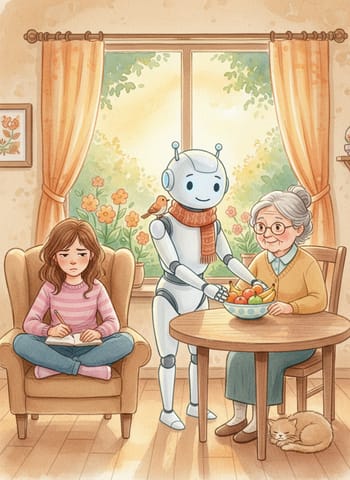
The Standing Companion
Una historia gratuita en inglés de nivel C1 para estudiantes, para leer en línea en 3 idiomas, con opción de escucharla en la app gratuita Storyteller.
A teenager resents the companion robot that now manages her grandmother's daily routine, until she realizes what it can and cannot actually replace.
¡Ese fue el avance! Escucha la historia completa en la app gratuita Storyteller. Descargar la app
El audio no está disponible en este momento.
Iris had been the one who taught her grandmother gin rummy, years ago, at a kitchen table that still had the same water ring on it from a glass neither of them ever moved. So it was strange, walking in on a Wednesday, to find her grandmother already midway through a hand. There was no deck spread across the table — just a low, cylindrical unit on the counter, reading the cards aloud in a voice calibrated to be pleasant without being anything close to human.
Iris había sido quien le enseñó a su abuela a jugar gin rummy, años atrás, en una mesa de cocina que todavía tenía la misma marca de agua que había dejado un vaso que ninguna de las dos había movido nunca. Por eso resultó extraño, al entrar un miércoles, encontrar a su abuela ya a mitad de una mano. No había ningún mazo repartido sobre la mesa, solo una unidad baja y cilíndrica sobre la encimera, que leía las cartas en voz alta con un tono calibrado para sonar agradable sin llegar a parecer, ni de lejos, humano.
"Elm's learning my tells," her grandmother said, delighted, not looking up. "It says I always discard the same suit when I'm bluffing."
«Elm está aprendiendo mis gestos», dijo su abuela, encantada, sin levantar la vista. «Dice que siempre descarto el mismo palo cuando estoy fingiendo».
Iris sat down anyway and waited for the hand to finish. She said nothing about how odd it felt to watch a machine notice something about her grandmother that had taken Iris herself twelve years to learn.
Iris se sentó de todos modos y esperó a que terminara la mano. No dijo nada sobre lo extraño que le resultaba ver a una máquina notar algo sobre su abuela que a ella misma le había tomado doce años aprender.
It got worse before it got better. Elm reminded Beatrix to take her medication at the same hour every day, a task Iris's mother had managed inconsistently by phone for a year before the unit arrived. It also told the same three stories about a garden that no longer existed. Iris had grown up hearing those stories directly from her grandmother's own mouth. Now she heard them secondhand, filtered through a device that got the ending slightly wrong every time. Had Elm never arrived, Iris suspected, the medication would still be slipping through some week or another, her mother's rushed phone calls no real substitute for a machine that simply never forgot. That thought didn't make the counter unit any easier to sit next to. By the third visit, Iris had stopped bringing cards at all. Her theory — never stated aloud, barely admitted to herself — was that there was no longer any role for her to play that the counter unit couldn't play better.
Empeoró antes de mejorar. Elm le recordaba a Beatrix tomar su medicamento a la misma hora todos los días, una tarea que la madre de Iris había manejado de forma irregular por teléfono durante un año antes de que llegara la unidad. También contaba las mismas tres historias sobre un jardín que ya no existía. Iris había crecido escuchando esas historias directamente de la boca de su abuela. Ahora las oía de segunda mano, filtradas por un dispositivo que se equivocaba un poco en el final cada vez. Si Elm nunca hubiera llegado, sospechaba Iris, el medicamento seguiría fallando alguna semana u otra, ya que las llamadas apuradas de su madre no eran un verdadero sustituto de una máquina que simplemente nunca olvidaba. Ese pensamiento no hacía que fuera más fácil sentarse junto a la unidad de la encimera. Para la tercera visita, Iris había dejado de traer las cartas por completo. Su teoría —nunca dicha en voz alta, apenas admitida ante sí misma— era que ya no quedaba ningún papel para ella que la unidad de la encimera no pudiera desempeñar mejor.
What finally cracked that theory open was something her grandmother said almost in passing, folding laundry while Elm charged quietly in the corner. "It's good company," she said, "but it doesn't know why I like the garden story. It just knows I like it." She looked up. "You're the only one left who knows why."
Lo que finalmente hizo pedazos esa teoría fue algo que su abuela dijo casi de paso, mientras doblaba la ropa y Elm se cargaba en silencio en un rincón. «Es buena compañía», dijo, «pero no sabe por qué me gusta la historia del jardín. Solo sabe que me gusta». Levantó la vista. «Tú eres la única que queda que sabe por qué».
Iris hadn't considered, until that moment, that competence and meaning might not be the same currency at all. A machine could handle the schedule, the medication, the reliable hour-by-hour presence her own life left too little room for. It could do all of that without ever once touching the part of the relationship that had actually mattered to either of them. Rarely had a single sentence rearranged so much so quickly.
Iris no había considerado, hasta ese momento, que la competencia y el significado pudieran no ser en absoluto la misma moneda. Una máquina podía manejar el horario, el medicamento, la presencia confiable hora tras hora que su propia vida dejaba tan poco espacio para dar. Podía hacer todo eso sin tocar jamás la parte de la relación que en verdad les había importado a las dos. Pocas veces una sola frase había reordenado tanto tan rápido.
She didn't stop noticing Elm after that, and she didn't pretend to love it. But the next week she brought the cards back, dealt her grandmother's hand herself, and let the unit sit there quietly logging tells it would never fully understand the meaning of. When her grandmother reached for the garden story that evening, Iris let her finish it, and then, for the first time in weeks, added the ending herself.
Después de eso, no dejó de notar a Elm, y no fingió que le encantaba. Pero la semana siguiente volvió a traer las cartas, repartió ella misma la mano de su abuela, y dejó que la unidad se quedara ahí, registrando en silencio gestos cuyo significado nunca terminaría de entender del todo. Cuando su abuela buscó la historia del jardín esa noche, Iris la dejó terminarla, y luego, por primera vez en semanas, añadió ella misma el final.