The Standing Companion
A free C1-level English story for language learners, readable online in English, with an option to listen via the free Storyteller app.
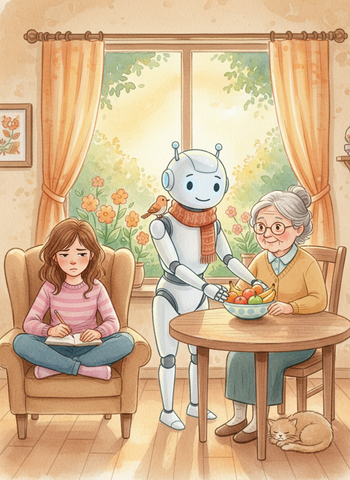
A teenager resents the companion robot that now manages her grandmother's daily routine, until she realizes what it can and cannot actually replace.
Iris had been the one who taught her grandmother gin rummy, years ago, at a kitchen table that still had the same water ring on it from a glass neither of them ever moved. So it was strange, walking in on a Wednesday, to find her grandmother already midway through a hand. There was no deck spread across the table — just a low, cylindrical unit on the counter, reading the cards aloud in a voice calibrated to be pleasant without being anything close to human.
"Elm's learning my tells," her grandmother said, delighted, not looking up. "It says I always discard the same suit when I'm bluffing."
Iris sat down anyway and waited for the hand to finish. She said nothing about how odd it felt to watch a machine notice something about her grandmother that had taken Iris herself twelve years to learn.
It got worse before it got better. Elm reminded Beatrix to take her medication at the same hour every day, a task Iris's mother had managed inconsistently by phone for a year before the unit arrived. It also told the same three stories about a garden that no longer existed. Iris had grown up hearing those stories directly from her grandmother's own mouth. Now she heard them secondhand, filtered through a device that got the ending slightly wrong every time. Had Elm never arrived, Iris suspected, the medication would still be slipping through some week or another, her mother's rushed phone calls no real substitute for a machine that simply never forgot. That thought didn't make the counter unit any easier to sit next to. By the third visit, Iris had stopped bringing cards at all. Her theory — never stated aloud, barely admitted to herself — was that there was no longer any role for her to play that the counter unit couldn't play better.
What finally cracked that theory open was something her grandmother said almost in passing, folding laundry while Elm charged quietly in the corner. "It's good company," she said, "but it doesn't know why I like the garden story. It just knows I like it." She looked up. "You're the only one left who knows why."
Iris hadn't considered, until that moment, that competence and meaning might not be the same currency at all. A machine could handle the schedule, the medication, the reliable hour-by-hour presence her own life left too little room for. It could do all of that without ever once touching the part of the relationship that had actually mattered to either of them. Rarely had a single sentence rearranged so much so quickly.
She didn't stop noticing Elm after that, and she didn't pretend to love it. But the next week she brought the cards back, dealt her grandmother's hand herself, and let the unit sit there quietly logging tells it would never fully understand the meaning of. When her grandmother reached for the garden story that evening, Iris let her finish it, and then, for the first time in weeks, added the ending herself.
