The Salt Flat Crossing
Una historia gratuita en inglés de nivel C1 para estudiantes, para leer en línea en 5 idiomas, con opción de escucharla en la app gratuita Storyteller.
Over two days on foot across a vast salt flat, a woman loses her sense of distance and slowly discovers a different reason for having come.
¡Ese fue el avance! Escucha la historia completa en la app gratuita Storyteller. Descargar la app
El audio no está disponible en este momento.
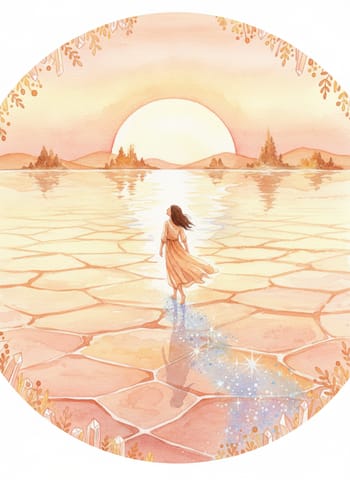
At dawn the flat is not white but the colour of the inside of a shell. Svea, standing at its edge in boots that still smell of the shop, cannot find a single thing to look at. The guide, a lean man who has already said everything he intends to say about safety, ties a cloth across his face and starts walking. She follows. Under each step the crust gives a thin, dry crack, like ice that has decided not to break.
Al amanecer, el salar no es blanco sino del color del interior de una concha. Svea, de pie en su orilla con unas botas que aún huelen a tienda, no encuentra una sola cosa que mirar. El guía, un hombre enjuto que ya ha dicho todo lo que pensaba decir sobre seguridad, se ata un paño sobre la cara y echa a andar. Ella lo sigue. Bajo cada paso, la costra emite un crujido fino y seco, como el hielo que ha decidido no romperse.
By ten the horizon has stopped behaving. A dark line that looked like a hill an hour ago turns, as they approach, into a scatter of stones the size of fists, and the hill is somewhere else. "Distance here is a rumour," the guide says, in the tone of a man who has said it to many people and is still faintly pleased with it. Svea drinks at the intervals he sets, tastes the mineral edge of salt that has crept inside her lips, and finds that she has stopped estimating anything at all.
A las diez, el horizonte ha dejado de comportarse. Una línea oscura que hace una hora parecía una colina se convierte, al acercarse, en un puñado de piedras del tamaño de puños, y la colina está en otra parte. «Aquí la distancia es un rumor», dice el guía, en el tono de quien se lo ha dicho a mucha gente y aún está levemente satisfecho con la frase. Svea bebe a los intervalos que él marca, siente en los labios el borde mineral de la sal que se le ha colado, y descubre que ha dejado de calcular nada.
She had come, she told people at home, for the photographs. It was a believable reason and she had rehearsed it. The truer one she had not rehearsed, because it would not fit into a sentence. It was a postcard that had hung above her father's desk for thirty years, a white plain under a white sky, and the way he said "one day" whenever he looked at it. She has the postcard in her inside pocket now. It is, she is beginning to see, a poor likeness; it has no sound in it.
Había venido, les dijo a los suyos en casa, por las fotografías. Era un motivo creíble y lo había ensayado. El más verdadero no lo había ensayado, porque no cabía en una frase. Era una postal que había colgado sobre el escritorio de su padre durante treinta años, una llanura blanca bajo un cielo blanco, y el modo en que él decía «algún día» siempre que la miraba. La lleva ahora en el bolsillo interior. Es, empieza a ver, un retrato pobre; no tiene sonido.
Noon is the worst of it. No shadow falls anywhere, and the glare rises from the ground as much as it falls from the sky, so she walks with her hat brim low and watches only her boots: left, right, left. Time stretches the way it does in waiting rooms. She checks her watch and finds that eleven minutes have passed, and later, that it has been two hours, and neither figure seems more believable than the other.
El mediodía es lo peor. No cae sombra en ninguna parte, y el resplandor sube del suelo tanto como baja del cielo, de modo que camina con el ala del sombrero baja y mira solo sus botas: izquierda, derecha, izquierda. El tiempo se estira como en las salas de espera. Mira el reloj y descubre que han pasado once minutos, y más tarde, que han pasado dos horas, y ninguna de las dos cifras parece más creíble que la otra.
They camp where nothing marks the spot. The guide cooks flat bread on a stove no bigger than a fist and eats with his back to the wind. When the sun goes, it goes quickly, leaving a violet band along the edge of the world and then, abruptly, stars in numbers that seem almost rude. Lying on her back, Svea finds she is holding the postcard against her chest. If her father had come, he would have talked the whole way across, she thinks, and she would still be hearing him. What she feels, instead, is how little of this a desk could ever have shown him.
Acampan donde nada señala el lugar. El guía cocina pan plano en un hornillo no más grande que un puño y come de espaldas al viento. Cuando se va el sol, se va rápido, dejando una franja violeta en el borde del mundo y luego, de golpe, estrellas en cantidades casi descorteses. Tendida de espaldas, Svea descubre que sostiene la postal contra el pecho. Si su padre hubiera venido, piensa, habría hablado durante toda la travesía, y ella aún lo estaría oyendo. Lo que siente, en cambio, es lo poco de todo esto que un escritorio habría podido mostrarle jamás.
On the second day the reason changes without consulting her. She no longer wants to have seen the place; she wants to be walking through it, one boot after the other, with the silence ringing faintly in her ears like a struck glass. Not until mid-afternoon does she realise she has not taken a single photograph. The camera swings against her hip, forgotten as a limb.
El segundo día el motivo cambia sin consultarla. Ya no quiere haber visto el lugar; quiere estar caminando por él, una bota tras otra, con el silencio resonándole levemente en los oídos como una copa golpeada. No es hasta media tarde que se da cuenta de que no ha tomado una sola fotografía. La cámara se balancea contra su cadera, olvidada como un miembro más.
Late in the day she asks how much further. The guide lifts his chin towards a dark smudge so far away that it might be a mark on the lens. "That," he says. To Svea it looks like an hour; to him, she suspects, it looks like four. She takes the postcard out, looks at it once, slides it back into her pocket with its face against her ribs, and starts walking before he does.
Al final del día pregunta cuánto falta. El guía alza la barbilla hacia una mancha oscura tan lejana que podría ser una marca en la lente. «Eso», dice. A Svea le parece una hora; a él, sospecha, le parecen cuatro. Saca la postal, la mira una vez, la desliza de vuelta al bolsillo con la cara contra las costillas y echa a andar antes que él.