The Kitchen with Six Names
Una historia gratuita en inglés de nivel C1 para estudiantes, para leer en línea en 5 idiomas, con opción de escucharla en la app gratuita Storyteller.
A cook in a delivery-only kitchen with six invented restaurants receives a heartfelt review that makes him rethink his work.
¡Ese fue el avance! Escucha la historia completa en la app gratuita Storyteller. Descargar la app
El audio no está disponible en este momento.
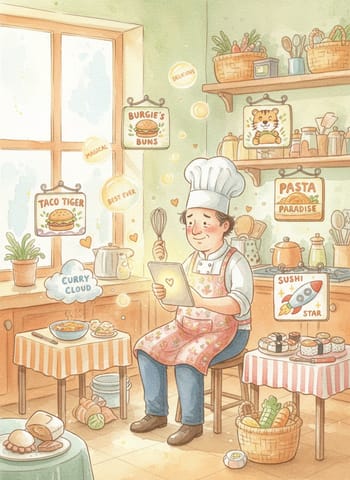
The kitchen had no dining room, no sign over the door and, strictly speaking, no restaurants. It had one fryer, two induction hobs, a steel counter and Reinhold. Out of these it served six establishments to the city: the Copper Skillet, Grandmother's Table, the Seaside Fry House, Green Bowl, Little Dumpling House and the Smokehouse Co-op. Each had a menu, a logo and a set of warm, glossy photographs, all produced in one afternoon by a program that had never eaten anything.
La cocina no tenía comedor, ni letrero sobre la puerta ni, hablando con propiedad, restaurantes. Tenía una freidora, dos placas de inducción, una mesada de acero y a Reinhold. Con eso le servía a la ciudad seis establecimientos: el Copper Skillet, la Mesa de la Abuela, la Seaside Fry House, Green Bowl, la Casita de los Dumplings y la Cooperativa del Ahumadero. Cada uno tenía su menú, su logotipo y un juego de fotografías cálidas y relucientes, todo producido en una tarde por un programa que nunca había comido nada.
Emeric, who handled the accounts, had explained the idea on Reinhold's first day. "People trust a restaurant with a story," he had said. "Nobody wants to order from a kitchen." So the chicken that left the building at six o'clock was "rustic family-style" on Grandmother's Table, "crispy coastal" at the Seaside Fry House and, with a pinch of sesame seeds, "street-style" at the Smokehouse Co-op. It all came out of the same oil. Reinhold had stopped finding this funny some time in the spring and had started finding it merely tiring, like answering to six names at once.
Emeric, que llevaba las cuentas, le había explicado la idea el primer día de Reinhold. «La gente confía en un restaurante con historia», le había dicho. «Nadie quiere pedirle a una cocina». Así que el pollo que salía del local a las seis era «rústico, estilo familiar» en la Mesa de la Abuela, «crujiente costero» en la Seaside Fry House y, con una pizca de semillas de sésamo, «estilo callejero» en la Cooperativa del Ahumadero. Todo salía del mismo aceite. Reinhold había dejado de encontrarlo gracioso en algún momento de la primavera y había empezado a encontrarlo simplemente agotador, como responder a seis nombres a la vez.
The grandmother in the photographs had flour on her hands and a kind, creased smile. Her left hand, if you looked closely, had six fingers. Reinhold had pointed this out once. "Nobody counts," Emeric had said.
La abuela de las fotografías tenía harina en las manos y una sonrisa amable y arrugada. Su mano izquierda, si uno se fijaba bien, tenía seis dedos. Reinhold lo había señalado una vez. «Nadie los cuenta», había dicho Emeric.
On a wet Tuesday in October, a review arrived. It was posted under Grandmother's Table, five stars, signed with a single initial, and Reinhold read it standing at the pass with a damp cloth over his shoulder, expecting a complaint about cold chips. Instead the customer wrote that the chicken had tasted exactly like the food her aunt used to make before the aunt moved away. She had eaten it at the kitchen table with the radio on, she said, which she had not done in years. "Please tell the cook thank you," the review ended. "Someone is clearly looking after this recipe."
Un martes lluvioso de octubre llegó una reseña. Estaba publicada bajo la Mesa de la Abuela, cinco estrellas, firmada con una sola inicial, y Reinhold la leyó de pie junto al pase, con un paño húmedo sobre el hombro, esperando una queja por las papas frías. En cambio, la clienta escribía que el pollo sabía exactamente a la comida que solía preparar su tía antes de mudarse lejos. Lo había comido en la mesa de la cocina con la radio encendida, decía, algo que no hacía desde hacía años. «Por favor, díganle gracias al cocinero», terminaba la reseña. «Está claro que alguien cuida esta receta».
Reinhold read it twice. Never in four months had a customer written more than the word "fine." It was the same chicken that had gone out that evening to the Copper Skillet, with a different sprinkle. If he was honest, he had cooked it badly, because a delivery had come late and he had been rushing. What bothered him was not that the woman had been deceived. It was that she had been, for the length of one dinner, genuinely looked after, and that the only person she had thanked was somebody who did not exist.
Reinhold la leyó dos veces. En cuatro meses ningún cliente había escrito más que la palabra «bien». Era el mismo pollo que esa tarde había salido hacia el Copper Skillet, con otro espolvoreo. Si era sincero, lo había cocinado mal, porque un pedido había llegado tarde y andaba apurado. Lo que le molestaba no era que la mujer hubiera sido engañada. Era que, durante el tiempo de una cena, la habían cuidado de verdad, y que la única persona a la que había dado las gracias era alguien que no existía.
Had the grandmother been real, he would have passed the message on. As it was, there was nobody to pass it to but himself.
Si la abuela hubiera sido real, le habría transmitido el mensaje. Tal como estaban las cosas, no había a quién dárselo salvo a sí mismo.
The reply box on the app blinked at him. Emeric's guidance for replies was a short template beginning, "Grandmother says thank you!" Reinhold typed it, deleted it, and sat for a while with the fryer ticking as it cooled. Then he wrote, "Thank you. The cook is glad it reached you." He considered adding a name and found that, of the six available, none of them was his. He pressed send before he could improve it.
El cuadro de respuesta de la aplicación parpadeaba ante él. La pauta de Emeric para las respuestas era una plantilla breve que empezaba: «¡La abuela te da las gracias!». Reinhold la escribió, la borró y se quedó un rato con la freidora chasqueando mientras se enfriaba. Luego escribió: «Gracias. El cocinero se alegra de que le haya llegado». Pensó en añadir un nombre y descubrió que, de los seis disponibles, ninguno era el suyo. Pulsó enviar antes de poder mejorarlo.
Behind him the printer chattered and produced three tickets, one for the Copper Skillet, one for the Seaside Fry House and one for Green Bowl. Reinhold tied on a fresh apron, wiped down the counter, and began, as carefully as on his first night, to cook the same chicken three times.
Detrás de él, la impresora traqueteó y escupió tres comandas: una para el Copper Skillet, una para la Seaside Fry House y una para Green Bowl. Reinhold se ató un delantal limpio, repasó la mesada y empezó, con tanto cuidado como en su primera noche, a cocinar el mismo pollo tres veces.