The Kitchen with Six Names
A free C1-level English story for language learners, readable online in 5 languages, with an option to listen via the free Storyteller app.
A cook in a delivery-only kitchen with six invented restaurants receives a heartfelt review that makes him rethink his work.
That was the preview! Hear the full story in the free Storyteller app. Get the app
Audio isn't available right now.
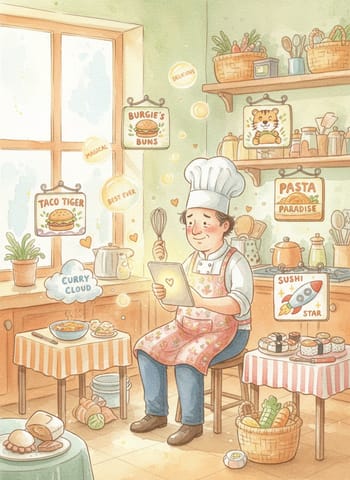
The kitchen had no dining room, no sign over the door and, strictly speaking, no restaurants. It had one fryer, two induction hobs, a steel counter and Reinhold. Out of these it served six establishments to the city: the Copper Skillet, Grandmother's Table, the Seaside Fry House, Green Bowl, Little Dumpling House and the Smokehouse Co-op. Each had a menu, a logo and a set of warm, glossy photographs, all produced in one afternoon by a program that had never eaten anything.
Emeric, who handled the accounts, had explained the idea on Reinhold's first day. "People trust a restaurant with a story," he had said. "Nobody wants to order from a kitchen." So the chicken that left the building at six o'clock was "rustic family-style" on Grandmother's Table, "crispy coastal" at the Seaside Fry House and, with a pinch of sesame seeds, "street-style" at the Smokehouse Co-op. It all came out of the same oil. Reinhold had stopped finding this funny some time in the spring and had started finding it merely tiring, like answering to six names at once.
The grandmother in the photographs had flour on her hands and a kind, creased smile. Her left hand, if you looked closely, had six fingers. Reinhold had pointed this out once. "Nobody counts," Emeric had said.
On a wet Tuesday in October, a review arrived. It was posted under Grandmother's Table, five stars, signed with a single initial, and Reinhold read it standing at the pass with a damp cloth over his shoulder, expecting a complaint about cold chips. Instead the customer wrote that the chicken had tasted exactly like the food her aunt used to make before the aunt moved away. She had eaten it at the kitchen table with the radio on, she said, which she had not done in years. "Please tell the cook thank you," the review ended. "Someone is clearly looking after this recipe."
Reinhold read it twice. Never in four months had a customer written more than the word "fine." It was the same chicken that had gone out that evening to the Copper Skillet, with a different sprinkle. If he was honest, he had cooked it badly, because a delivery had come late and he had been rushing. What bothered him was not that the woman had been deceived. It was that she had been, for the length of one dinner, genuinely looked after, and that the only person she had thanked was somebody who did not exist.
Had the grandmother been real, he would have passed the message on. As it was, there was nobody to pass it to but himself.
The reply box on the app blinked at him. Emeric's guidance for replies was a short template beginning, "Grandmother says thank you!" Reinhold typed it, deleted it, and sat for a while with the fryer ticking as it cooled. Then he wrote, "Thank you. The cook is glad it reached you." He considered adding a name and found that, of the six available, none of them was his. He pressed send before he could improve it.
Behind him the printer chattered and produced three tickets, one for the Copper Skillet, one for the Seaside Fry House and one for Green Bowl. Reinhold tied on a fresh apron, wiped down the counter, and began, as carefully as on his first night, to cook the same chicken three times.