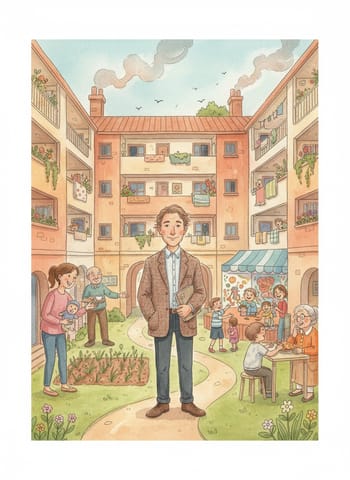
The Architect's Return
Una historia gratuita en inglés de nivel C1 para estudiantes, para leer en línea en 5 idiomas, con opción de escucharla en la app gratuita Storyteller.
An architect visits his prize-winning housing block unannounced and learns from its residents what went wrong and what went right.
¡Ese fue el avance! Escucha la historia completa en la app gratuita Storyteller. Descargar la app
El audio no está disponible en este momento.
Ottavio has told nobody he is coming. He steps off the bus at the foot of the hill and stands for a while, looking up at the housing block he designed twenty years ago. Five slabs of pale concrete step down the slope like a staircase built for giants. In the photographs that won the prize, nobody was in it. Now there are bicycles chained to every railing, a mattress airing over a balcony, and a washing line strung between two of his carefully proportioned columns.
Ottavio no le ha dicho a nadie que viene. Se baja del autobús al pie de la colina y se queda un rato mirando hacia arriba, al bloque de viviendas que diseñó hace veinte años. Cinco losas de hormigón pálido descienden por la ladera como una escalera construida para gigantes. En las fotografías que ganaron el premio no había nadie. Ahora hay bicicletas encadenadas a cada barandilla, un colchón aireándose sobre un balcón y un tendedero tendido entre dos de sus columnas cuidadosamente proporcionadas.
He climbs the long outdoor stair, the one part he is sure about, and on the third landing a woman in a quilted dressing gown stops him. She takes him for a surveyor, presumably because of the notebook, and she has clearly been waiting years for one. Her name is Farida, she says, and she has lived on this landing since the first week. "The wind," she says. "Come and feel it."
Sube la larga escalera exterior, lo único de lo que está seguro, y en el tercer rellano lo detiene una mujer en bata acolchada. Lo toma por un topógrafo, presumiblemente por el cuaderno, y es evidente que lleva años esperando a uno. Se llama Farida, dice, y vive en este rellano desde la primera semana. «El viento», dice. «Venga a sentirlo».
She leads him to the corner where the walkway turns, and there the air hits his face like a slammed door. Nobody tested for this, she tells him. Every autumn the bins roll across the courtyard unless somebody chocks them with a brick.
Lo lleva a la esquina donde la pasarela gira, y allí el aire le golpea la cara como un portazo. Nadie midió esto, le dice. Cada otoño los contenedores ruedan por el patio a menos que alguien los calce con un ladrillo.
The complaints come in a steady, well-rehearsed list, like something she has said to a wall many times. The lift is too small for a stretcher. The flat roofs leak at the joints, which he had worried about at the time and been overruled on. The balconies, so narrow in his drawings that he had privately called them gestures, have all been glassed in by their tenants, each in a different shade of plastic. Taking notes in the margin of his sketchbook, Ottavio finds that he is not defending any of it, and this surprises him more than the wind did.
Las quejas llegan en una lista constante y bien ensayada, como algo que ha dicho muchas veces a una pared. El ascensor es demasiado pequeño para una camilla. Las azoteas planas gotean en las juntas, cosa que él había temido en su momento y en la que lo habían desoído. Los balcones, tan estrechos en sus dibujos que en privado los había llamado gestos, han sido todos acristalados por sus inquilinos, cada uno en un tono distinto de plástico. Tomando notas al margen de su cuaderno de bocetos, Ottavio descubre que no defiende nada de ello, y eso le sorprende más que el viento.
What he had not expected was the landing itself. He drew it wide, wider than the fire regulations required, over the objections of a cost consultant who called the extra width vanity. Now it holds a row of mismatched chairs, three tomato plants in buckets, a card table with a half-finished jigsaw, and two children racing toy cars along the gutter. Rarely has he seen a corridor so firmly refuse to be one.
Lo que no había esperado era el rellano mismo. Lo dibujó ancho, más ancho de lo que exigía la normativa contra incendios, frente a las objeciones de un consultor de costes que llamó vanidad al ancho extra. Ahora alberga una hilera de sillas desparejadas, tres tomateras en cubos, una mesa de juego con un rompecabezas a medias y dos niños haciendo correr coches de juguete por la canaleta. Pocas veces ha visto un pasillo negarse con tanta firmeza a serlo.
"That's where we sit," Farida says, as if answering a question he has not asked. "In summer, half the floor is out here."
«Aquí es donde nos sentamos», dice Farida, como respondiendo a una pregunta que él no ha hecho. «En verano, media planta está aquí fuera».
She looks at him sideways. "The man who drew this never imagined it, I'd say. If he had, he would have put in a bench."
Lo mira de reojo. «El hombre que dibujó esto nunca lo imaginó, diría yo. Si lo hubiera hecho, habría puesto un banco».
The sentence "I drew this" is ready in Ottavio's mouth, and he finds that it will not stand up next to the leaking roofs and the wind. It was the width, not the prize, that he had come to check, though he would not have admitted that on the bus. He closes the notebook instead.
La frase «Yo dibujé esto» está lista en la boca de Ottavio, y descubre que no se sostiene junto a las azoteas con goteras y el viento. Era el ancho, no el premio, lo que había venido a comprobar, aunque no lo habría admitido en el autobús. Cierra el cuaderno en cambio.
"You look tired," Farida says. She drags out a green chair with a cracked seat and sets it beside the card table. "Sit. Everyone does, up here."
«Se ve cansado», dice Farida. Arrastra una silla verde de asiento agrietado y la coloca junto a la mesa de juego. «Siéntese. Todo el mundo lo hace, aquí arriba».
"Just for a minute," Ottavio says. He lowers himself into the chair, and, noticing a corner piece lying alone on the concrete beside the jigsaw, he picks it up and finds, on the second try, where it goes.
«Solo un minuto», dice Ottavio. Se deja caer en la silla y, al advertir una pieza de esquina suelta sobre el hormigón junto al rompecabezas, la recoge y encuentra, al segundo intento, dónde va.