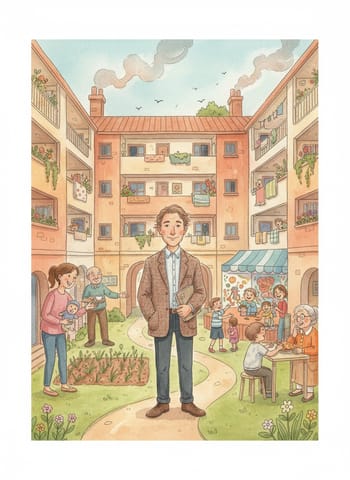
The Architect's Return
A free C1-level English story for language learners, readable online in 5 languages, with an option to listen via the free Storyteller app.
An architect visits his prize-winning housing block unannounced and learns from its residents what went wrong and what went right.
That was the preview! Hear the full story in the free Storyteller app. Get the app
Audio isn't available right now.
Ottavio has told nobody he is coming. He steps off the bus at the foot of the hill and stands for a while, looking up at the housing block he designed twenty years ago. Five slabs of pale concrete step down the slope like a staircase built for giants. In the photographs that won the prize, nobody was in it. Now there are bicycles chained to every railing, a mattress airing over a balcony, and a washing line strung between two of his carefully proportioned columns.
He climbs the long outdoor stair, the one part he is sure about, and on the third landing a woman in a quilted dressing gown stops him. She takes him for a surveyor, presumably because of the notebook, and she has clearly been waiting years for one. Her name is Farida, she says, and she has lived on this landing since the first week. "The wind," she says. "Come and feel it."
She leads him to the corner where the walkway turns, and there the air hits his face like a slammed door. Nobody tested for this, she tells him. Every autumn the bins roll across the courtyard unless somebody chocks them with a brick.
The complaints come in a steady, well-rehearsed list, like something she has said to a wall many times. The lift is too small for a stretcher. The flat roofs leak at the joints, which he had worried about at the time and been overruled on. The balconies, so narrow in his drawings that he had privately called them gestures, have all been glassed in by their tenants, each in a different shade of plastic. Taking notes in the margin of his sketchbook, Ottavio finds that he is not defending any of it, and this surprises him more than the wind did.
What he had not expected was the landing itself. He drew it wide, wider than the fire regulations required, over the objections of a cost consultant who called the extra width vanity. Now it holds a row of mismatched chairs, three tomato plants in buckets, a card table with a half-finished jigsaw, and two children racing toy cars along the gutter. Rarely has he seen a corridor so firmly refuse to be one.
"That's where we sit," Farida says, as if answering a question he has not asked. "In summer, half the floor is out here."
She looks at him sideways. "The man who drew this never imagined it, I'd say. If he had, he would have put in a bench."
The sentence "I drew this" is ready in Ottavio's mouth, and he finds that it will not stand up next to the leaking roofs and the wind. It was the width, not the prize, that he had come to check, though he would not have admitted that on the bus. He closes the notebook instead.
"You look tired," Farida says. She drags out a green chair with a cracked seat and sets it beside the card table. "Sit. Everyone does, up here."
"Just for a minute," Ottavio says. He lowers himself into the chair, and, noticing a corner piece lying alone on the concrete beside the jigsaw, he picks it up and finds, on the second try, where it goes.