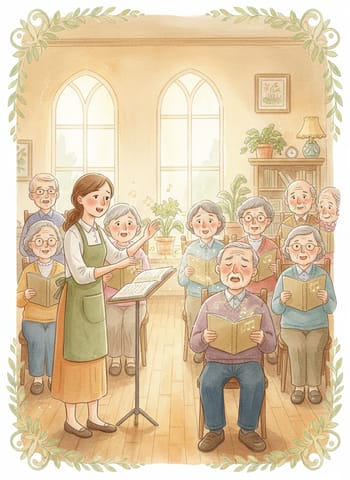
The choir meets on Thursday afternoons in a church hall with a leaking skylight and a tea urn that takes forty minutes to boil. Rosamund arrives early, as she has for five months, to set out the folders and the plastic cups and to arrange the chairs in a curve. The singers do better when they can see one another's faces. There are twenty-two of them, most with some form of memory loss, and eleven carers, who sing quietly and pretend not to. Her father, Halvard, is third from the left in the front row, in the cardigan she ironed that morning.
合唱团每个星期四下午在一间教会礼堂里聚会,天窗漏水,茶炉要烧四十分钟才开。罗莎蒙德来得很早,五个月来一直如此,她要摆好乐谱夹和塑料杯,把椅子排成一道弧形。歌者们在能看见彼此面孔的时候唱得更好。一共有二十二位,多数人有某种程度的记忆衰退,还有十一位陪护者,他们轻声地唱,却装作没在唱。她的父亲哈尔瓦德坐在前排左数第三个位置,穿着她那天早上熨好的开襟毛衣。
He does not always know her. Some weeks he greets her with the polished warmth he used to keep for the neighbours; some weeks he calls her "the nice lady with the folders" and asks whether she lives nearby. She has stopped correcting him, less out of resignation than out of a practical sort of mercy, since correction costs him something and the cost is visible. Today he calls her "madam" and thanks her for the tea.
他并不总是认得她。有些星期,他用从前对待邻居的那种圆熟的热情向她问好;有些星期,他管她叫“拿着乐谱夹的好心女士”,还问她是不是住在附近。她已经不再纠正他了,与其说是出于无奈,不如说是出于一种实实在在的慈悲,因为纠正会让他付出代价,而且那代价是看得见的。今天,他称她“夫人”,谢谢她递来的茶。
Then the pianist plays four bars, and something in the room changes. What Rosamund has still not got used to is the speed of it. A woman who cannot remember the name of her own street sings the first verse without a hitch, perfectly in tune. The man beside her, who has not spoken a full sentence since Easter, comes in on the second line with the exact tremor he must have had at twenty. Her father does not look at the sheet. Rarely does he look at anything except the pianist's hands. He sings the words in order, every one, including the old-fashioned verse that nobody else remembers.
然后钢琴师弹了四个小节,房间里的某种东西就变了。罗莎蒙德至今仍没有习惯的,是这变化的速度。一个连自家街道名字都想不起来的女人,毫无磕绊地唱完了第一段,音准完美。她旁边那位自复活节以来没说过一句完整句子的男人,在第二句上加入进来,带着他二十岁时一定有过的那种一模一样的颤音。她的父亲没有看乐谱。除了钢琴师的手,他很少看别的东西。他按顺序唱出每一个词,一个不落,包括那段谁也不记得的老式唱词。
She has read the explanations, and two doctors have kindly given them to her: that melody and memory are stored in different places, that rhythm acts as a kind of scaffolding. None of it helps. The words are all there, perfectly kept, in a man who cannot say what he had for breakfast. She, who has every day of her life at her disposal, cannot finish the second verse without the page. If someone had told her a year ago that she would envy her father's memory, she would have laughed.
她读过那些解释,两位医生也好心地给她讲过:旋律与记忆存放在不同的地方,节奏像是一种脚手架。这些都没有用。那些词全都在,保存得完好无损,存在一个说不出自己早饭吃了什么的人身上。而她,拥有自己人生中的每一天,没有乐谱却唱不完第二段。要是一年前有人告诉她,她会羡慕父亲的记忆,她会大笑起来。
At the break she carries the tea around on a tray, the cups rattling in their saucers. Her father takes one with both hands and studies her over the rim.
休息时,她用托盘端着茶水挨个递过去,杯子在碟子里叮当作响。她的父亲用双手接过一杯,隔着杯沿打量着她。
"You sing very quietly," he says. It is the most direct remark he has made to her in a month.
“你唱得很轻,”他说。这是他一个月来对她说过的最直接的一句话。
"I'm following the others," she says.
“我在跟着别人唱。”她说。
"No," he says, with perfect courtesy. "You're listening. It's different."
“不对,”他说,礼貌得毫无瑕疵,“你是在听。这不一样。”
After the break, the last song is the long one, the one he used to sing in the car, the one with seven verses. The pianist begins. Rosamund opens her folder, finds the page, and joins in half a beat late, as always. Carrying on through the fifth verse with her eyes on the words, she is aware of a hand reaching across her without any break in the singing. The page turns, one beat before she needs it. Her father, his eyes on the pianist, is still singing.
休息之后,最后一首是那首很长的歌,是他过去在车里唱的那首,有七段。钢琴师开始弹奏。罗莎蒙德打开夹子,找到那一页,像往常一样,晚了半拍加入进去。唱到第五段,她的眼睛盯着歌词,意识到有一只手伸过她的面前,歌声没有一丝中断。那一页翻了过去,比她需要的时候早了一拍。她的父亲,眼睛望着钢琴师,仍在继续歌唱。
She lets one line go by without her, and then she finds her place.
她任由一句唱词从身边溜过去,没有跟上,然后她找到了自己的位置。