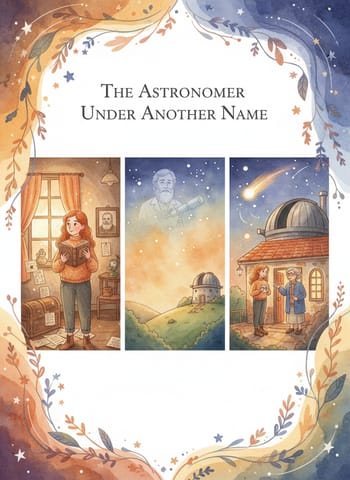
The Astronomer Under Another Name
一个面向英语学习者的免费 C1 级英语故事,可用 7 种语言在线阅读,也可以在免费的 Storyteller 应用中收听。
After her silent father's death, Lorna discovers that he spent forty years publishing astronomy observations under a pen name, and goes to meet one of his correspondents.
试听结束!在免费的 Storyteller 应用中收听完整故事。 下载应用
音频暂时无法播放。
Her father had spoken, by Lorna's rough estimate, about four hundred words a month, and rarely had any of them been about himself. Clearing his loft a fortnight after the funeral, she expected tax papers, spare radiator parts, the plain residue of a plain man. What she found instead, behind the water tank, were forty years of notebooks in a tidy slanting hand, each page ruled into columns of dates, times and numbers. Beneath them lay a shoebox of printed bulletins from a society of amateur astronomers.
据洛娜粗略估计,她父亲一个月大约只说四百个字,而且几乎从没有一个字是关于他自己的。葬礼过去两周后,她清理他的阁楼,本以为会找到税务文件、备用的暖气片零件,一个平凡人留下的平淡残余。可她在水箱后面找到的,却是四十年的笔记本,字迹工整,向右微斜,每一页都划成一栏栏的日期、时间和数字。笔记本下面,是一只鞋盒,里面装着业余天文爱好者协会印发的公报。
The bulletins carried a regular column of observations on variable stars, signed with the pen name Meridian. It took her an evening, comparing the handwriting in the margins, to be certain that Meridian was her father. He had stood in a cold garden on some thousand nights, she calculated, timing the dimming and brightening of lights she had never once seen him look at. He had told nobody: not her, and not her mother while she was alive. "Why would a man hide that?" she asked the empty loft, and found it had no more to say than he had.
公报上有一个固定的变星观测专栏,署名是笔名“子午线”。她花了一个晚上,对照页边的笔迹,才确定子午线就是她父亲。她算过,他大概在寒冷的院子里站了上千个夜晚,为那些她从没见他看过一眼的星光,记录着它们的变暗和变亮。他对谁都没说过:不对她说,母亲在世时也不对母亲说。“一个人为什么要把这个藏起来?”她问空荡荡的阁楼,发现它能说的并不比他多。
One bulletin mentioned a reader who wrote to Meridian so often that the editor had started printing the replies. His name was Vidar, and he lived two hours up the coast. Lorna wrote to him without any real plan, and he answered by return, in a note that began, "I have wondered for years what he looked like."
有一期公报提到,一位读者经常给子午线写信,编辑便开始刊登回信。他名叫维达尔,住在沿海岸往北两小时路程的地方。洛娜没什么明确的打算,就给他写了信,他当即回了信,信的开头是:“多年来我一直想知道他长什么样。”
Vidar turned out to be a small, careful man in his seventies who kept a telescope under a tarpaulin in his orchard, and he received her as though she were a rumour finally confirmed. He had a drawer of letters, he said, and brought them out. Reading them at his kitchen table, Lorna met someone she did not know. The Meridian of these pages teased and complained about the weather. Once he gave an entire page to a feud with a neighbour's floodlight, and he closed each letter with some version of "Clear skies, and say hello to the family."
维达尔是个瘦小、谨慎的七十多岁男人,他在果园里的防水布下藏着一架望远镜,接待她的样子,仿佛她是一个终于被证实的传闻。他说他有一抽屉的信,然后把它们拿了出来。洛娜坐在他的厨房桌边读着,遇见了一个她不认识的人。这些纸页上的子午线爱开玩笑,也爱抱怨天气。有一次他整整用了一页篇幅,写他和邻居家泛光灯的争执,而且每封信的结尾,都是某种版本的“晴朗的夜空,代我向家人问好”。
What unsettled her was not that her father had been different on paper. It was that she recognised the jokes. Had anyone told her, as a girl, that the long silences at the dinner table were his way of saving the words for later, she would have taken it for an excuse. Now, with the letters in front of her, she thought it might simply have been true. He had spent his talk in a place where nobody could answer back, and she could not decide whether that was a kind of generosity or a kind of absence.
让她不安的,并不是父亲在纸上判若两人。而是她认出了那些玩笑。要是当年有人告诉小时候的她,饭桌上那些长长的沉默,是他把话省下来留到以后说的方式,她只会当成借口。现在,面对这些信,她觉得这也许就是实情。他把自己的话都花在了一个没有人能回嘴的地方,而她没法判断,这算是一种慷慨,还是一种缺席。
Vidar asked whether she would like to look through the telescope. It was not yet dark, but a few stars had come out above the apple trees, and he aimed at one of them with the patience of a man who had done it many times. "Your father measured this one every clear night since before you were born," he said. "It fades for a day or so, then recovers. He never missed a minimum."
维达尔问她想不想通过望远镜看看。天还没黑透,但苹果树上方已经有几颗星星出来了,他把镜头对准其中一颗,耐心得像个已经做过很多次的人。“你父亲每个晴朗的夜晚都测这一颗,从你出生以前就开始了,”他说,“它会暗一天左右,然后恢复。他从来没有漏过一次极小值。”
Lorna bent to the eyepiece. The star was small, steady and entirely ordinary, and she realised, looking at it, that she was holding her breath. It was not reverence. It was the particular stillness she had watched from the kitchen window as a child, on nights when he would not come in for supper. She did not breathe out until Vidar cleared his throat behind her and asked, very gently, whether she could see it.
洛娜俯身凑近目镜。那颗星又小,又稳,普通得不能再普通,而她看着它,意识到自己屏住了呼吸。那不是敬畏。那是她小时候从厨房窗口看到过的那种特别的静止,在他不肯进屋吃晚饭的那些夜晚。直到维达尔在她身后清了清嗓子,非常轻柔地问她能不能看到,她才吐出那口气。
"Yes," she said, and stayed where she was.
“能,”她说,仍然待在原处。