The Choir for Forgetting
A free C1-level English story for language learners, readable online in 5 languages, with an option to listen via the free Storyteller app.
A volunteer at a choir for people with memory loss watches her father forget her name but remember every word of the songs.
That was the preview! Hear the full story in the free Storyteller app. Get the app
Audio isn't available right now.
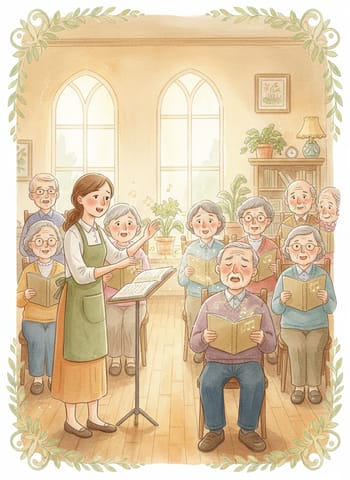
The choir meets on Thursday afternoons in a church hall with a leaking skylight and a tea urn that takes forty minutes to boil. Rosamund arrives early, as she has for five months, to set out the folders and the plastic cups and to arrange the chairs in a curve. The singers do better when they can see one another's faces. There are twenty-two of them, most with some form of memory loss, and eleven carers, who sing quietly and pretend not to. Her father, Halvard, is third from the left in the front row, in the cardigan she ironed that morning.
He does not always know her. Some weeks he greets her with the polished warmth he used to keep for the neighbours; some weeks he calls her "the nice lady with the folders" and asks whether she lives nearby. She has stopped correcting him, less out of resignation than out of a practical sort of mercy, since correction costs him something and the cost is visible. Today he calls her "madam" and thanks her for the tea.
Then the pianist plays four bars, and something in the room changes. What Rosamund has still not got used to is the speed of it. A woman who cannot remember the name of her own street sings the first verse without a hitch, perfectly in tune. The man beside her, who has not spoken a full sentence since Easter, comes in on the second line with the exact tremor he must have had at twenty. Her father does not look at the sheet. Rarely does he look at anything except the pianist's hands. He sings the words in order, every one, including the old-fashioned verse that nobody else remembers.
She has read the explanations, and two doctors have kindly given them to her: that melody and memory are stored in different places, that rhythm acts as a kind of scaffolding. None of it helps. The words are all there, perfectly kept, in a man who cannot say what he had for breakfast. She, who has every day of her life at her disposal, cannot finish the second verse without the page. If someone had told her a year ago that she would envy her father's memory, she would have laughed.
At the break she carries the tea around on a tray, the cups rattling in their saucers. Her father takes one with both hands and studies her over the rim.
"You sing very quietly," he says. It is the most direct remark he has made to her in a month.
"I'm following the others," she says.
"No," he says, with perfect courtesy. "You're listening. It's different."
After the break, the last song is the long one, the one he used to sing in the car, the one with seven verses. The pianist begins. Rosamund opens her folder, finds the page, and joins in half a beat late, as always. Carrying on through the fifth verse with her eyes on the words, she is aware of a hand reaching across her without any break in the singing. The page turns, one beat before she needs it. Her father, his eyes on the pianist, is still singing.
She lets one line go by without her, and then she finds her place.