The Choir for Forgetting
Una historia gratuita en inglés de nivel C1 para estudiantes, para leer en línea en 5 idiomas, con opción de escucharla en la app gratuita Storyteller.
A volunteer at a choir for people with memory loss watches her father forget her name but remember every word of the songs.
¡Ese fue el avance! Escucha la historia completa en la app gratuita Storyteller. Descargar la app
El audio no está disponible en este momento.
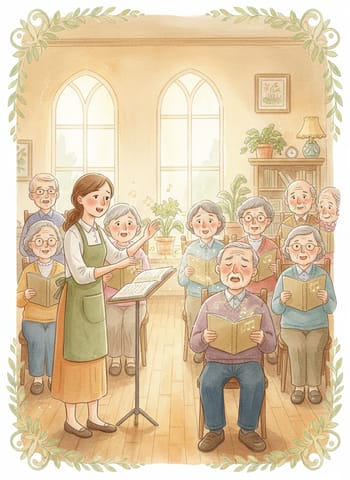
The choir meets on Thursday afternoons in a church hall with a leaking skylight and a tea urn that takes forty minutes to boil. Rosamund arrives early, as she has for five months, to set out the folders and the plastic cups and to arrange the chairs in a curve. The singers do better when they can see one another's faces. There are twenty-two of them, most with some form of memory loss, and eleven carers, who sing quietly and pretend not to. Her father, Halvard, is third from the left in the front row, in the cardigan she ironed that morning.
El coro se reúne los jueves por la tarde en un salón parroquial con una claraboya que gotea y un termo de té que tarda cuarenta minutos en hervir. Rosamund llega temprano, como lo ha hecho durante cinco meses, para disponer las carpetas y los vasos de plástico y acomodar las sillas en una curva. Los cantantes lo hacen mejor cuando pueden verse las caras. Son veintidós, la mayoría con alguna forma de pérdida de memoria, y once cuidadores, que cantan en voz baja y fingen que no lo hacen. Su padre, Halvard, está tercero desde la izquierda en la primera fila, con el cárdigan que ella planchó esa mañana.
He does not always know her. Some weeks he greets her with the polished warmth he used to keep for the neighbours; some weeks he calls her "the nice lady with the folders" and asks whether she lives nearby. She has stopped correcting him, less out of resignation than out of a practical sort of mercy, since correction costs him something and the cost is visible. Today he calls her "madam" and thanks her for the tea.
No siempre la reconoce. Algunas semanas la saluda con la cálida corrección que antes reservaba para los vecinos; otras la llama «la señora amable de las carpetas» y le pregunta si vive cerca. Ha dejado de corregirlo, menos por resignación que por una especie de piedad práctica, pues corregirlo le cuesta algo y el costo se nota. Hoy la llama «señora» y le da las gracias por el té.
Then the pianist plays four bars, and something in the room changes. What Rosamund has still not got used to is the speed of it. A woman who cannot remember the name of her own street sings the first verse without a hitch, perfectly in tune. The man beside her, who has not spoken a full sentence since Easter, comes in on the second line with the exact tremor he must have had at twenty. Her father does not look at the sheet. Rarely does he look at anything except the pianist's hands. He sings the words in order, every one, including the old-fashioned verse that nobody else remembers.
Entonces el pianista toca cuatro compases y algo cambia en la sala. A lo que Rosamund aún no se acostumbra es a la rapidez con que ocurre. Una mujer que no recuerda el nombre de su propia calle canta la primera estrofa sin un tropiezo, perfectamente afinada. El hombre a su lado, que no ha dicho una frase completa desde Pascua, entra en el segundo verso con el mismo temblor exacto que debió de tener a los veinte años. Su padre no mira la partitura. Rara vez mira otra cosa que las manos del pianista. Canta las palabras en orden, todas, incluida la estrofa anticuada que nadie más recuerda.
She has read the explanations, and two doctors have kindly given them to her: that melody and memory are stored in different places, that rhythm acts as a kind of scaffolding. None of it helps. The words are all there, perfectly kept, in a man who cannot say what he had for breakfast. She, who has every day of her life at her disposal, cannot finish the second verse without the page. If someone had told her a year ago that she would envy her father's memory, she would have laughed.
Ella ha leído las explicaciones, y dos médicos se las han dado amablemente: que la melodía y la memoria se almacenan en lugares distintos, que el ritmo actúa como una especie de andamio. Nada de eso ayuda. Las palabras están ahí, perfectamente conservadas, en un hombre que no sabe decir qué desayunó. Ella, que tiene a su disposición todos los días de su vida, no puede terminar la segunda estrofa sin la página. Si alguien le hubiera dicho hace un año que envidiaría la memoria de su padre, se habría reído.
At the break she carries the tea around on a tray, the cups rattling in their saucers. Her father takes one with both hands and studies her over the rim.
En el descanso reparte el té en una bandeja, con las tazas tintineando en sus platos. Su padre toma una con ambas manos y la estudia por encima del borde.
"You sing very quietly," he says. It is the most direct remark he has made to her in a month.
«Cantas muy bajito», dice. Es el comentario más directo que le ha hecho en un mes.
"I'm following the others," she says.
«Voy siguiendo a los demás», dice ella.
"No," he says, with perfect courtesy. "You're listening. It's different."
«No», dice él, con perfecta cortesía. «Estás escuchando. Es distinto».
After the break, the last song is the long one, the one he used to sing in the car, the one with seven verses. The pianist begins. Rosamund opens her folder, finds the page, and joins in half a beat late, as always. Carrying on through the fifth verse with her eyes on the words, she is aware of a hand reaching across her without any break in the singing. The page turns, one beat before she needs it. Her father, his eyes on the pianist, is still singing.
Después del descanso, la última canción es la larga, la que él cantaba en el coche, la de siete estrofas. El pianista empieza. Rosamund abre su carpeta, encuentra la página y se une medio compás tarde, como siempre. Mientras sigue por la quinta estrofa con los ojos en las palabras, advierte una mano que se extiende sobre ella sin interrumpir el canto. La página pasa, un compás antes de que la necesite. Su padre, con los ojos en el pianista, sigue cantando.
She lets one line go by without her, and then she finds her place.
Deja pasar un verso sin ella, y luego encuentra su lugar.