The Tour Guide Who Ran Out of Facts
Uma história gratuita em inglês de nível B2 para estudantes, para ler online em 4 idiomas, com opção de ouvir no app gratuito Storyteller.
When his summer job's folder of town facts runs out halfway through a walking tour, Barnaby starts making things up, and one quiet tourist is taking notes.
Essa foi a prévia! Ouça a história completa no app gratuito Storyteller. Baixar o app
O áudio não está disponível no momento.
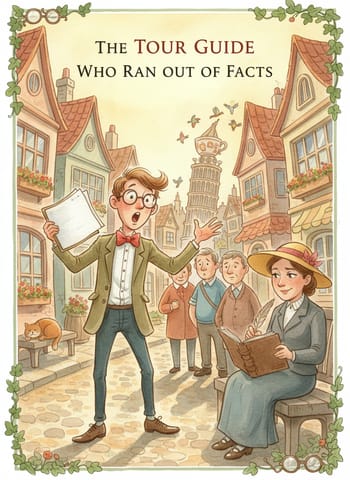
Barnaby had been hired to lead walking tours of his small harbor town for the summer, mostly because nobody else had applied. The job came with a laminated map, a bright yellow cap, and a folder of facts put together by the town council years ago.
Barnaby tinha sido contratado para guiar passeios a pé pela sua pequena cidade portuária no verão, principalmente porque mais ninguém tinha se candidatado. O trabalho vinha com um mapa plastificado, um boné amarelo vivo e uma pasta de fatos reunida pelo conselho da cidade anos atrás.
The folder was thin. By the third stop, the old clock tower, Barnaby had already told his group everything it contained. The tower was built in 1902, and the clock had been running five minutes fast ever since.
A pasta era fina. Na terceira parada, a torre do relógio antiga, Barnaby já tinha contado ao grupo tudo o que ela continha. A torre tinha sido construída em 1902, e o relógio adiantava cinco minutos desde então.
Eight tourists were looking at him, waiting for more. He probably should have admitted the truth. Instead, he pointed at a small window near the top of the tower.
Oito turistas o encaravam, esperando mais. Ele provavelmente devia ter admitido a verdade. Em vez disso, apontou para uma pequena janela perto do topo da torre.
"That window," he said, "is where the clockmaker lived. He refused to come down for eleven years, because he was convinced the town would steal his gears."
"Aquela janela", disse ele, "é onde morava o relojoeiro. Ele se recusou a descer por onze anos, porque estava convencido de que a cidade ia roubar suas engrenagens."
The tourists laughed and took photos. Encouraged, Barnaby kept going. The fountain in the square, he explained, had been designed by a sailor who was homesick for the sea. The crooked lamppost outside the bakery had been hit by a runaway cheese wheel in the 1950s. He was starting to enjoy himself.
Os turistas riram e tiraram fotos. Encorajado, Barnaby continuou. A fonte na praça, explicou ele, tinha sido projetada por um marinheiro com saudade do mar. O poste torto em frente à padaria tinha sido atingido por uma roda de queijo desgovernada nos anos 1950. Ele estava começando a se divertir.
Only one person wasn't taking photos. She was an older woman in a green raincoat, and after every story she wrote something down in a small notebook.
Só uma pessoa não estava tirando fotos. Era uma senhora mais velha, de capa de chuva verde, e, depois de cada história, ela anotava algo num caderninho.
At the end of the tour, she waited until the others had left. "Young man," she said, "my name is Imelda Ross. I've been the town's volunteer historian for thirty years."
No final do passeio, ela esperou até que os outros tivessem ido embora. "Jovem", disse ela, "meu nome é Imelda Ross. Sou a historiadora voluntária da cidade há trinta anos."
Barnaby felt his face turn hot. He tried to think of an excuse, but nothing came to mind.
Barnaby sentiu o rosto esquentar. Tentou pensar numa desculpa, mas nada lhe veio à cabeça.
"The clockmaker story is nonsense," she continued. "The cheese wheel is nonsense. The sailor is nonsense." She closed her notebook. "They were also the first stories anyone has actually enjoyed on that tour since it started."
"A história do relojoeiro é bobagem", ela continuou. "A roda de queijo é bobagem. O marinheiro é bobagem." Ela fechou o caderninho. "Também foram as primeiras histórias de que alguém realmente gostou nesse passeio desde que ele começou."
Then she told him that the town's real history was far stranger than anything he had invented. The clock ran fast because the mayor in 1902 had wanted everyone to arrive early for church. The fountain had been paid for by a man who lost a bet about the weather.
Então ela contou a ele que a verdadeira história da cidade era muito mais estranha do que qualquer coisa que ele tivesse inventado. O relógio adiantava porque o prefeito de 1902 queria que todos chegassem cedo para a igreja. A fonte tinha sido paga por um homem que perdeu uma aposta sobre o tempo.
"The council's folder leaves all of that out," she said. "They thought it was undignified."
"A pasta do conselho deixa tudo isso de fora", disse ela. "Achavam que era indigno."
The next morning, Barnaby found a thick envelope that had been pushed under the door of the tourist office. Inside were forty pages of handwritten notes, each one marked with a date and a source. On the last page, Imelda had added a short message.
Na manhã seguinte, Barnaby encontrou um envelope grosso empurrado por baixo da porta do escritório de turismo. Dentro havia quarenta páginas de anotações à mão, cada uma marcada com uma data e uma fonte. Na última página, Imelda tinha acrescentado um bilhete curto.
"Real facts only from now on. But you may keep the cheese wheel."
"Só fatos reais a partir de agora. Mas você pode ficar com a roda de queijo."