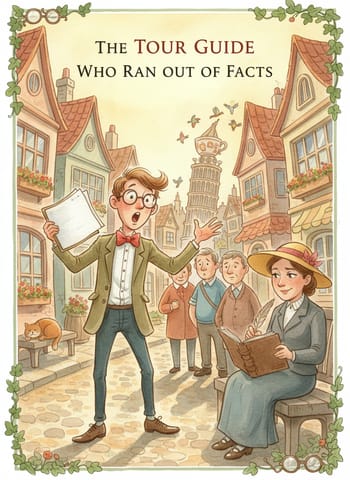
The Tour Guide Who Ran Out of Facts
Una historia gratuita en inglés de nivel B2 para estudiantes, para leer en línea en 3 idiomas, con opción de escucharla en la app gratuita Storyteller.
When his summer job's folder of town facts runs out halfway through a walking tour, Barnaby starts making things up, and one quiet tourist is taking notes.
¡Ese fue el avance! Escucha la historia completa en la app gratuita Storyteller. Descargar la app
El audio no está disponible en este momento.
Barnaby had been hired to lead walking tours of his small harbor town for the summer, mostly because nobody else had applied. The job came with a laminated map, a bright yellow cap, and a folder of facts put together by the town council years ago.
A Barnaby lo habían contratado para dirigir recorridos a pie por su pequeño pueblo portuario durante el verano, sobre todo porque nadie más se había postulado. El trabajo venía con un mapa laminado, una gorra amarilla brillante y una carpeta de datos que el consejo del pueblo había reunido años atrás.
The folder was thin. By the third stop, the old clock tower, Barnaby had already told his group everything it contained. The tower was built in 1902, and the clock had been running five minutes fast ever since.
La carpeta era delgada. Para la tercera parada, la vieja torre del reloj, Barnaby ya le había contado a su grupo todo lo que contenía. La torre se construyó en 1902, y el reloj había estado adelantado cinco minutos desde entonces.
Eight tourists were looking at him, waiting for more. He probably should have admitted the truth. Instead, he pointed at a small window near the top of the tower.
Ocho turistas lo miraban, esperando más. Probablemente debería haber admitido la verdad. En cambio, señaló una pequeña ventana cerca de la parte superior de la torre.
"That window," he said, "is where the clockmaker lived. He refused to come down for eleven years, because he was convinced the town would steal his gears."
«Esa ventana», dijo, «es donde vivía el relojero. Se negó a bajar durante once años, porque estaba convencido de que el pueblo le robaría los engranajes».
The tourists laughed and took photos. Encouraged, Barnaby kept going. The fountain in the square, he explained, had been designed by a sailor who was homesick for the sea. The crooked lamppost outside the bakery had been hit by a runaway cheese wheel in the 1950s. He was starting to enjoy himself.
Los turistas rieron y tomaron fotos. Animado, Barnaby siguió adelante. La fuente de la plaza, explicó, había sido diseñada por un marinero que añoraba el mar. El poste de luz torcido frente a la panadería había sido golpeado por una rueda de queso desbocada en los años cincuenta. Estaba empezando a disfrutarlo.
Only one person wasn't taking photos. She was an older woman in a green raincoat, and after every story she wrote something down in a small notebook.
Solo una persona no estaba tomando fotos. Era una mujer mayor con un impermeable verde, y después de cada historia anotaba algo en una pequeña libreta.
At the end of the tour, she waited until the others had left. "Young man," she said, "my name is Imelda Ross. I've been the town's volunteer historian for thirty years."
Al final del recorrido, esperó a que los demás se fueran. «Joven», dijo, «me llamo Imelda Ross. He sido la historiadora voluntaria del pueblo durante treinta años».
Barnaby felt his face turn hot. He tried to think of an excuse, but nothing came to mind.
Barnaby sintió que la cara le ardía. Intentó pensar en una excusa, pero no le vino ninguna a la mente.
"The clockmaker story is nonsense," she continued. "The cheese wheel is nonsense. The sailor is nonsense." She closed her notebook. "They were also the first stories anyone has actually enjoyed on that tour since it started."
«La historia del relojero es un disparate», continuó. «La rueda de queso es un disparate. El marinero es un disparate». Cerró su libreta. «También son las primeras historias que alguien ha disfrutado de verdad en ese recorrido desde que empezó».
Then she told him that the town's real history was far stranger than anything he had invented. The clock ran fast because the mayor in 1902 had wanted everyone to arrive early for church. The fountain had been paid for by a man who lost a bet about the weather.
Entonces le contó que la verdadera historia del pueblo era mucho más extraña que cualquier cosa que él hubiera inventado. El reloj estaba adelantado porque el alcalde de 1902 había querido que todos llegaran temprano a la iglesia. La fuente había sido pagada por un hombre que perdió una apuesta sobre el clima.
"The council's folder leaves all of that out," she said. "They thought it was undignified."
«La carpeta del consejo omite todo eso», dijo. «Pensaban que no era digno».
The next morning, Barnaby found a thick envelope that had been pushed under the door of the tourist office. Inside were forty pages of handwritten notes, each one marked with a date and a source. On the last page, Imelda had added a short message.
A la mañana siguiente, Barnaby encontró un grueso sobre que habían deslizado bajo la puerta de la oficina de turismo. Dentro había cuarenta páginas de notas escritas a mano, cada una marcada con una fecha y una fuente. En la última página, Imelda había añadido un breve mensaje.
"Real facts only from now on. But you may keep the cheese wheel."
«Solo datos reales de ahora en adelante. Pero puede conservar la rueda de queso».