The Master-Smith
A free B2-level English story for language learners, readable online in 7 languages, with an option to listen via the free Storyteller app.
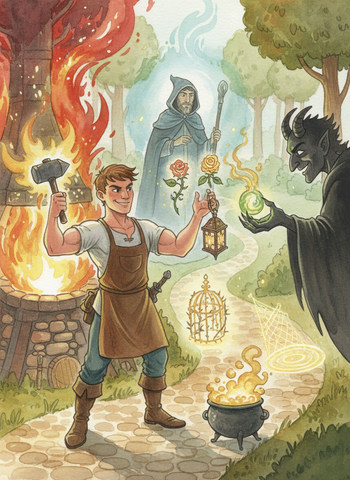
A cocky blacksmith trades his soul to the Devil, then wins three strange wishes from a mysterious traveller — and turns them into traps for anyone who comes to collect what's owed.
Once on a time, in the days when our Lord and St Peter used to wander on earth, they came to a smith’s house. He had made a bargain with the Devil, that the fiend should have him after seven years, but during that time he was to be the master of all masters in his trade, and to this bargain both he and the Devil had signed their names. So he had stuck up in great letters over the door of his forge: _“Here dwells the Master over all Masters.”_
Era uma vez, nos dias em que Nosso Senhor e São Pedro costumavam vagar pela terra, chegaram à casa de um ferreiro. Ele tinha feito um acordo com o Diabo, de que o demônio o teria depois de sete anos, mas durante esse tempo ele seria o mestre de todos os mestres em seu ofício, e a esse acordo tanto ele quanto o Diabo tinham assinado seus nomes. Assim, ele tinha pregado, em letras grandes, acima da porta de sua forja: “Aqui mora o Mestre acima de todos os Mestres.”
Now when our Lord passed by and saw that, he went in.
Ora, quando Nosso Senhor passou por ali e viu aquilo, entrou.
“Who are you?” he said to the Smith.
— Quem é você? — perguntou ao Ferreiro.
“Read what’s written over the door”, said the Smith; “but maybe you can’t read writing. If so, you must wait till some one comes to help you.”
— Leia o que está escrito acima da porta — disse o Ferreiro. — Mas talvez o senhor não saiba ler. Se for esse o caso, terá que esperar até que alguém venha ajudá-lo.
Before our Lord had time to answer him, a man came with his horse, which he begged the Smith to shoe.
Antes que Nosso Senhor tivesse tempo de lhe responder, chegou um homem com seu cavalo, que pediu ao Ferreiro para ferrar.
“Might I have leave to shoe it?” asked our Lord.
— Poderia eu ter permissão para ferrá-lo? — perguntou Nosso Senhor.
“You may try, if you like”, said the Smith; “you can’t do it so badly that I shall not be able to make it right again.”
— Pode tentar, se quiser — disse o Ferreiro. — Não pode fazer tão mal a ponto de eu não conseguir consertar depois.
So our Lord went out and took one leg off the horse, and laid it in the furnace, and made the shoe red-hot; after that, he turned up the ends of the shoe, and filed down the heads of the nails, and clenched the points; and then he put back the leg safe and sound on the horse again.
Então Nosso Senhor saiu e tirou uma pata do cavalo, e a colocou na fornalha, e deixou a ferradura em brasa; depois disso, virou as pontas da ferradura, e limou as cabeças dos pregos, e rebitou as pontas; e então recolocou a pata, sã e salva, de volta no cavalo.
And when he was done with that leg, he took the other fore-leg and did the same with it; and when he was done with that, he took the hind-legs—first, the off, and then the near leg, and laid them in the furnace, making the shoes red-hot, turning up the ends; filing the heads of the nails, and clenching the points; and after all was done, putting the legs on the horse again. All the while, the Smith stood by and looked on.
E quando terminou com aquela pata, pegou a outra pata dianteira e fez o mesmo com ela; e quando terminou com essa, pegou as patas traseiras… primeiro a direita, depois a esquerda, e as colocou na fornalha, deixando as ferraduras em brasa, virando as pontas; limando as cabeças dos pregos, e rebitando as pontas; e depois de tudo feito, recolocou as patas no cavalo de novo. Durante todo esse tempo, o Ferreiro ficou ali parado, observando.
“You’re not so bad a smith after all”, said he.
— Você não é um ferreiro tão ruim, afinal — disse ele.
“Oh, you think so, do you?” said our Lord.
— Ah, é o que você acha? — disse Nosso Senhor.
A little while after came the Smith’s mother to the forge, and called him to come home and eat his dinner; she was an old, old woman with an ugly crook on her back, and wrinkles in her face, and it was as much as she could do to crawl along.
Pouco depois, veio até a forja a mãe do Ferreiro, e o chamou para vir comer o jantar; ela era uma mulher muito, muito velha, com uma corcunda feia nas costas, e rugas no rosto, e mal conseguia se arrastar.
“Mark now, what you see”, said our Lord.
— Preste atenção agora, no que você vai ver — disse Nosso Senhor.
Then he took the woman and laid her in the furnace, and smithied a lovely young maiden out of her.
Então pegou a mulher e a colocou na fornalha, e forjou dela uma linda donzela jovem.
“Well”, said the Smith, “I say now, as I said before, you are not such a bad smith after all. There it stands over my door. _Here dwells the Master over all Masters_ ; but for all that, I say right out, one learns as long as one lives”; and with that he walked off to his house and ate his dinner.
— Bem — disse o Ferreiro —, eu digo agora, como já disse antes, você não é um ferreiro tão ruim, afinal. Ali está escrito acima da minha porta: Aqui mora o Mestre acima de todos os Mestres; mas apesar disso tudo, eu digo bem claro, a gente aprende enquanto vive — e com isso foi para casa e comeu seu jantar.
So after dinner, just after he had got back to his forge, a man came riding up to have his horse shod.
Então, depois do jantar, mal tinha voltado à sua forja, veio um homem cavalgando para ferrar seu cavalo.
“It shall be done in the twinkling of an eye”, said the Smith, “for I have just learnt a new way to shoe; and a very good way it is when the days are short.”
— Será feito num piscar de olhos — disse o Ferreiro —, pois acabei de aprender um novo jeito de ferrar; e é um jeito muito bom quando os dias são curtos.
So he began to cut and hack till he had got all the horse’s legs off, for he said, I don’t know why one should go pottering backwards and forwards—first, with one leg, and then with another.
Então começou a cortar e a talhar até ter arrancado todas as patas do cavalo, pois disse, não sei por que a gente deveria ficar indo e voltando… primeiro com uma pata, depois com outra.
Then he laid the legs in the furnace, just as he had seen our Lord lay them, and threw on a great heap of coal, and made his mates work the bellows bravely; but it went as one might suppose it would go. The legs were burnt to ashes, and the Smith had to pay for the horse.
Então colocou as patas na fornalha, exatamente como tinha visto Nosso Senhor fazer, e jogou um grande monte de carvão, e fez seus ajudantes trabalharem o fole com força; mas as coisas foram como qualquer um poderia imaginar que iriam. As patas se queimaram até virarem cinzas, e o Ferreiro teve que pagar pelo cavalo.
Well, he didn’t care much about that, but just then an old beggar-woman came along the road, and he thought to himself, “better luck next time”; so he took the old dame and laid her in the furnace, and though she begged and prayed hard for her life, it was no good.
Bem, ele não se importou muito com isso, mas nesse instante uma velha mendiga vinha passando pela estrada, e ele pensou consigo: “Melhor sorte da próxima vez”; então pegou a velha senhora e a colocou na fornalha, e embora ela implorasse e rogasse com fervor por sua vida, não adiantou nada.
“You’re so old, you don’t know what is good for you”, said the Smith; “now you shall be a lovely young maiden in half no time, and for all that, I’ll not charge you a penny for the job.”
— Você já é tão velha, não sabe o que é bom para você — disse o Ferreiro. — Agora você será uma linda donzela jovem num instante, e apesar de tudo, não vou lhe cobrar um centavo pelo serviço.
But it went no better with the poor old woman than with the horse’s legs.
Mas as coisas não saíram melhor com a pobre velha do que com as patas do cavalo.
“That was ill done, and I say it”, said our Lord.
— Isso foi mal feito, eu digo — disse Nosso Senhor.
“Oh! for that matter”, said the Smith, “there’s not many who’ll ask after her, I’ll be bound; but it’s a shame of the Devil, if this is the way he holds to what is written up over the door.”
— Ah! Quanto a isso — disse o Ferreiro —, tenho certeza de que não são muitos que vão perguntar por ela; mas é uma vergonha para o Diabo, se é assim que ele cumpre o que está escrito acima da porta.
“If you might have three wishes from me”, said our Lord, “what would you wish for?”
— Se você pudesse ter três desejos meus — disse Nosso Senhor —, o que você desejaria?
“Only try me”, said the Smith, “and you’ll soon know.”
— Só experimente e verá — disse o Ferreiro.
So our Lord gave him three wishes.
Então Nosso Senhor lhe concedeu três desejos.
“Well”, said the Smith, “first and foremost, I wish that any one whom I ask to climb up into the pear-tree that stands outside by the wall of my forge, may stay sitting there till I ask him to come down again. The second wish I wish is, that any one whom I ask to sit down in my easy chair which stands inside the workshop yonder, may stay sitting there till I ask him to get up. Last of all, I wish that any one whom I ask to creep into the steel purse which I have in my pocket, may stay in it till I give him leave to creep out again.”
— Bem — disse o Ferreiro —, antes de tudo, desejo que qualquer um a quem eu peça para subir na pereira que fica do lado de fora, junto ao muro da minha forja, fique sentado ali até que eu peça que desça de novo. O segundo desejo que faço é que qualquer um a quem eu peça para se sentar na minha poltrona confortável que fica ali dentro da oficina, fique sentado ali até que eu peça que se levante. Por último, desejo que qualquer um a quem eu peça para se enfiar na bolsa de aço que tenho no bolso, fique dentro dela até que eu lhe dê licença para sair de novo.
“You have wished as a wicked man”, said St Peter; “first and foremost, you should have wished for God’s grace and goodwill.”
— Você desejou como um homem mau — disse São Pedro. — Antes de tudo, você deveria ter desejado a graça e a boa vontade de Deus.
“I durstn’t look so high as that”, said the Smith; and after that our Lord and St Peter bade him “good-bye”, and went on their way.
— Não ousaria mirar tão alto assim — disse o Ferreiro; e depois disso Nosso Senhor e São Pedro se despediram dele e seguiram seu caminho.
Well, the years went on and on, and when the time was up, the Devil came to fetch the Smith, as it was written in their bargain.
Bem, os anos foram passando, e quando o tempo se esgotou, o Diabo veio buscar o Ferreiro, como estava escrito em seu acordo.
“Are you ready?” he said, as he stuck his nose in at the door of the forge.
— Está pronto? — disse ele, enfiando o nariz pela porta da forja.
“Oh”, said the Smith, “I must just hammer the head of this tenpenny nail first; meantime, you can just climb up into the pear-tree, and pluck yourself a pear to gnaw at; you must be, both hungry and thirsty after your journey.”
— Ah — disse o Ferreiro —, só preciso martelar a cabeça deste prego de dez centavos primeiro; enquanto isso, você pode subir na pereira, e colher uma pera para roer; deve estar com fome e sede depois de sua viagem.
So the Devil thanked him for his kind offer, and climbed up into the pear-tree.
Então o Diabo lhe agradeceu pela gentil oferta, e subiu na pereira.
“Very good”, said the Smith; “but now, on thinking the matter over, I find I shall never be able to have done hammering the head of this nail till four years are out at least, this iron is so plaguey hard; down you can’t come in all that time, but may sit up there and rest your bones.”
— Muito bem — disse o Ferreiro. — Mas agora, pensando bem no assunto, percebo que não vou conseguir terminar de martelar a cabeça deste prego antes de pelo menos quatro anos, este ferro é tão maldito e duro; você não pode descer em todo esse tempo, mas pode ficar sentado aí em cima descansando os ossos.
When the Devil heard this, he begged and prayed till his voice was as thin as a silver penny that he might have leave to come down; but there was no help for it. There he was, and there he must stay. At last he had to give his word of honour not to come again till the four years were out, which the Smith had spoken of, and then the Smith said, “Very well, now you may come down.”
Quando o Diabo ouviu isso, implorou e rogou até sua voz ficar tão fina quanto uma moeda de prata, para que lhe dessem licença de descer; mas não havia jeito. Ali ele estava, e ali tinha que ficar. Por fim, teve que dar sua palavra de honra de não voltar até os quatro anos terem se passado, dos quais o Ferreiro tinha falado, e então o Ferreiro disse: — Muito bem, agora você pode descer.
So when the time was up, the Devil came again to fetch the Smith.
Então, quando o tempo se esgotou, o Diabo veio de novo buscar o Ferreiro.
“You’re ready now, of course”, said he; “you’ve had time enough to hammer the head of that nail, I should think.”
— Você já está pronto agora, com certeza — disse ele. — Já teve tempo de sobra para martelar a cabeça daquele prego, eu acho.
“Yes, the head is right enough now”, said the Smith; “but still you have come a little tiny bit too soon, for I haven’t quite done sharpening the point; such plaguey hard iron I never hammered in all my born days. So while I work at the point, you may just as well sit down in my easy chair and rest yourself; I’ll be bound you’re weary after coming so far.”
— Sim, a cabeça já está bem certinha agora — disse o Ferreiro. — Mas ainda assim você chegou um pouquinho cedo demais, pois ainda não terminei de afiar a ponta; um ferro tão maldito e duro eu nunca martelei em todos os meus dias de vida. Então, enquanto trabalho na ponta, você pode muito bem se sentar na minha poltrona confortável e descansar; tenho certeza de que está cansado depois de vir de tão longe.
“Thank you kindly”, said the Devil, and down he plumped into the easy chair; but just as he had made himself comfortable, the Smith said, on second thoughts, he found he couldn’t get the point sharp till four years were out. First of all, the Devil begged so prettily to be let out of the chair, and afterwards, waxing wroth, he began to threaten and scold; but the Smith kept on, all the while excusing himself, and saying it was all the iron’s fault, it was so plaguy hard, and telling the Devil he was not so badly off to have to sit quietly in an easy chair, and that he would let him out to the minute when the four years were over.
— Muito obrigado — disse o Diabo, e se acomodou de vez na poltrona confortável; mas assim que já estava confortável, o Ferreiro disse, pensando melhor, que tinha percebido que não conseguiria deixar a ponta afiada antes que quatro anos se passassem. Primeiro, o Diabo implorou muito educadamente para ser deixado sair da poltrona, e depois, enfurecendo-se, começou a ameaçar e a xingar; mas o Ferreiro continuava, o tempo todo se desculpando, e dizendo que a culpa era toda do ferro, que era tão maldito e duro, e dizendo ao Diabo que ele não estava tão mal assim, tendo que ficar sentado tranquilamente numa poltrona confortável, e que o deixaria sair no minuto exato em que os quatro anos terminassem.
Well, at last there was no help for it, and the Devil had to give his word of honour not to fetch the Smith till the four years were out; and then the Smith said:
Bem, por fim não havia jeito, e o Diabo teve que dar sua palavra de honra de não vir buscar o Ferreiro até que os quatro anos tivessem se passado; e então o Ferreiro disse:
“Well now, you may get up and be off about your business”, and away went the Devil as fast as he could lay legs to the ground.
— Bem agora, você pode se levantar e ir cuidar da sua vida — e lá se foi o Diabo o mais rápido que suas pernas podiam levá-lo pelo chão.
When the four years were over, the Devil came again to fetch the Smith, and he called out, as he stuck his nose in at the door of the forge:
Quando os quatro anos terminaram, o Diabo veio de novo buscar o Ferreiro, e gritou, enfiando o nariz pela porta da forja:
“Now, I know you must be ready.”
— Agora, sei que você deve estar pronto.
“Ready, aye, ready”, answered the Smith; “we can go now as soon as you please; but hark ye, there is one thing I have stood here and thought, and thought, I would ask you to tell me. Is it true what people say, that the Devil can make himself as small as he pleases?”
— Pronto, sim, pronto — respondeu o Ferreiro —; podemos ir agora, assim que você quiser; mas escute aqui, há uma coisa que fiquei aqui parado pensando, e pensando, que gostaria de lhe perguntar. É verdade o que as pessoas dizem, que o Diabo pode se tornar tão pequeno quanto quiser?
“God knows, it is the very truth”, said the Devil.
— Deus sabe que é a mais pura verdade — disse o Diabo.
“Oh!” said the Smith; “it is true, is it? then I wish you would just be so good as to creep into this steel purse of mine, and see whether it is sound at the bottom, for to tell you the truth, I’m afraid my travelling money will drop out.”
— Ah! — disse o Ferreiro. — É verdade, é? Então eu gostaria que você fosse tão gentil a ponto de se enfiar nesta bolsa de aço minha, e ver se ela está firme no fundo, pois para lhe dizer a verdade, tenho medo de que meu dinheiro de viagem caia fora.
“With all my heart”, said the Devil, who made himself small in a trice, and crept into the purse; but he was scarce in when the Smith snapped to the clasp.
— Com todo o prazer — disse o Diabo, que se tornou pequeno num instante, e se enfiou na bolsa; mas mal tinha entrado quando o Ferreiro fechou o fecho com um estalo.
“Yes”, called out the Devil inside the purse; “it’s right and tight everywhere.”
— Sim — gritou o Diabo de dentro da bolsa —, está tudo certinho e apertado por toda parte.
“Very good”, said the Smith; “I’m glad to hear you say so, but ‘more haste the worse speed’, says the old saw, and ‘forewarned is forearmed’, says another; so I’ll just weld these links a little together, just for safety’s sake”; and with that he laid the purse in the furnace, and made it red-hot.
— Muito bem — disse o Ferreiro. — Fico contente de ouvir você dizer isso, mas “pressa demais atrapalha” diz o velho ditado, e “homem prevenido vale por dois” diz outro; então vou soldar esses elos juntos, só por segurança — e com isso colocou a bolsa na fornalha, e a deixou em brasa.
“AU! AU!” screamed the Devil, “are you mad? don’t you know I’m inside the purse?”
— AI! AI! — gritou o Diabo. — Você está louco? Não sabe que estou dentro da bolsa?
“Yes, I do!” said the Smith; “but I can’t help you, for another old saw says, ‘one must strike while the iron is hot’”; and as he said this, he took up his sledge-hammer, laid the purse on the anvil, and let fly at it as hard as he could.
— Sim, eu sei! — disse o Ferreiro. — Mas não posso te ajudar, pois outro velho ditado diz: “tem que malhar enquanto o ferro está quente” — e ao dizer isso, pegou sua marreta, colocou a bolsa na bigorna, e desceu o golpe nela com toda a força que pôde.
“AU! AU! AU!” bellowed the Devil, inside the purse. “Dear friend, do let me out, and I’ll never come near you again.”
— AI! AI! AI! — bramiu o Diabo, dentro da bolsa. — Querido amigo, me deixe sair, e nunca mais vou chegar perto de você.
“Very well!” said the Smith; “now, I think, the links are pretty well welded, and you may come out”; so he unclasped the purse, and away went the Devil in such a hurry that he didn’t once look behind him.
— Muito bem! — disse o Ferreiro. — Agora, acho que os elos já estão bem soldados, e você pode sair — então abriu o fecho da bolsa, e lá se foi o Diabo com tanta pressa que nem uma vez olhou para trás.
Now, some time after, it came across the Smith’s mind that he had done a silly thing in making the Devil his enemy, for, he said to himself:
Ora, algum tempo depois, passou pela cabeça do Ferreiro que tinha feito uma coisa boba ao fazer do Diabo seu inimigo, pois, disse a si mesmo:
“If, as is like enough, they won’t have me in the kingdom of Heaven, I shall be in danger of being houseless, since I’ve fallen out with him who rules over Hell.”
— Se, como é bem provável, não me quiserem no reino do Céu, corro o risco de ficar sem casa, já que briguei com aquele que reina sobre o Inferno.
So he made up his mind it would be best to try to get either into Hell or Heaven, and to try at once, rather than to put it off any longer, so that he might know how things really stood. Then he threw his sledge-hammer over his shoulder and set off; and when he had gone a good bit of the way, he came to a place where two roads met, and where the path to the kingdom of Heaven parts from the path that leads to Hell, and here he overtook a tailor, who was pelting along with his goose in his hand.
Então decidiu que seria melhor tentar entrar tanto no Inferno quanto no Céu, e tentar logo, em vez de adiar mais, para que pudesse saber como realmente estavam as coisas. Então jogou sua marreta sobre o ombro e partiu; e quando já tinha percorrido um bom pedaço do caminho, chegou a um lugar onde dois caminhos se encontravam, e onde a trilha para o reino do Céu se separava da trilha que leva ao Inferno, e ali alcançou um alfaiate, que ia correndo apressado com sua tesoura de alfaiate na mão.
“Good day”, said the Smith; “whither are you off to?”
— Bom dia — disse o Ferreiro. — Para onde você está indo?
“To the kingdom of Heaven”, said the Tailor, “if I can only get into it”—“but whither are you going yourself?”
— Para o reino do Céu — disse o Alfaiate —, se eu conseguir entrar. — Mas para onde você mesmo está indo?
“Oh, our ways don’t run together”, said the Smith; “for I have made up my mind to try first in Hell, as the Devil and I know something of one another, from old times.”
— Ah, nossos caminhos não seguem juntos — disse o Ferreiro. — Pois decidi tentar primeiro no Inferno, já que o Diabo e eu nos conhecemos um pouco, de tempos antigos.
So they bade one another “Good-bye”, and each went his way; but the Smith was a stout, strong man, and got over the ground far faster than the tailor, and so it wasn’t long before he stood at the gates of Hell. Then he called the watch, and bade him go and tell the Devil there was some one outside who wished to speak a word with him.
Então se despediram um do outro, e cada um seguiu seu caminho; mas o Ferreiro era um homem robusto e forte, e cobriu o terreno muito mais depressa do que o alfaiate, e assim não demorou muito para que estivesse diante dos portões do Inferno. Então chamou o guarda, e pediu que fosse dizer ao Diabo que havia alguém do lado de fora que queria trocar uma palavra com ele.
“Go out”, said the Devil to the watch, “and ask him who he is?” So that when the watch came and told him that, the Smith answered:
— Vá lá fora — disse o Diabo ao guarda —, e pergunte quem ele é. — Então, quando o guarda veio e lhe contou isso, o Ferreiro respondeu:
“Go and greet the Devil in my name, and say it is the Smith who owns the purse he wots of; and beg him prettily to let me in at once, for I worked at my forge till noon, and I have had a long walk since.”
— Vá e cumprimente o Diabo em meu nome, e diga que é o Ferreiro dono da bolsa que ele bem conhece; e peça-lhe educadamente que me deixe entrar logo, pois trabalhei em minha forja até o meio-dia, e tive uma longa caminhada desde então.
But when the Devil heard who it was, he charged the watch to go back and lock up all the nine locks on the gates of Hell.
Mas quando o Diabo ouviu quem era, ordenou ao guarda que voltasse e trancasse todas as nove fechaduras dos portões do Inferno.
“And, besides”, he said, “you may as well put on a padlock, for if he only once gets in, he’ll turn Hell topsy-turvy!”
— E, além disso — disse ele —, é melhor colocar um cadeado também, pois se ele conseguir entrar uma vez sequer, vai virar o Inferno de cabeça para baixo!
“Well!” said the Smith to himself, when he saw them busy bolting up the gates, “there’s no lodging to be got here, that’s plain; so I may as well try my luck in the kingdom of Heaven”; and with that he turned round and went back till he reached the cross-roads, and then he went along the path the tailor had taken. And now, as he was cross at having gone backwards and forwards so far for no good, he strode along with all his might, and reached the gate of Heaven just as St Peter was opening it a very little, just enough to let the half-starved tailor slip in. The Smith was still six or seven strides off the gate, so he thought to himself, “Now there’s no time to be lost”; and, grasping his sledge-hammer, he hurled it into the opening of the door just as the tailor slunk in; and if the Smith didn’t get in then, when the door was ajar, why I don’t know what has become of him.
— Bem! — disse o Ferreiro para si mesmo, quando os viu ocupados trancando os portões —, não há pousada a ser encontrada aqui, isso é claro; então também posso tentar minha sorte no reino do Céu — e com isso deu meia-volta e voltou até chegar à encruzilhada, e então seguiu pelo caminho que o alfaiate tinha tomado. E agora, como estava irritado por ter ido e voltado tanto sem nenhum proveito, avançou com toda a sua força, e chegou ao portão do Céu bem quando São Pedro o estava abrindo bem pouquinho, apenas o suficiente para deixar o alfaiate faminto se esgueirar para dentro. O Ferreiro ainda estava a seis ou sete passos do portão, então pensou consigo: “Agora não há tempo a perder”; e, agarrando sua marreta, arremessou-a na abertura da porta bem quando o alfaiate se esgueirava para dentro; e se o Ferreiro não conseguiu entrar então, com a porta entreaberta, bem, não sei o que foi feito dele.
